







Question: Read the full case study . You may need to read it multible times to comprehend it. After doing so, you now know that the
Read the full case study . You may need to read it multible times to comprehend it. After doing so, you now know that the US is different in dealing with Facebook privacy than EU countries. You have been appointed as a leader at The Communications and Information Technology Commission (CITC) in Saudi Arabia, to decide how should we deal with Facebook privacy in Saudi. You will be the leader of a big team and you are required to have an initial plan for this mission. Using your knowledge and creative thinking, please write the initial plan that concerns reviwing Facebook practices and deciding the new Saudi law to deal with these unethical practices. You can use bullet points for this task. You are required to write from 100 to 150 words only. you will be assessed on your knowledge and critical and creative thinking, in addition to formatting. Important note: Do not upload any file, instead, write your full assignment on BB. If there is any plagiarism found will be marked zero and reported to the faculty adminstration. So DO NOT COPY AND PASTE!
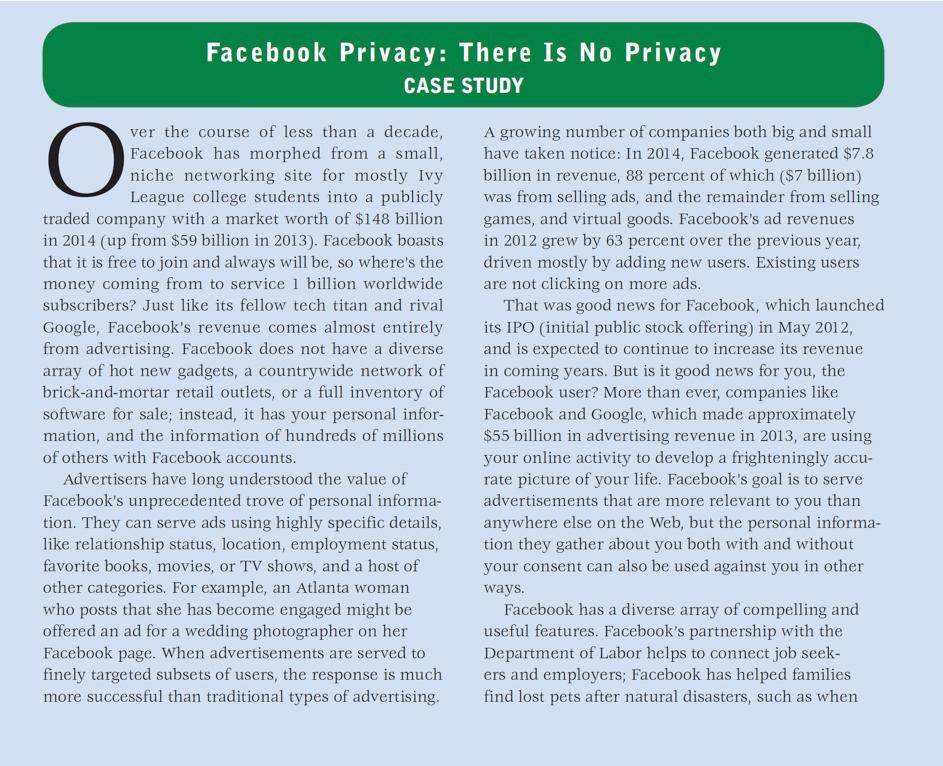
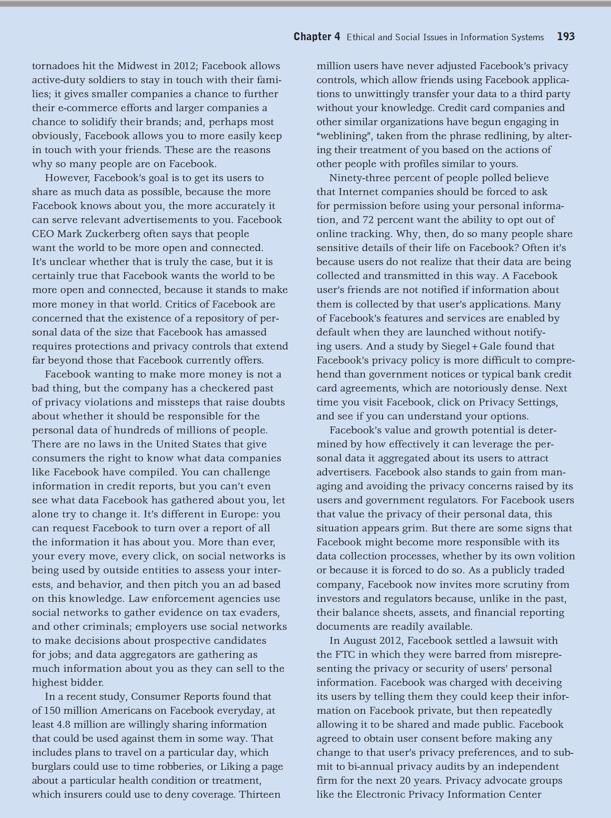
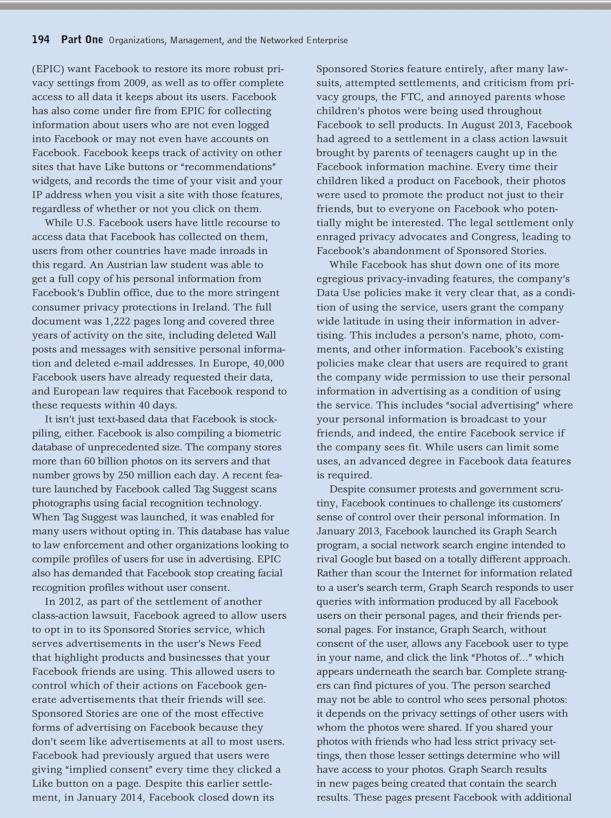
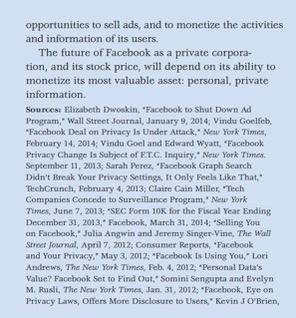
over the course of less than a decade, Facebook has morphed from a small, niche networking site for mostly Ivy League college students into a publicly traded company with a market worth of $148 billion in 2014 (up from $59 billion in 2013). Facebook boasts that it is free to join and always will be, so wheres the money coming from to service 1 billion worldwide subscribers? Just like its fellow tech titan and rival Google, Facebooks revenue comes almost entirely from advertising. Facebook does not have a diverse array of hot new gadgets, a countrywide network of brick-and-mortar retail outlets, or a full inventory of software for sale; instead, it has your personal infor-mation, and the information of hundreds of millions of others with Facebook accounts.
Advertisers have long understood the value of Facebooks unprecedented trove of personal informa-tion. They can serve ads using highly specific details, like relationship status, location, employment status, favorite books, movies, or TV shows, and a host of other categories. For example, an Atlanta woman who posts that she has become engaged might be offered an ad for a wedding photographer on her Facebook page. When advertisements are served to finely targeted subsets of users, the response is much more successful than traditional types of advertising.
A growing number of companies both big and small have taken notice: In 2014, Facebook generated $7.8 billion in revenue, 88 percent of which ($7 billion) was from selling ads, and the remainder from selling games, and virtual goods. Facebooks ad revenues in 2012 grew by 63 percent over the previous year, driven mostly by adding new users. Existing users are not clicking on more ads.
That was good news for Facebook, which launched its IPO (initial public stock offering) in May 2012, and is expected to continue to increase its revenue in coming years. But is it good news for you, the Facebook user? More than ever, companies like Facebook and Google, which made approximately
$55 billion in advertising revenue in 2013, are using your online activity to develop a frighteningly accu-rate picture of your life. Facebooks goal is to serve advertisements that are more relevant to you than anywhere else on the Web, but the personal informa-tion they gather about you both with and without your consent can also be used against you in other ways.
Facebook has a diverse array of compelling and useful features. Facebooks partnership with the Department of Labor helps to connect job seek-
ers and employers; Facebook has helped families find lost pets after natural disasters, such as when tornadoes hit the Midwest in 2012; Facebook allows active-duty soldiers to stay in touch with their fami-lies; it gives smaller companies a chance to further their e-commerce efforts and larger companies a chance to solidify their brands; and, perhaps most obviously, Facebook allows you to more easily keep in touch with your friends. These are the reasons why so many people are on Facebook.
However, Facebooks goal is to get its users to share as much data as possible, because the more Facebook knows about you, the more accurately it can serve relevant advertisements to you. Facebook CEO Mark Zuckerberg often says that people
want the world to be more open and connected. Its unclear whether that is truly the case, but it is certainly true that Facebook wants the world to be more open and connected, because it stands to make more money in that world. Critics of Facebook are concerned that the existence of a repository of per-sonal data of the size that Facebook has amassed requires protections and privacy controls that extend far beyond those that Facebook currently offers.
Facebook wanting to make more money is not a bad thing, but the company has a checkered past of privacy violations and missteps that raise doubts about whether it should be responsible for the personal data of hundreds of millions of people. There are no laws in the United States that give consumers the right to know what data companies like Facebook have compiled. You can challenge information in credit reports, but you cant even see what data Facebook has gathered about you, let alone try to change it. Its different in Europe: you can request Facebook to turn over a report of all the information it has about you. More than ever, your every move, every click, on social networks is being used by outside entities to assess your inter-ests, and behavior, and then pitch you an ad based on this knowledge. Law enforcement agencies use social networks to gather evidence on tax evaders, and other criminals; employers use social networks to make decisions about prospective candidates for jobs; and data aggregators are gathering as much information about you as they can sell to the highest bidder.
In a recent study, Consumer Reports found that of 150 million Americans on Facebook everyday, at least 4.8 million are willingly sharing information that could be used against them in some way. That includes plans to travel on a particular day, which burglars could use to time robberies, or Liking a page about a particular health condition or treatment, which insurers could use to deny coverage. Thirteen
million users have never adjusted Facebooks privacy controls, which allow friends using Facebook applica-tions to unwittingly transfer your data to a third party without your knowledge. Credit card companies and other similar organizations have begun engaging in
weblining, taken from the phrase redlining, by alter-ing their treatment of you based on the actions of other people with profiles similar to yours.
Ninety-three percent of people polled believe that Internet companies should be forced to ask
for permission before using your personal informa-tion, and 72 percent want the ability to opt out of online tracking. Why, then, do so many people share sensitive details of their life on Facebook? Often its because users do not realize that their data are being collected and transmitted in this way. A Facebook users friends are not notified if information about them is collected by that users applications. Many of Facebooks features and services are enabled by default when they are launched without notify-
ing users. And a study by Siegel+Gale found that Facebooks privacy policy is more difficult to compre-hend than government notices or typical bank credit card agreements, which are notoriously dense. Next time you visit Facebook, click on Privacy Settings, and see if you can understand your options.
Facebooks value and growth potential is deter-mined by how effectively it can leverage the per-sonal data it aggregated about its users to attract advertisers. Facebook also stands to gain from man-aging and avoiding the privacy concerns raised by its users and government regulators. For Facebook users that value the privacy of their personal data, this situation appears grim. But there are some signs that Facebook might become more responsible with its data collection processes, whether by its own volition or because it is forced to do so. As a publicly traded company, Facebook now invites more scrutiny from investors and regulators because, unlike in the past, their balance sheets, assets, and financial reporting documents are readily available.
In August 2012, Facebook settled a lawsuit with the FTC in which they were barred from misrepre-senting the privacy or security of users personal information. Facebook was charged with deceiving its users by telling them they could keep their infor-mation on Facebook private, but then repeatedly allowing it to be shared and made public. Facebook agreed to obtain user consent before making any change to that users privacy preferences, and to sub-mit to bi-annual privacy audits by an independent firm for the next 20 years. Privacy advocate groups like the Electronic Privacy Information Center (EPIC) want Facebook to restore its more robust pri-vacy settings from 2009, as well as to offer complete access to all data it keeps about its users. Facebook has also come under fire from EPIC for collecting information about users who are not even logged into Facebook or may not even have accounts on Facebook. Facebook keeps track of activity on other sites that have Like buttons or recommendations widgets, and records the time of your visit and your IP address when you visit a site with those features, regardless of whether or not you click on them.
While U.S. Facebook users have little recourse to access data that Facebook has collected on them, users from other countries have made inroads in this regard. An Austrian law student was able to
get a full copy of his personal information from Facebooks Dublin office, due to the more stringent consumer privacy protections in Ireland. The full document was 1,222 pages long and covered three years of activity on the site, including deleted Wall posts and messages with sensitive personal informa-tion and deleted e-mail addresses. In Europe, 40,000 Facebook users have already requested their data, and European law requires that Facebook respond to these requests within 40 days.
It isnt just text-based data that Facebook is stock-piling, either. Facebook is also compiling a biometric database of unprecedented size. The company stores more than 60 billion photos on its servers and that number grows by 250 million each day. A recent fea-ture launched by Facebook called Tag Suggest scans photographs using facial recognition technology. When Tag Suggest was launched, it was enabled for many users without opting in. This database has value to law enforcement and other organizations looking to compile profiles of users for use in advertising. EPIC also has demanded that Facebook stop creating facial recognition profiles without user consent.
In 2012, as part of the settlement of another class-action lawsuit, Facebook agreed to allow users to opt in to its Sponsored Stories service, which serves advertisements in the users News Feed that highlight products and businesses that your Facebook friends are using. This allowed users to control which of their actions on Facebook gen-erate advertisements that their friends will see. Sponsored Stories are one of the most effective forms of advertising on Facebook because they dont seem like advertisements at all to most users. Facebook had previously argued that users were giving implied consent every time they clicked a Like button on a page. Despite this earlier settle-ment, in January 2014, Facebook closed down its
Sponsored Stories feature entirely, after many law-suits, attempted settlements, and criticism from pri-vacy groups, the FTC, and annoyed parents whose childrens photos were being used throughout Facebook to sell products. In August 2013, Facebook had agreed to a settlement in a class action lawsuit brought by parents of teenagers caught up in the Facebook information machine. Every time their children liked a product on Facebook, their photos were used to promote the product not just to their friends, but to everyone on Facebook who poten-tially might be interested. The legal settlement only enraged privacy advocates and Congress, leading to Facebooks abandonment of Sponsored Stories.
While Facebook has shut down one of its more egregious privacy-invading features, the companys Data Use policies make it very clear that, as a condi-tion of using the service, users grant the company wide latitude in using their information in adver-tising. This includes a persons name, photo, com-ments, and other information. Facebooks existing policies make clear that users are required to grant the company wide permission to use their personal information in advertising as a condition of using the service. This includes social advertising where your personal information is broadcast to your friends, and indeed, the entire Facebook service if the company sees fit. While users can limit some uses, an advanced degree in Facebook data features is required.
Despite consumer protests and government scru-tiny, Facebook continues to challenge its customers sense of control over their personal information. In January 2013, Facebook launched its Graph Search program, a social network search engine intended to rival Google but based on a totally different approach. Rather than scour the Internet for information related to a users search term, Graph Search responds to user queries with information produced by all Facebook users on their personal pages, and their friends per-sonal pages. For instance, Graph Search, without consent of the user, allows any Facebook user to type in your name, and click the link Photos of which appears underneath the search bar. Complete strang-ers can find pictures of you. The person searched may not be able to control who sees personal photos: it depends on the privacy settings of other users with whom the photos were shared. If you shared your photos with friends who had less strict privacy set-tings, then those lesser settings determine who will have access to your photos. Graph Search results
in new pages being created that contain the search results. These pages present Facebook with additional opportunities to sell ads, and to monetize the activities
and information of its users.
The future of Facebook as a private corpora-
tion, and its stock price, will depend on its ability to
monetize its most valuable asset: personal, private
information.
Facebook Privacy: There Is No Privacy CASE STUDY O ver the course of less than a decade, Facebook has morphed from a small, niche networking site for mostly Ivy League college students into a publicly traded company with a market worth of $148 billion in 2014 (up from $59 billion in 2013). Facebook boasts that it is free to join and always will be, so where's the money coming from to service 1 billion worldwide subscribers? Just like its fellow tech titan and rival Google, Facebook's revenue comes almost entirely from advertising. Facebook does not have a diverse array of hot new gadgets, a countrywide network of brick-and-mortar retail outlets, or a full inventory of software for sale; instead, it has your personal infor- mation, and the information of hundreds of millions of others with Facebook accounts. Advertisers have long understood the value of Facebook's unprecedented trove of personal informa- tion. They can serve ads using highly specific details, like relationship status, location, employment status, favorite books, movies, or TV shows, and a host of other categories. For example, an Atlanta woman who posts that she has become engaged might be offered an ad for a wedding photographer on her Facebook page. When advertisements are served to finely targeted subsets of users, the response is much more successful than traditional types of advertising. A growing number of companies both big and small have taken notice: In 2014, Facebook generated $7.8 billion in revenue, 88 percent of which ($7 billion) was from selling ads, and the remainder from selling games, and virtual goods. Facebook's ad revenues in 2012 grew by 63 percent over the previous year, driven mostly by adding new users. Existing users are not clicking on more ads. That was good news for Facebook, which launched its IPO (initial public stock offering) in May 2012, and is expected to continue to increase its revenue in coming years. But is it good news for you, the Facebook user? More than ever, companies like Facebook and Google, which made approximately $55 billion in advertising revenue in 2013, are using your online activity to develop a frighteningly accu- rate picture of your life. Facebook's goal is to serve advertisements that are more relevant to you than anywhere else on the Web, but the personal informa- tion they gather about you both with and without your consent can also be used against you in other ways. Facebook has a diverse array of compelling and useful features. Facebook's partnership with the Department of Labor helps to connect job seek- ers and employers; Facebook has helped families find lost pets after natural disasters, such as when Chapter 4 Ethical and Social Issues in Information Systems 193 tornadoes hit the Midwest in 2012, Facebook allows active-duty soldiers to stay in touch with their fami- lies, it gives smaller companies a chance to further their e-commerce efforts and larger companies a chance to solidify their brands; and, perhaps most obviously, Facebook allows you to more easily keep in touch with your friends. These are the reasons why so many people are on Facebook However, Facebook's goal is to get its users to share as much data as possible, because the more Facebook knows about you, the more accurately it can serve relevant advertisements to you, Facebook CEO Mark Zuckerberg often says that people want the world to be more open and connected. It's unclear whether that is truly the case, but it is certainly true that Facebook wants the world to be more open and connected, because it stands to make more money in that world. Critics of Facebook are concerned that the existence of a repository of per- sonal data of the size that Facebook has amassed requires protections and privacy controls that extend far beyond those that Facebook currently offers. Facebook wanting to make more money is not a bad thing, but the company has a checkered past of privacy violations and missteps that raise doubts about whether it should be responsible for the personal data of hundreds of millions of people. There are no laws in the United States that give consumers the right to know what data companies like Facebook have compiled. You can challenge information in credit reports, but you can't even see what data Facebook has gathered about you, let alone try to change it. It's different in Europe: you can request Facebook to turn over a report of all the information it has about you. More than ever, your every move, every click, on social networks is being used by outside entities to assess your inter- ests, and behavior, and then pitch you an ad based on this knowledge. Law enforcement agencies use social networks to gather evidence on tax evaders, and other criminals; employers use social networks to make decisions about prospective candidates for jobs; and data aggregators are gathering as much information about you as they can sell to the highest bidder In a recent study, Consumer Reports found that of 150 million Americans on Facebook everyday, at least 4.8 million are willingly sharing information that could be used against them in some way. That includes plans to travel on a particular day, which burglars could use to time robberies, or Liking a page about a particular health condition or treatment, which insurers could use to deny coverage. Thirteen million users have never adjusted Facebook's privacy controls, which allow friends using Facebook applica- tions to unwittingly transfer your data to a third party without your knowledge. Credit card companies and other similar organizations have begun engaging in *weblining", taken from the phrase redlining, by alter- ing their treatment of you based on the actions of other people with profiles similar to yours. Ninety-three percent of people polled believe that Internet companies should be forced to ask for permission before using your personal informa- tion, and 72 percent want the ability to opt out of online tracking. Why, then, do so many people share sensitive details of their life on Facebook? Often it's because users do not realize that their data are being collected and transmitted in this way. A Facebook user's friends are not notified if information about them is collected by that user's applications. Many of Facebook's features and services are enabled by default when they are launched without notify- ing users. And a study by Siegel + Gale found that Facebook's privacy policy is more difficult to compre- hend than government notices or typical bank credit card agreements, which are notoriously dense. Next time you visit Facebook, click on Privacy Settings, and see if you can understand your options. Facebook's value and growth potential is deter- mined by how effectively it can leverage the per- sonal data it aggregated about its users to attract advertisers, Facebook also stands to gain from man- aging and avoiding the privacy concerns raised by its users and government regulators. For Facebook users that value the privacy of their personal data, this situation appears grim. But there are some signs that Facebook might become more responsible with its data collection processes, whether by its own volition or because it is forced to do so. As a publicly traded company, Facebook now invites more scrutiny from investors and regulators because, unlike in the past, their balance sheets, assets, and financial reporting documents are readily available. In August 2012, Facebook settled a lawsuit with the FTC in which they were barred from misrepre- senting the privacy or security of users' personal information. Facebook was charged with deceiving its users by telling them they could keep their infor- mation on Facebook private, but then repeatedly allowing it to be shared and made public. Facebook agreed to obtain user consent before making any change to that user's privacy preferences, and to sub- mit to bi-annual privacy audits by an independent firm for the next 20 years. Privacy advocate groups like the Electronic Privacy Information Center 194 Part One Organizations, Management, and the Networked Enterprise (EPIC) want Facebook to restore its more robust pri- Sponsored Stories feature entirely, after many law- vacy settings from 2009, as well as to offer complete suits, attempted settlements, and criticism from pri- access to all data it keeps about its users. Facebook vacy groups, the FTC, and annoyed parents whose has also come under fire from EPIC for collecting children's photos were being used throughout information about users who are not even logged Facebook to sell products. In August 2013, Facebook into Facebook or may not even have accounts on had agreed to a settlement in a class action lawsuit Facebook. Facebook keep track of activity on other brought by parents of teenagers caught up in the sites that have Like buttons or recommendations Facebook information machine. Every time their widgets, and records the time of your visit and your children liked a product on Facebook, their photos IP address when you visit a site with those features, were used to promote the product not just to their regardless of whether or not you click on them. friends, but to everyone on Facebook who poten- While U.S. Facebook users have little recourse to tially might be interested. The legal settlement only access data that Facebook has collected on them, enraged privacy advocates and Congress, leading to users from other countries have made inroads in Facebook's abandonment of Sponsored Stories this regard. An Austrian law student was able to While Facebook has shut down one of its more get a full copy of his personal information from egregious privacy-invading features, the company's Facebook's Dublin office, due to the more stringent Data Use policies make it very clear that, as a condi- consumer privacy protections in Ireland. The full tion of using the service, users grant the company document was 1,222 pages long and covered three wide latitude in using their information in adver- years of activity on the site, including deleted Wall tising. This includes a person's name, photo, com- posts and messages with sensitive personal informa- ments, and other information. Facebook's existing tion and deleted e-mail addresses. In Europe, 40,000 policies make clear that users are required to grant Facebook users have already requested their data, the company wide permission to use their personal and European law requires that Facebook respond to information in advertising as a condition of using these requests within 40 days the service. This includes "social advertising" where It isn't just text-based data that Facebook is stock- your personal information is broadcast to your piling, either. Facebook is also compiling a biometric friends, and indeed, the entire Facebook service if database of unprecedented size. The company stores the company sees fit. While users can limit some more than 60 billion photos on its servers and that uses, an advanced degree in Facebook data features number grows by 250 million each day. A recent fea- is required ture launched by Facebook called Tag Suggest scans Despite consumer protests and government scru- photographs using facial recognition technology. tiny, Facebook continues to challenge its customers' When Tag Suggest was launched, it was enabled for sense of control over their personal information. In many users without opting in. This database has value January 2013, Facebook launched its Graph Search to law enforcement and other organizations looking to program, a social network search engine intended to compile profiles of users for use in advertising, EPIC rival Google but based on a totally different approach. also has demanded that Facebook stop creating facial Rather than scour the Internet for information related recognition profiles without user consent. to a user's search term, Graph Search responds to user In 2012, as part of the settlement of another queries with information produced by all Facebook class-action lawsuit, Facebook agreed to allow users users on their personal pages, and their friends per- to opt in to its Sponsored Stories service, which sonal pages. For instance, Graph Search, without serves advertisements in the user's News Feed consent of the user, allows any Facebook user to type that highlight products and businesses that your in your name, and click the link "Photos of..." which Facebook friends are using. This allowed users to appears underneath the search bar. Complete strang- control which of their actions on Facebook gen- ers can find pictures of you. The person searched erate advertisements that their friends will see. may not be able to control who sees personal photos: Sponsored Stories are one of the most effective it depends on the privacy settings of other users with forms of advertising on Facebook because they whom the photos were shared. If you shared your don't seem like advertisements at all to most users, photos with friends who had less strict privacy set- Facebook had previously argued that users were tings, then those lesser settings determine who will giving implied consent" every time they clicked a have access to your photos. Graph Search results Like button on a page. Despite this earlier settle- in new pages being created that contain the search ment, in January 2014, Facebook closed down its results. These pages present Facebook with additional opportunities to sell ads, and to monetize the activities and information of its users. The future of Facebook as a private corpora- tion, and its stock price, will depend on its ability to monetize its most valuable asset: personal, private information. Sources Elizabeth Dwoskin, "Facebook to Shut Down Ad Program," Wall Street Journal, January 9, 2014; Vindu Golfeb "Facebook Deal on Privacy is Under Attack, New York Times, February 14, 2014; Vindu Goel and Edward Wyatt, "Facebook Privacy Change Is Subject of ET.C. Inquiry, New York Times September 11, 2013; Sarah Perez, "Facebook Graph Search Didn't Break Your Privacy Settings. It Only Feels Like That, TechCrunch, February 4, 2013, Claire Cain Miller, "Tech Companics Concede to Surveillance Program," New York Times, June 7, 2013, "SEC Form 10X for the Fiscal Year Ending December 31, 2013. Facebook, March 31, 2014. Selling You on Facebook, Julia Angwin and Jeremy Singer Vine, The Wall Street Journal, April 7, 2012: Consumer Reports, "Facebook and Your Privacy, May 3, 2012; "Facebook Is Using You, Lori Andrews, The New York Times, Feb 4, 2012, "Personal Data's Value? Facebook Set to Find Out, Somini Sengupta and Evelyn M. Rusli, The New York Times, Jan 31, 2012, "Facebook, Eye on Privacy Laws, Offers More Disclosure to Users." Kevin O'BrienStep by Step Solution
There are 3 Steps involved in it

Get step-by-step solutions from verified subject matter experts
 Study Help