







Question: 19) The analyst then says: Now let's calculate the company value of Case Corp. You will want to calculate Cost of Equity using CAPM, then
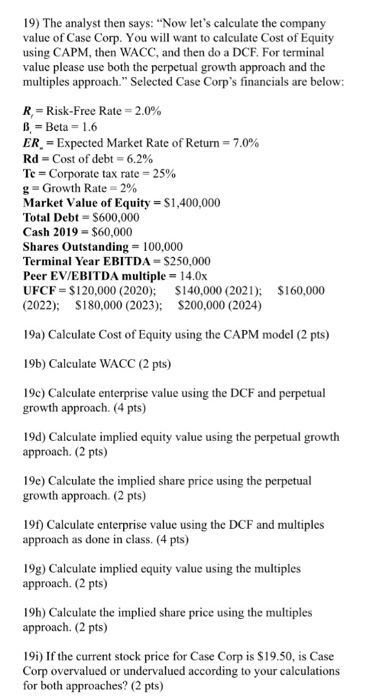
19) The analyst then says: "Now let's calculate the company value of Case Corp. You will want to calculate Cost of Equity using CAPM, then WACC, and then do a DCF. For terminal value please use both the perpetual growth approach and the multiples approach." Selected Case Corp's financials are below: R = Risk-Free Rate - 2.0% B = Beta = 1.6 ER. = Expected Market Rate of Return - 7.0% Rd = Cost of debt = 6.2% Te = Corporate tax rate = 25% g-Growth Rate = 2% Market Value of Equity = $1,400,000 Total Debt = $600,000 Cash 2019 = $60,000 Shares Outstanding = 100,000 Terminal Year EBITDA -$250,000 Peer EV/EBITDA multiple = 14.0x UFCF = $120,000 (2020); $140,000 (2021); $160,000 (2022); $180,000 (2023); $200,000 (2024) 19a) Calculate Cost of Equity using the CAPM model (2 pts) 196) Calculate WACC (2 pts) 19c) Calculate enterprise value using the DCF and perpetual growth approach. (4 pts) 190) Calculate implied equity value using the perpetual growth approach. (2 pts) 19e) Calculate the implied share price using the perpetual growth approach. (2 pts) 191) Calculate enterprise value using the DCF and multiples approach as done in class. (4 pts) 199) Calculate implied equity value using the multiples approach. (2 pts) 19h) Calculate the implied share price using the multiples approach. (2 pts) 191) If the current stock price for Case Corp is $19.50, is Case Corp overvalued or undervalued according to your calculations for both approaches? (2 pts)
Step by Step Solution
There are 3 Steps involved in it

Get step-by-step solutions from verified subject matter experts
 Study Help