



Question: 19. Velocity vs. time graphs for three objects, labeled A, B, and C, are all shown on the same axes below. All three objects start
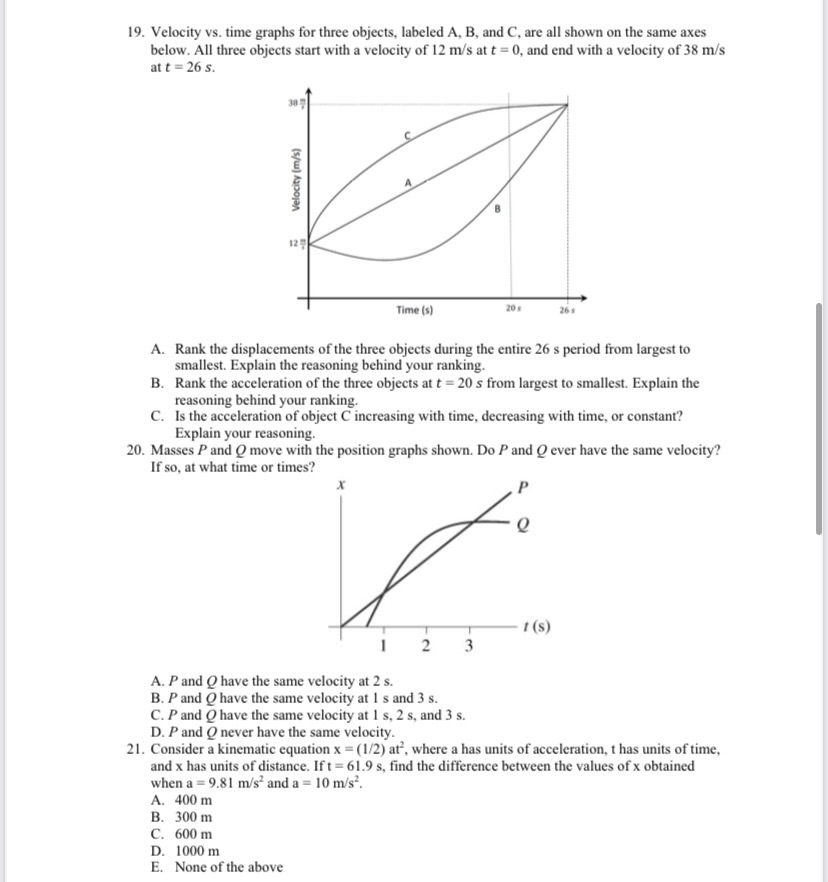
19. Velocity vs. time graphs for three objects, labeled A, B, and C, are all shown on the same axes below. All three objects start with a velocity of 12 m/s at t = 0, and end with a velocity of 38 m/s at t = 26 s. Velocity (m/s) 12 Time (s) 20 26 s A. Rank the displacements of the three objects during the entire 26 s period from largest to smallest. Explain the reasoning behind your ranking. B. Rank the acceleration of the three objects at t = 20 s from largest to smallest. Explain the reasoning behind your ranking. C. Is the acceleration of object C increasing with time, decreasing with time, or constant? Explain your reasoning. 20. Masses P and O move with the position graphs shown. Do P and O ever have the same velocity? If so, at what time or times? 1 (s) A. P and O have the same velocity at 2 s. B. P and O have the same velocity at I s and 3 s. C. P and O have the same velocity at I s, 2 s, and 3 s. D. P and O never have the same velocity. 21. Consider a kinematic equation x = (1/2) at, where a has units of acceleration, t has units of time, and x has units of distance. If t = 61.9 s, find the difference between the values of x obtained when a = 9.81 m/s' and a = 10 m/s'. A. 400 m B. 300 m C. 600 m D. 1000 m E. None of the above
Step by Step Solution
There are 3 Steps involved in it

Get step-by-step solutions from verified subject matter experts