Question: 1B 2A EXS 453 Motor Learning and Control Activity 1: Labeling Skills using Gentile's Taxonomy Gentile's two-dimensional taxonomy is a way to categorize skills. Gentile's
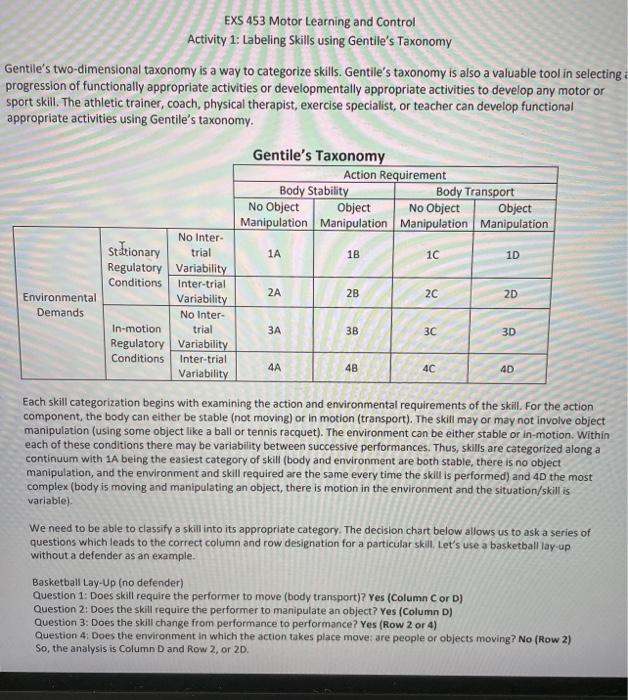
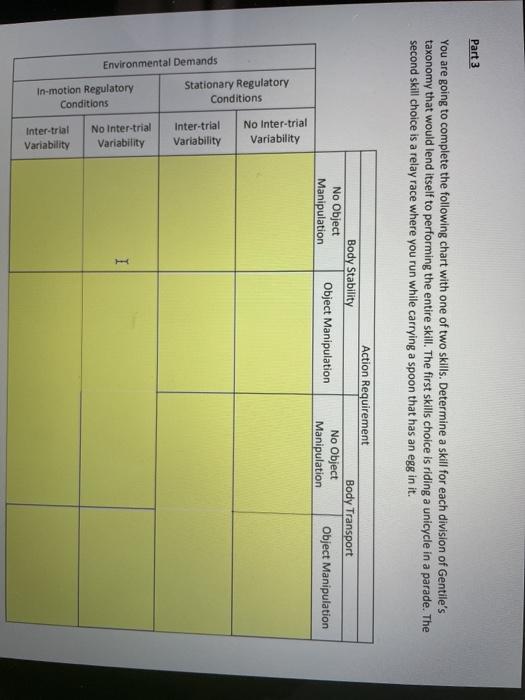
1B 2A EXS 453 Motor Learning and Control Activity 1: Labeling Skills using Gentile's Taxonomy Gentile's two-dimensional taxonomy is a way to categorize skills. Gentile's taxonomy is also a valuable tool in selecting a progression of functionally appropriate activities or developmentally appropriate activities to develop any motor or sport skill. The athletic trainer, coach, physical therapist, exercise specialist, or teacher can develop functional appropriate activities using Gentile's taxonomy. Gentile's Taxonomy Action Requirement Body Stability Body Transport No Object Object No Object Object Manipulation Manipulation Manipulation Manipulation No Inter stdrionary trial 1A 1C 1D Regulatory Variability Conditions Inter-trial 2B 20 2D Environmental Variability Demands No Inter- In-motion trial 3C Regulatory Variability Conditions Inter-trial 4C Variability Each skill categorization begins with examining the action and environmental requirements of the skill. For the action component, the body can either be stable (not moving) or in motion (transport). The skill may or may not involve object manipulation (using some object like a ball or tennis racquet). The environment can be either stable or in-motion. Within each of these conditions there may be variability between successive performances. Thus, skills are categorized along a continuum with 1A being the easiest category of skill (body and environment are both stable, there is no object manipulation, and the environment and skill required are the same every time the skill is performed) and 4D the most complex (body is moving and manipulating an object, there is motion in the environment and the situation/skill is variable) We need to be able to classify a skill into its appropriate category. The decision chart below allows us to ask a series of questions which leads to the correct column and row designation for a particular skill, Let's use a basketball lay-up without a defender as an example. Basketball Lay-Up (no defender) Question 1: Does skill require the performer to move (body transport)? Yes (Column Cor D) Question 2: Does the skill require the performer to manipulate an object? Yes (Column D) Question 3: Does the skill change from performance to performance? Yes (Row 2 or 4) Question 4: Does the environment in which the action takes place move: are people or objects moving? No (Row 2) So, the analysis is Column D and Row 2, or 2D. 3B 3D 4A 4B 40 Part 3 You are going to complete the following chart with one of two skills. Determine a skill for each division of Gentile's taxonomy that would lend itself to performing the entire skill. The first skills choice is riding a unicycle in a parade. The second skill choice is a relay race where you run while carrying a spoon that has an egg in it. Action Requirement Body Stability Body Transport No Object No Object Object Manipulation Manipulation Manipulation Object Manipulation No Inter-trial Variability Inter-trial Variability Stationary Regulatory Conditions Environmental Demands In-motion Regulatory Conditions No Inter-trial Variability I Inter-trial Variability 1B 2A EXS 453 Motor Learning and Control Activity 1: Labeling Skills using Gentile's Taxonomy Gentile's two-dimensional taxonomy is a way to categorize skills. Gentile's taxonomy is also a valuable tool in selecting a progression of functionally appropriate activities or developmentally appropriate activities to develop any motor or sport skill. The athletic trainer, coach, physical therapist, exercise specialist, or teacher can develop functional appropriate activities using Gentile's taxonomy. Gentile's Taxonomy Action Requirement Body Stability Body Transport No Object Object No Object Object Manipulation Manipulation Manipulation Manipulation No Inter stdrionary trial 1A 1C 1D Regulatory Variability Conditions Inter-trial 2B 20 2D Environmental Variability Demands No Inter- In-motion trial 3C Regulatory Variability Conditions Inter-trial 4C Variability Each skill categorization begins with examining the action and environmental requirements of the skill. For the action component, the body can either be stable (not moving) or in motion (transport). The skill may or may not involve object manipulation (using some object like a ball or tennis racquet). The environment can be either stable or in-motion. Within each of these conditions there may be variability between successive performances. Thus, skills are categorized along a continuum with 1A being the easiest category of skill (body and environment are both stable, there is no object manipulation, and the environment and skill required are the same every time the skill is performed) and 4D the most complex (body is moving and manipulating an object, there is motion in the environment and the situation/skill is variable) We need to be able to classify a skill into its appropriate category. The decision chart below allows us to ask a series of questions which leads to the correct column and row designation for a particular skill, Let's use a basketball lay-up without a defender as an example. Basketball Lay-Up (no defender) Question 1: Does skill require the performer to move (body transport)? Yes (Column Cor D) Question 2: Does the skill require the performer to manipulate an object? Yes (Column D) Question 3: Does the skill change from performance to performance? Yes (Row 2 or 4) Question 4: Does the environment in which the action takes place move: are people or objects moving? No (Row 2) So, the analysis is Column D and Row 2, or 2D. 3B 3D 4A 4B 40 Part 3 You are going to complete the following chart with one of two skills. Determine a skill for each division of Gentile's taxonomy that would lend itself to performing the entire skill. The first skills choice is riding a unicycle in a parade. The second skill choice is a relay race where you run while carrying a spoon that has an egg in it. Action Requirement Body Stability Body Transport No Object No Object Object Manipulation Manipulation Manipulation Object Manipulation No Inter-trial Variability Inter-trial Variability Stationary Regulatory Conditions Environmental Demands In-motion Regulatory Conditions No Inter-trial Variability I Inter-trial Variability









 Study Help