







Question: 1Consider a vector A that lies in a plane. It can be expressed as the sum of two components. The components are usually chosen to
1Consider a vector A that lies in a plane. It can be expressed as the sum of two components. The components are usually chosen to be along two perpendicular directions. The vector A can be resolved in to its x- and y-components by drawing two lines perpendicular to the x- and y-axes. Then A, and A, are the x and y components of A, respectively.
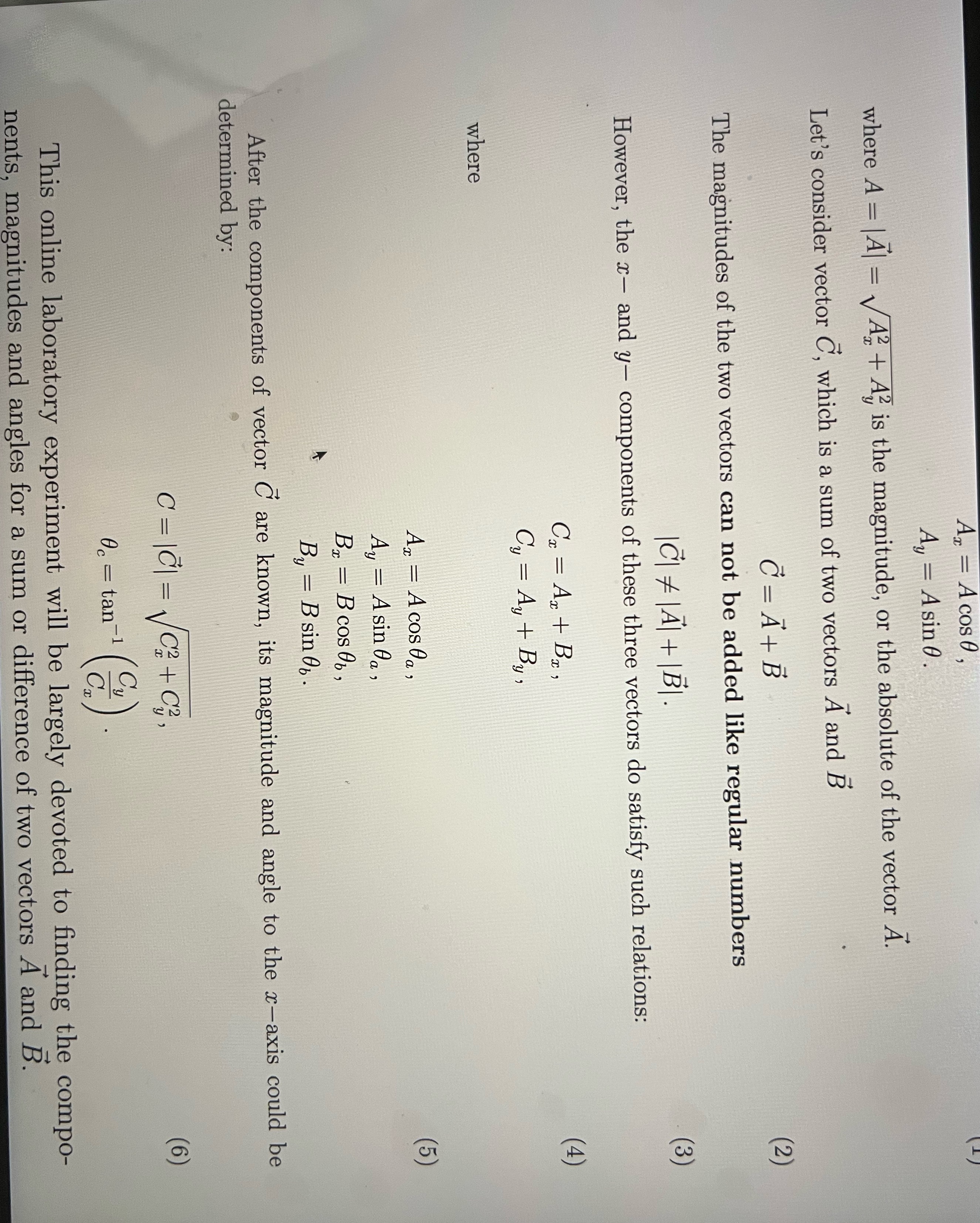
Ar = A cos 0 , Ay - Asin 0. where A = |A| = VA2 + A? is the magnitude, or the absolute of the vector A. Let's consider vector C, which is a sum of two vectors A and B C = A+B The magnitudes of the two vectors can not be added like regular numbers ICI # 1AI + 1BI. Co However, the x- and y- components of these three vectors do satisfy such relations: Cx = Ax + Bx , Cy = Ay + By , where A. = A cos la , Ay = A sin da , B. = Bcos Ob , By = B sin 06 . After the components of vector C are known, its magnitude and angle to the x-axis could be determined by: C = 101 = 1/02 + 02, Oc = tan-1 This online laboratory experiment will be largely devoted to finding the compo- nents, magnitudes and angles for a sum or difference of two vectors A and B
Step by Step Solution
There are 3 Steps involved in it

Get step-by-step solutions from verified subject matter experts
 Study Help