







Question: 1f). Be sure to answer all questions here: Let's say that you are concerned that the intravenous saline solution that people receive upon admission to
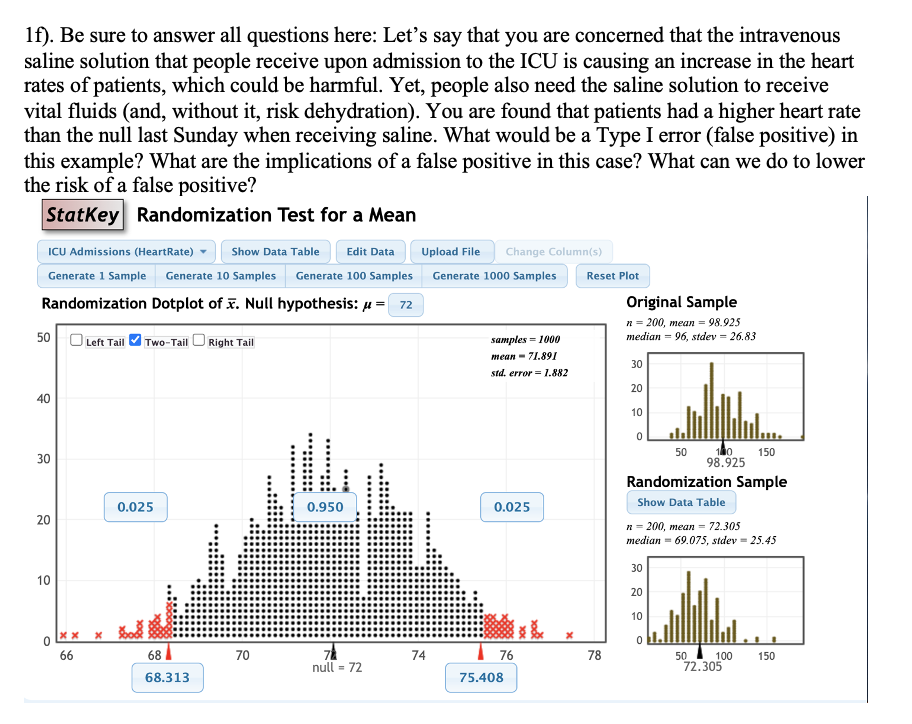
1f). Be sure to answer all questions here: Let's say that you are concerned that the intravenous saline solution that people receive upon admission to the ICU is causing an increase in the heart rates of patients, which could be harmful. Yet, people also need the saline solution to receive vital uids (and, without it, risk dehydration). You are found that patients had a higher heart rate than the null last Sunday when receiving saline. What would be a Type I error (false positive) in this example? What are the implications of a false positive in this case? What can we do to lower the risk of a false positive? Randomization Test for a Mean i ICU Admissions [Heartliaue] Y i l Show Data Table Edit Data Upload File i'i-...-|:c_|-.. r':;:-_..-:i=.:-.': i Generate 1 Sample Genelate 10 Samples - Generate 100 Samples Generate 1000 Samples Reset Plot Original Sample Pl =3!\" mean = 98.925 median = 96, .1159! = 25.83 Randomization Dotplot of E. Null hypothesis: ,u ==_ 3' 50 Cl Lm Tail TwoTail El Right Tail W = "390 mean - H.891 Mm =I.882 30 20 10 0 150 1 93.925 Randomization Sample Show Data Table 30 n =2\"! mean = 72.30} median - 69.015, 5W - 25.45 20 30 20 10 a II )I' gnnvonuunpc 0 68 TD 7 74 76 78 a u 72 - - 5072301500 53.313 J "" ' 75.403 ' \\ 150
Step by Step Solution
There are 3 Steps involved in it

Get step-by-step solutions from verified subject matter experts
 Study Help