



Question: #1please only 1. A sample of lithium bromide was dissolved in water in a simple calorimeter. What mass of lithium bromide, LiBre, must have dissolved
#1please only
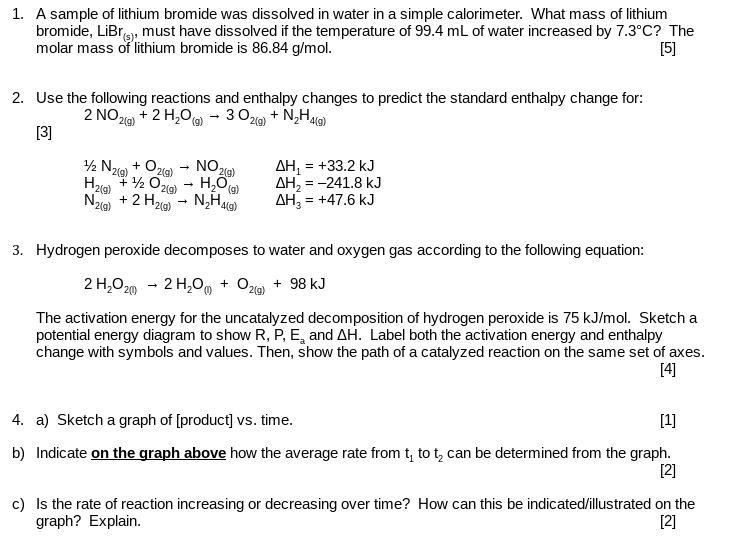
1. A sample of lithium bromide was dissolved in water in a simple calorimeter. What mass of lithium bromide, LiBre, must have dissolved if the temperature of 99.4 ml of water increased by 7.3C? The molar mass of lithium bromide is 86.84 g/mol. [5] 2. Use the following reactions and enthalpy changes to predict the standard enthalpy change for: 2 NO2(g) + 2 H,09) - 302(0)+ NH4() [3] ( g) +020) / N219) H20) + 2 H20) = = +42029) NO 219) - H20 (9) AH, = +33.2 kJ , =-241.8 kJ , = +47.6 kJ N2(0) N, HA 3. Hydrogen peroxide decomposes to water and oxygen gas according to the following equation: 2 H,020 - 2 H,0, + O2(g) + 98 kJ The activation energy for the uncatalyzed decomposition of hydrogen peroxide is 75 kJ/mol. Sketch a potential energy diagram to show R, P, E, and AH. Label both the activation energy and enthalpy change with symbols and values. Then, show the path of a catalyzed reaction on the same set of axes. [4] 4. a) Sketch a graph of [product] vs. time. [1] b) Indicate on the graph above how the average rate from t to t, can be determined from the graph. [2] c) Is the rate of reaction increasing or decreasing over time? How can this be indicated/illustrated on the graph? Explain. [2]
Step by Step Solution
There are 3 Steps involved in it

Get step-by-step solutions from verified subject matter experts