







Question: 1-The objective function equation in standardized form is written as * z = 6x1 - 8x2 - 4x3 - 0 z - 6x1 - 8x2
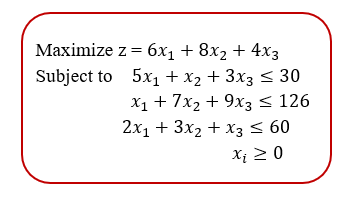
1-The objective function equation in "standardized" form is written as *
z = 6x1 - 8x2 - 4x3 - 0
z - 6x1 - 8x2 + 4x3 = 0
None of the answers.
z - 6x1 + 8x2 - 4x3 = 0
z - 6x1 - 8x2 - 4x3 = 0
2-Add/Subtract a slack/surplus variable to the 1st constraint *
None of the answers.
5x1 + x2 + 3x3 - S1 30
5x1 + x2 + 3x3 + S1 30
5x1 + x2 + 3x3 + S1 = 30
5x1 + x2 + 3x3 - S1 = 30
3-Add/Subtract a slack/surplus variable to the 2nd constraint *
None of the answers.
x1 + 7x2 + 9x3 - S2 = 126
x1 + 7x2 + 9x3 - S2 126
x1 + 7x2 + 9x3 + S2 126
x1 + 7x2 + 9x3 + S2 = 126
4-Add/Subtract a slack/surplus variable to the 3rd constraint *
2x1 + 3x2 + x3 - S3 60
2x1 + 3x2 + x3 + S3 60
2x1 + 3x2 + x3 - S3= 60
None of the answers.
2x1 + 3x2 + x3 + S3 = 60
5-_____ is the "1st entering variable" since it has the ________ which is equal to __________ *
X2; minimum positive coefficient; 8
X2; most negative coefficient; -8
X2; minimum positive ratio; 8
None of the answers.
X2; most positive coefficient; -8
6-__________ is the "1st leaving variable" since it has the/a _________. *
S3; minimum positive ratio
S1; minimum positive ratio
S2; minimum negative ratio
None of the answers.
S2; minimum positive ratio
7-The first pivot element is the intersection of the _________________ &_____________ it's equal to _________. *
Pivot column; pivot row; 5
Pivot column; pivot row; 7
None of the answers.
Pivot column; z-row; 4.25
Pivot column; z-row; 4
8-The "new pivot row" of the first iteration is written as: *
(014, 1, 1.29, 0, 0.14, 0, 18)
None of the answers.
(0.14, 1, 1.29, 0, 0.14, 0, 1.8)
(0.14, 1, 1.29, 0, 0.14, 0, 18)
(0.14, 1, 129, 0, 0.14, 0, 18)
9-The "New Z-row" of the first iteration is written as: *
(-4.86, 0, 6.29, 0, 1.14, 0, 144)
(4.86, 0, 6.29, 0, 1.14, 0, 144)
(-4.86, 0, 6.29, 0, 1.14, 0, 1.44)
None of the answers.
(-4.86, 0, 6.29, 0, 114, 0, 144)
10-The values of the "first basic" variable in the first iteration, is written as: *
(4.86, 0, 171, 1, -0.14, 0, 12)
(4.86, 0, 1.71, 1, 0.14, 0, 12)
None of the answers.
(4.86, 0, 1.71, 1, -0.14, 0, 12)
(-4.86, 0, 1.71, 1, -0.14, 0, 12)
11-The values of the "3rd basic" variable in the first iteration, is written as: *
(1.57, 0, 2.86, 0, -0.43, 1, 0.6)
(1.57, 0, -2.86, 0, 0.43, 1, 0.6)
(1.57, 0, -2.86, 0, 0.43, 1, 6)
(1.57, 0, -2.86, 0, -0.43, 1, 0.6)
None of the answers.
12-The 2nd entering variable is ______ with a coefficient of______. *
X1; -4.86
X2; 0
X3; 6.29
X1; -6
None of the answers.
13-The 2nd leaving variable is *
S2
S1
S3
None of the answers.
X2
14-The pivot element of the 2nd iteration is *
1.71
4.86
1.57
None of the answers.
-0.43
15-The "new pivot row" of the 2nd iteration is written as: *
(1.57, 0, 2.86, 0, -0.43, 1, 0.6)
(1.57, 0, -2.86, 0, 0.43, 1, 0.6)
None of the answers.
(1, 0, 0.35, 0.21, -0.03, 0, 2.47)
(1.57, 0, 2.86, 0, 0.43, 1, 0.6)
16-The "New Z-row" of the 2nd iteration is written as: *
(0, 0, 8, 1, 1, 0, 15.6)
(0, 0, 8, 1, 1, 0, 156)
None of the answers.
(0, 0, 0.8, 1, 1, 0, 156)
(0, 8, 0, 1, 1, 0, 156)
17-The values of the "second basic" variable in the 2nd iteration, is written as: *
None of the answers.
(0, 1, 1.24, 0.03, -0.15, 0, 17.65)
(0, 1, 1.24, -0.03, 0.15, 0, 17.65)
(0, 1, 1.24, 0.03, 0.15, 0, 17.65)
(0, 1, -1.24, -0.03, 0.15, 0, 17.65)
18-The values of the "3rd basic" variable in the 2nd iteration, is written as: *
(0, 0, -3.41, 0.32, -0.38, 1, 2.12)
(0, 0, -3.41, 0.32, 0.38, 1, 2.12)
(0, 0, -3.41, -0.32, -0.38, 1, 2.12)
None of the answers.
(0, 0, -3.41, -0.32, 0.38, 1, 2.12)
19-The optimal value of "z" is: *
maximum z = 156
maximum z = 144
minimum z = 126
None of the answers.
minimum z = 15.6
20-The optimal value of "X1" is: *
17.65
None of the answers.
2.47
0
2.12
21-The optimal value of "X2" is: *
0
2.47
17.65
None of the answers.
2.12
22-The optimal value of "X3" is: *
2.12
2.47
0
17.65
None of the answers.
23-The optimal value of z in terms of D1, D2, & D3 (Changes in the RHS) is written as: *
z = 156 + D1 - D2
z = 156 - D1 + D2
z = 156 + D1 + D2
z = 156 - D1 - D2
None of the answers.
24-A unit increase in D1, D2, & D3 will result in a/an ________ in z by ------------- respectively. *
increase; 1, 1, & 0
decrease; 1, 0, & 0
decrease; 0, 1, & 1
increase; 0, 1, & 0
None of the answers.
25-The optimal value of X1 in terms of D1, D2, & D3 (Changes in the RHS) is written as: *
X1= 2.47 - 0.21D1 + 0.03D2
None of the answers.
X1= 2.47 - 0.21D1 - 0.03D2
X1= 2.47 + 0.21D1 - 0.03D2
X1= 2.47 + 0.21D1 + 0.03D2
Maximize z=6x1 + 8x2 + 4x3 Subject to 5x1 + x2 + 3x3 30 X1 + 7x2 + 9x3Step by Step Solution
There are 3 Steps involved in it

Get step-by-step solutions from verified subject matter experts
 Study Help