







Question: 1)true or false: The calling population in a queuing problem must go to the server, that is servers do not go to the calling population.
1)true or false: The calling population in a queuing problem must go to the server, that is servers do not go to the calling population.
2)true or false: Customer arrival rates vary throughout the day and the priority rules change depending on the customer mix and influence each has over the finances of the firm. Such a situation is best analyzed using simulation rather than one of the queuing formulas.
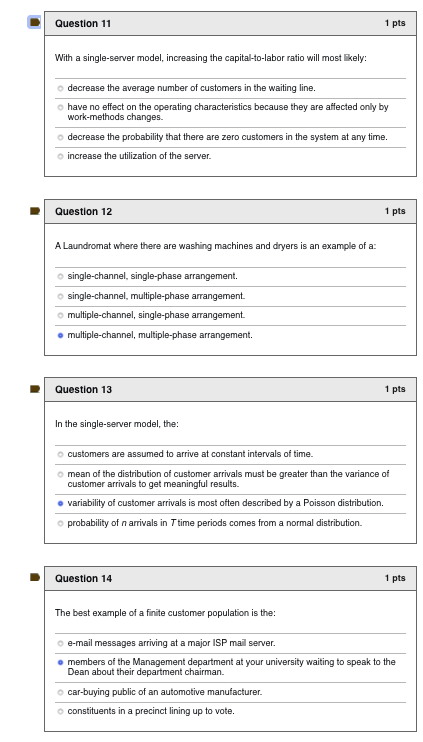
Question 11 1 pts With a single-server model, increasing the capital-to-labor ratio will most likely: decrease the average number of customers in the waiting line. have no effect on the operating characteristics because they are affected only by work-methods changes decrease the probability that there are zero customers in the system at any time. increase the utilization of the server. Question 12 1 pts A Laundromat where there are washing machines and dryers is an example of a: single-channel,single-phase arrangement. single-channel, multiple-phase arrangement. multiple-channel, single-phase arrangement. multiple-channel, multiple-phase arrangement. Question 13 1 pts In the single-server model, the: customers are assumed to arrive at constant intervals of time. mean of the distribution of customer arrivals must be greater than the variance of customer arrivals to get meaningful results. variability of customer arrivals is most often described by a Poisson distribution. probability of narrivals in time periods comes from a normal distribution. Question 14 1 pts The best example of a finite customer population is the: e-mail messages arriving at a major ISP mail server. members of the Management department at your university waiting to speak to the Dean about their department chairman. car-buying public of an automotive manufacturer. constituents in a precinct lining up to vote
Step by Step Solution
There are 3 Steps involved in it
1 Expert Approved Answer
Step: 1 Unlock

Question Has Been Solved by an Expert!
Get step-by-step solutions from verified subject matter experts
Step: 2 Unlock
Step: 3 Unlock
 Study Help