







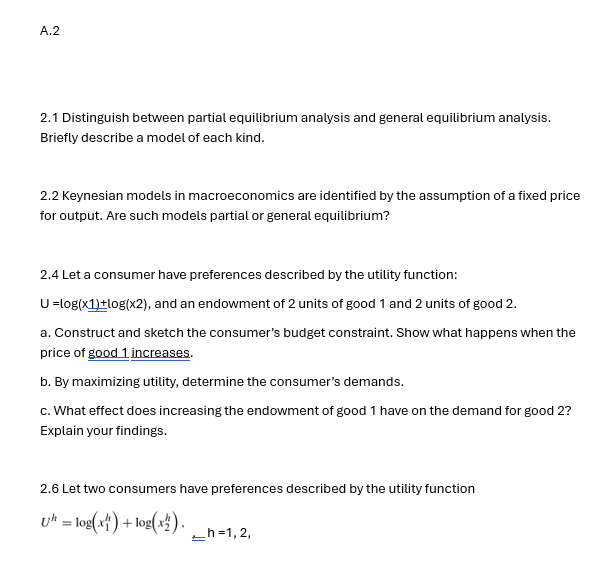
Question: 2 . 1 Distinguish between partial equilibrium analysis and general equilibrium analysis. Briefly describe a model o f each kind. 2 . 2 Keynesian models
Distinguish between partial equilibrium analysis and general equilibrium analysis. Briefly describe a model each kind.
Keynesian models macroeconomics are identified the assumption a fixed price for output. Are such models partial general equilibrium?
Let a consumer have preferences described the utility function:
and endowment units good and units good
Construct and sketch the consumer budget constraint. Show what happens when the price good increases.
maximizing utility, determine the consumer demands.
What effect does increasing the endowment good have the demand for good Explain your findings.
Distinguish between partial equilibrium analysis and general equilibrium analysis.
Briefly describe a model each kind.
Keynesian models macroeconomics are identified the assumption a fixed price
for output. Are such models partial general equilibrium?
Let a consumer have preferences described the utility function:
and endowment units good and units good
Construct and sketch the consumer's budget constraint. Show what happens when the
price good increases.
maximizing utility, determine the consumer's demands.
What effect does increasing the endowment good have the demand for good
Explain your findings.
Let two consumers have preferences described the utility function
Step by Step Solution
There are 3 Steps involved in it
1 Expert Approved Answer
Step: 1 Unlock

Question Has Been Solved by an Expert!
Get step-by-step solutions from verified subject matter experts
Step: 2 Unlock
Step: 3 Unlock
 Study Help