







Question: 1. In Note 2: Performing a Case Analysis (pages 10-17) there is a brief discussion on the difference between symptoms and issues. Explain your understanding
1. In Note 2: Performing a Case Analysis (pages 10-17) there is a brief discussion on the difference between "symptoms" and "issues." Explain your understanding of the distinction. If needed, use your own example. I am looking for a 2-6 sentence short paragraph.
2. For developing alternative solutions, what are the two most important things to consider? You can use bullet points but make sure to write complete sentences. No more than 4 sentences total, please.
Note 2 pages 10-17 attached below
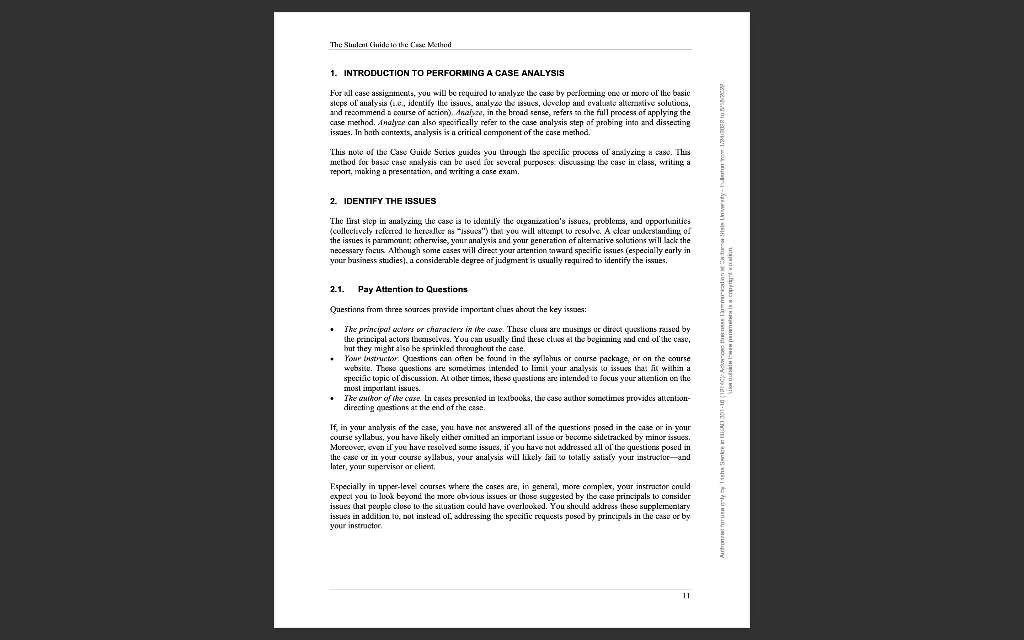
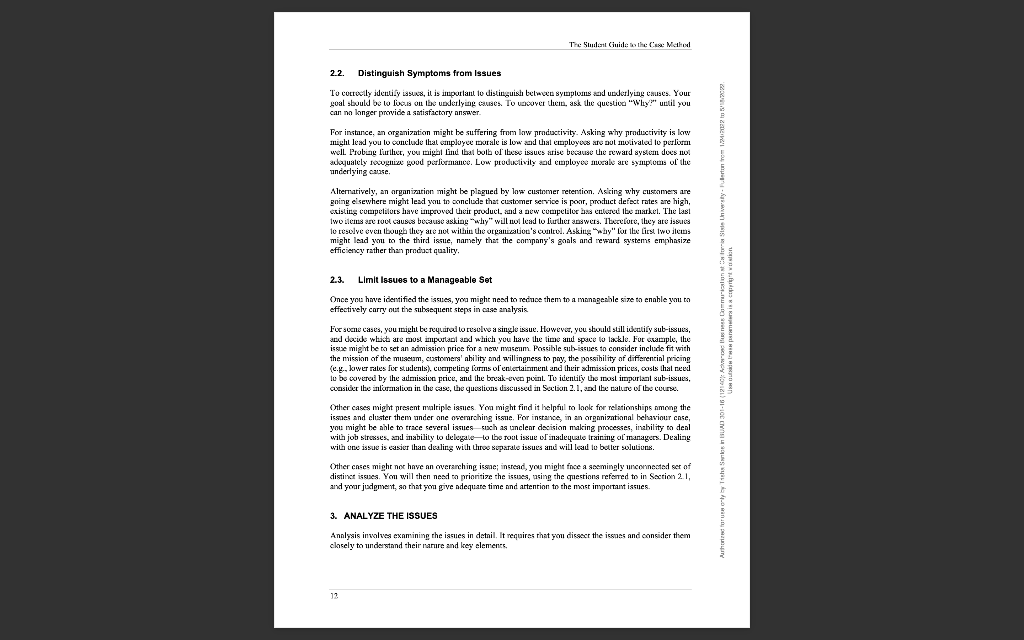
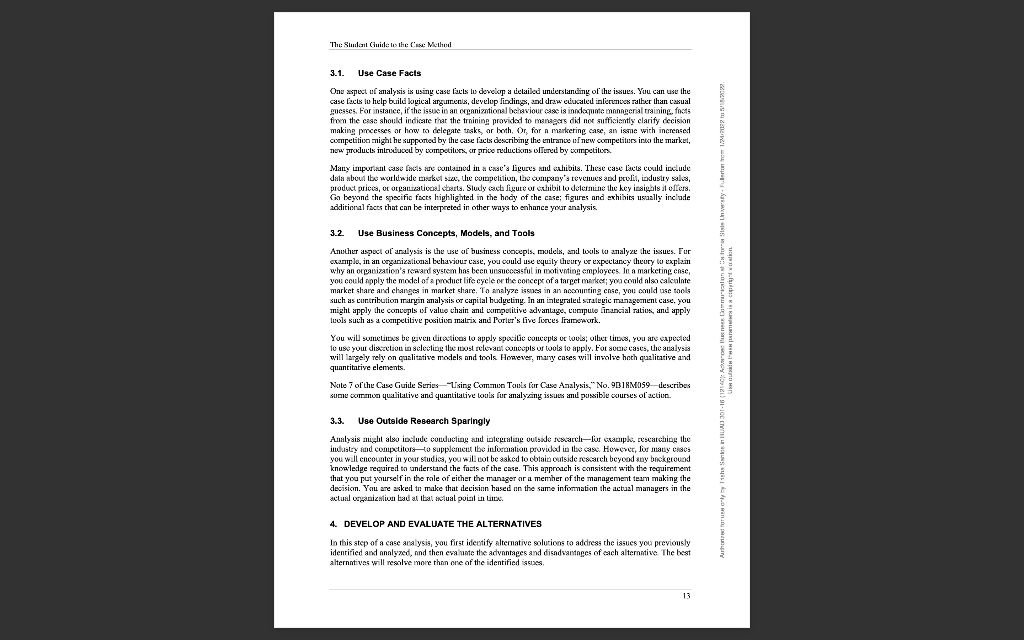
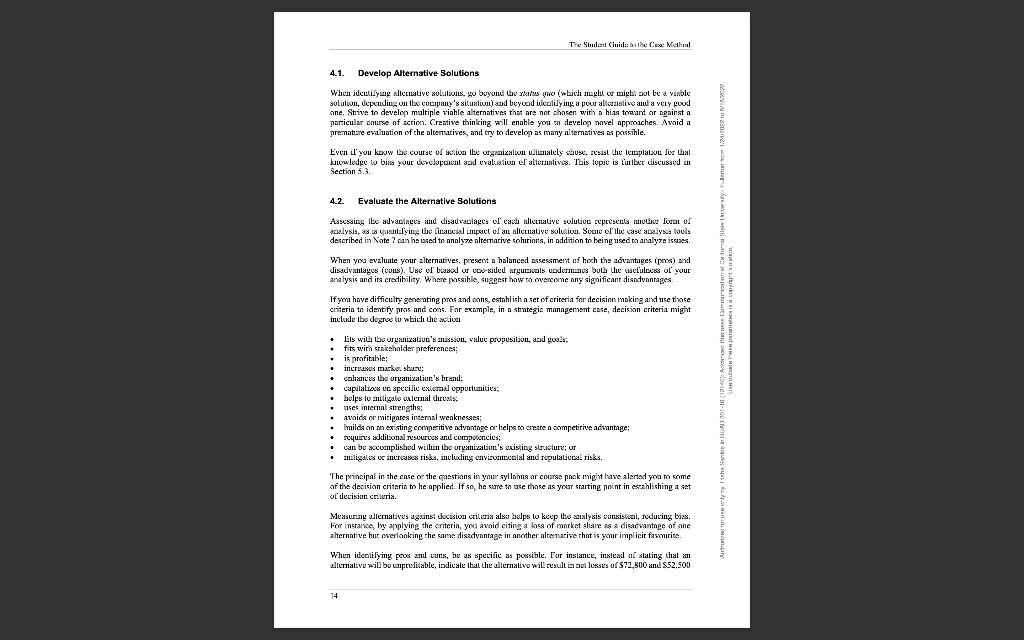
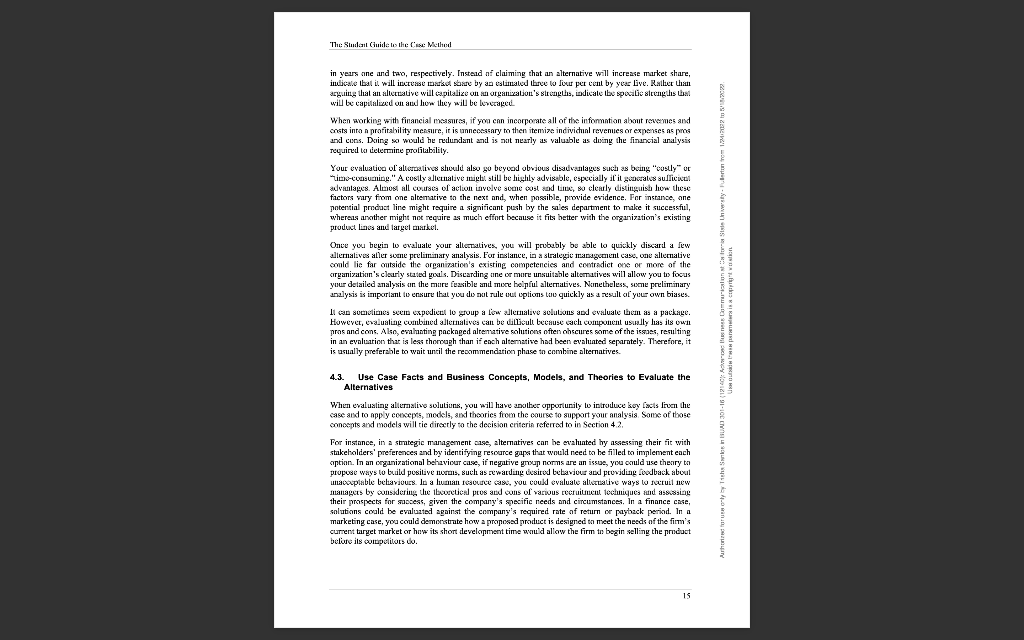
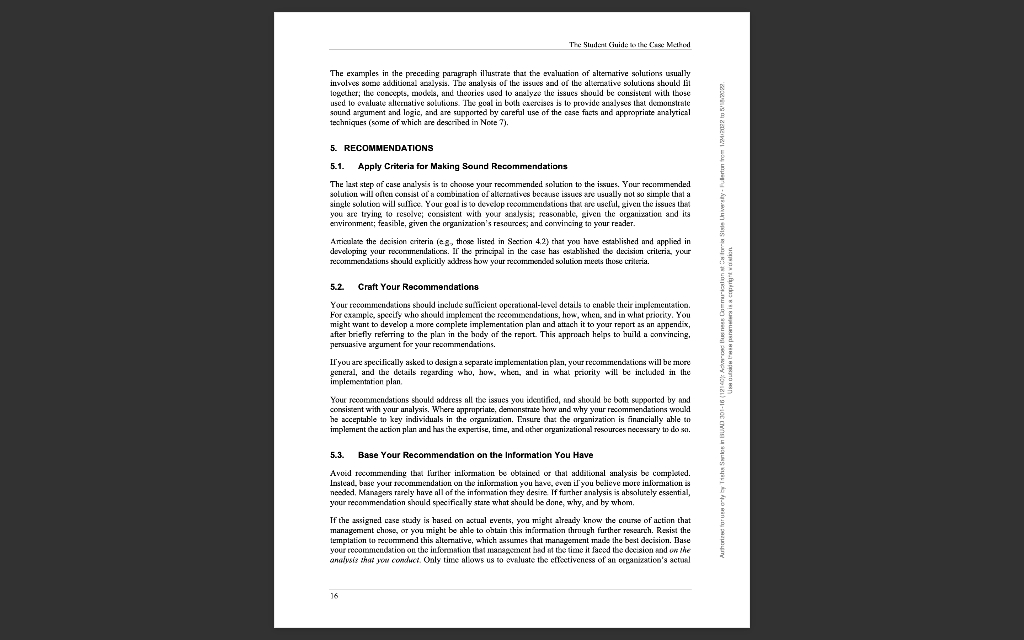
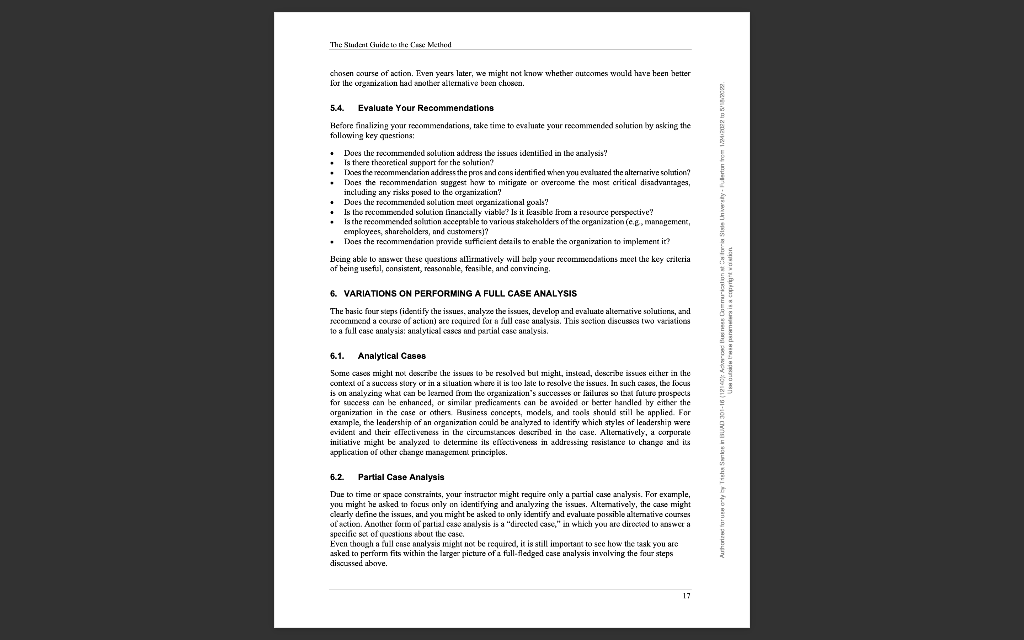
The Sun Ciuide to the Case: Mathe NOTE 2: PERFORMING A CASE ANALYSIS The Sun Clue to the Case Method 1. INTRODUCTION TO PERFORMING A CASE ANALYSIS For all case assiguens, you will be required to malyzetbe case by pelucming De or more of the basic sleps of analysis (L.o., identify the issues, analyze the issues, conclup and evaluate alternative solutions, and recommend a course of action). Analyze, in the broad sense, refers to the full process of applying the case method. Anaheze can also specifically refer to the case analysis step of probing into and dissecting issues. In hath contexts, analysis is a critical component of the case method. Thuis mole of the Case Guide Series gudes you wrough the specific procus of analyzing a case. Tlus method for basic case coalysis can be used for several purposes discussing be case in class, writing a report, making a presentation, and writing a case exam, 2. IDENTIFY THE ISSUES ha The list step in analyzing the case is to identity the gamezaliva's issues, problems, and opportunities (collectively clined to her as suas") that you will allcapll resulve. A clear kastanding of the issues is paramount; otherwise, your analysis and your generation of alternative solutions will lack the necessary focus. Although some cases will direct your attention toward specific issues (especially early in your business studies), a considerable degree of judgment is usually required to identify the issues. 2.1. Pay Attention to Questions . . Questions from three sources provide important clues about the key issues: The principal actors or characters in the case. These clues are usings ur direct questions passed by the principal actors brasives. You can usually Lind these clusal the beginning and end of the case, Imut they might also be sprinkled theaghout the case. Your instructor Questions can often be found in the syllabus or course package, or on the course website. These questions are sometimes intended to limit your analysis to issues that it willina speciiic topic of discussion. Al olber Lines, these questions are intended to focus your alleation up the most important issues. The cuthor of the case. In cases presented in textbooks, the case author Solbelins provides alcalon- directing questions at the end of the as If, in your analysis of the case, you have not answered all of the questions posed in the case or in your course syllabus, you have likely either onlled an impuran issue or bewire sidetracked by minus issues. Moreover, even if you have resolved sume issues, il you have not addressed all of the questions posed in ihe case or in your course syllabus, your analysis will likely Tail w lolally satisfy your instructura Inter, your supervisor ar client Especially in upper-level courses where the cases are, in general, more complex, your instructor could cipect you to look beyomi be more obvious issues ur howe suggested by the case principals to consider issues that people cluso to the situation could have overlosed. You should address these supplencalary issues in addition to cut instead of addressing the specilic requests pused by principals in the case or by your instructor 11 The Sul Ciuide to the ex: Mathew 22. Distinguish Symptoms from Issues To coolly identify issue, il is important to distinguish betwee symptoms and underlying causes. Your goal sbould be to focus on the underlying causes. To cover lei, ask the question "Vy?" until you can no longer provide a satisfactory answer 1 For instance, an organization might be suffering from low productivity: Asking why productivity is low might lead you to conclude that comployee murale is low and dial employees are al motivated to perlu well. Probimy Ciriler, you might line bal bolbol bese issues arise because the reward system does not adajually one good parlance. Low productivity and employee scale are symp.ons of the underlying care Alternatively, an organization might be plagued by low customer retention. Asicing why customers are gning elsewhere might lead you to conclude that customer service is poor, product defect rates are high, cuisling competitors have improved their product and a new cumipelalu bas etilored be market. The last Iwo tlenu are root causes because asking why" wil wilcad to liver answers. Therefore, iley ate issues to resolve ove bough they are not within the organization's cultul. Asking "wy" Coribe Lics twojens , might lead you to the third issue, namely that the company's goals and reward systems emphasize efficiency rather than product quality 2.3. Limit Issues to a Manageable Set Once you have identified the issues, you might need to reduce them to a manageable size to enable you to effectively carry out the subsequent steps in case analysis For sucne cases, you might be required to resolve a single issue. However, you should still identify sub-issues, and decide what are most important and winich you live the time and space to lackle. Fur cumple, the issue might be to set an admission price for a new mascum Possible sub-issues to consider include fit with the mission of the muscam, customers' ability and willingness to pay the possibility of differentin pricing (e.y., kwer rales for students). cumpeling forms of entertainment and their admission prices, costs that need to be covered by the admission price, and the break-oven point. To identity the most important sub-issues, casider the ancoralia in the case, the questions discussed in Section 2.1, and because of the course. Other cases might present malriple issiles. Y a might find it helpful to look for relationships among the issues and cluster them ander one remarching issue. For instance, in an organizational behaviour case, you might be able to trace several issues such as unclear decision making processes, inability to deal with job stresses, and inability to delegate the rout issue of inadequate training of managers. Dealiny with be issue is easier than dealing with three separate issues and will lead to beller solutions. Other cases might not have an overarching issue instead, you might face a seemingly unconnected ser of distinct issues. You will then need sa prioritize the issues, using the questions referred to in Section 2.1, and your judgment, so that you give adequate time and attention to the most important issues 3. ANALYZE THE ISSUES Annlysis involves examining the issues in detnil. It requires that you dissect the issues and consider them closely to understand their narure and ley elements The Student Ciuidelis the Case Method 3.1. Use Case Facts One aspect of analysis is using case facts to develop a detailed understanding of the issues. You can use the case locks to help build logical arguens, develop findings, and draw ciucated inferences rather than casual guesses. For instance, if the issue in an organizational behaviour case is indeunde managerial training facts from the case should indicate that the trnining provided to managers did not sufficiently clarify decision making processes or how to delegate tasks, or both, Or, for n marketing case, an ime with increased competitive might he supported by the case facts describing the entrance of new competities into the market, new products introduced by competitorx, cr price reductions olleed by competitors Many impuran case facts are contained in a case's ligures and cahibits. These case Lacts could include Jala about be worldwide akul sac, le compelution, to by's tochucs and prolit, industry sales, product prices, or organizational starta. Sludly eat ligure or ethibit to determine the key insights it offers Ga beyond the specific faces highlighted in the hody of the case; figures and exhibits usually include additional facts that can be interpreted in other ways to enhance your analysis 3.2 Use Business Concepts, Models, and Tools Another aspect of analysis is the use of business caps, models, and tools to analyze the issues. Fur cuample, in an organizational behaviour case, you could use equity theory or expectancy theory to explain why an organization's reward system has been successful in motiv ting employees li a marketing cose, you could apply the model of a product life cycle or the concept of a target marker; you could also calculate market share and changes in market share, To analyze issues in an ninting case, you could use tools such as contribution margin analysis or capital hudyetiny. In an integrated strategic management case, you might apply the concepls of value chain and competitive advantage, computo financial ratius, and apply lvols such as a competitive positive matrix and l'order's live lunces framework. You will surelius be givenditotives to apply spavilic concepts or lools; ullet Libe, you are capected to use you dixczciou in sclecling best relevant un copis ur tools to apply. For some cases, the analyses will largely rely on qualitative models and tools. However, many cases will involve hoth qualitative and quantitative elements . Note 7 of the Case Guide Series --Using Commun Touls for Care Analysis," No.9318M059 describes sume common qualitative and quantitative loul fur analyziny issues and pussible courses of action. 3.3. Use Outside Research Sparingly Analysis anglit also include conducting and integralmg outsade escarch-lur crampk.escatching the industry and competitorso supplement to information provided in the case. However, for many cases you will encounter in your studies, you will not be asked to obtain outside rescatch beyood by background knowledge required to understand the facts of the case. This approach is consistent with the requirement that you put yourself in the role of either the manager or a member of the management team making the decision. You are asked to make that decision hased on the same information the actual managers in the actual organization badal ibal cual poinline 4. DEVELOP AND EVALUATE THE ALTERNATIVES In this step of a case analysis, you first identify alternative solutions to address the issues you previously identified and analyzed, and then evaluate the advantages and disadvantages of each alternative. The best alternatives will resolve more than one of the identified issues The Sul Ciuide to the Mathe 4.1. Develop Alternative solutions When identifying alternative solutions. yu beyond the status gwo v tich night or might not be avable solution, depending on the company's siluen) and beyood idealifying a pour aliorative and a very good one. Strive to develop multiple vinhle alternatives that are not chosen with a hias toward or against a particular course of action. Creative thinking will enable you to develog novel approaches. Avoid a premature evaluation of the alternatives, and try to develop as many alternatives as possihle. Evenil you know the course of actiu be organization immately cause, esist the besplation for that kwledge lubiss your development and evaluation of alternatives. This topic is luriber discussed il Section 5.3. 4.2 Evaluate the Alternative Solutions Assessing ibe advantages and disadvantages of each alternative solution represents mother livm of alysis, as is usuallying the linesal pact of an allettative solution. Suge of the case analyse tools described in Note 7 can be used to analyze alternative solutions, in addition to being used to analyze issues When you evaluate your alternatives, present a halanced assessment of hoch the advantages (pros) and disadvantages (cums). Us of bused or ce-sided argue als undermines both the usefulness of your analysis and its credibility. Where possible, suggest how to overcome any significant disn tynntages If you have difficulty genernting pros and cons, establish a set of criteria for decision making and use those criterin to identify pros and cons. For example, in a stategic management case, decision criteria might include the degree to which the action . . Lils will be organization's ITLESSIOIL, value proposition, and goals . fits with stakeholder preferencer . is profitable; increases market share: enhances the organization's brand: capitalis on specific external opportunities: belps lo zniligale calernal dress : uses internal strengths: avoids or mitigates internal wenknesses luilds an existing competitive advantage ce helps to create a competitive advantage; requires acional sources and competencies; can be accomplished within the organization's existing structure; or miligales uc increase tisss, including envirautealal and reputatical risks. The principal in the case or the questions in your syllabus or course pack might have alerted you to some of the decision criteria to he applied. If so, he sure to use these as your starting point in establishing a set of decision criteria. Measuring alternatives against decision criteria also helps to keep the analysis consistcal, reducing bias. For instance, by applying the criterin, you avoid citing a loss of market share as a disadvantage of one alternative but overlooking the same disadvantage in another alternative that is your implicit favourite When identifying peos and vuns, be ax specific as possible. For instance, instead of slating that can allernalive will be unprofitable, indicate that the allernalive will result in allusses of $72,500 and $52,500 14 The Student Ciuide to the Case Method in years ane and tao, respectively. Instead of claiming that an alternative will increase market share, indicate that it will increase make sure by an estimated three to four per cent by yea Live. Raiber han aying that an allettative will capitalize o organization's slengtis, indicate be spoilic strengths that will be capitalized on and how lucy will be leveraged When working with financial measures, if you can incorporate all of the informntion about reuermes and crists inra n pratitalvility measure, it is unnecessary to then itemize indivictul revenues or expenses as pas and cons. Ding so would be redundant and is not nearly as valuable as diving the financial analysis Tequired to determine profitability. Your evaluation of all times should also go beycad obvious disadvantages such as being "costly up lic-cousutning." A costly alicilave much still be highly advisable, especially it'il gacralus sullicent advantages. Almost all courses of action involve some cost od luc, so clearly distinguish low these factors vary from one alternative to the next and, when possible, provide evidence. For instance, ane potential product line might require a significant push by the sales department to make it successful, whereas another might not require as much effort because it fits better with the organization's existing product lines and largul kul. Once you begin to evaluate your allcemaatives, you will probably be able to quickly discard a few alternatives aller sucne preliminary analysis. For instance, in a strategic asgaient case, one alternative could lic far outside the organization's existing competencies and contradict one or more of the crganization's clearly stated goals. Discarding sine or more unsuitable alteratives will allow you to focus your detailed analysis on the mure fexible and more beipful alternatives. Nonetheless, some preliminary analysis is important to ensure that you do not rule uut options to quickly as a result of your own biases. li ce suntimes we expedicello group a low alternative solutions and evaluate them as a package. However, evaluating combined alternatives can be dillicul because each component usually has its owil pros and cons. Also, evaluating packaged alternative solutions often obscures some of the issues, resulting in an evaluation that is less thorough than if each alternative had been evaluated separately. Therefore, it is usually preferable to wait until the recommendation phase in combine alternatives. 4.3. Use Case Facts and Business Concepts, Models, and Theories to Evaluate the Alternatives When evaluating alternative solutions, you will have another opportunity to introduce key facts live the case and to apply concepts, models, and theories from the course to support your analysis Some of those concepts and models will tie directly to the decision criterin referred to in Section 4.2. For instance, in a strategic management se, alternatives can be evalunted by assessing their fit with stakeholders' preferences and by identifying resource gups that would need to be filled to implement each sption. In an organizational behaviour case, if negative group norms are an issue, you could use theory to propose ways to build positive moms, such as rewarding desired behaviour and providing foodback about acoplable behaviours. In a nn COLECE case, you could evaluale alicznative ways recruit new manages by collidering the boretical plus and cons of varwus recruiticul techniques and assing their prospects for success, given the company's specific needs and circumstances. In a finance case, solutions could be evaluzted against the company's required rate of return or payback period. In a marketing case, you could demonstrate how a proposed product is designed to meet the needs of the firm's cum potius its short development time would allow the firm to beginselling the prodact target or how before its clupolilors do. 15 The Stat Ciuide the Method The examples in the preceding paragraph illustrate that the evaluation of alternative solutions usually involves some additional analysis. The analysis of the issues and of the alicutive soluticas sbould li logetherthe concepts, modis, and thotics used to analyze the issues should be consilical with bose used to evaluate alternative solutions. The goal in bull carcases is to provide analyses ibal demonsta sound argument and logic, and are supported by carefal use of the case facts and appropriate analytical techniques (some of which are described in Noce?). 5. RECOMMENDATIONS 5.1. Apply Criteria for Making Sound Recommendations The last step of case analysis is tn choose your recommended solution to the issues. Your recommended solution will often cuisas Ola bilica of alloratives because issues are usually Dol 80 sitple la single solutiod will sullice. Your goal is to develop toonudatives that are useful, given the issues that you are trying to resolve coasistent with your analysis reasonable, given the organization and its errvironment; feasible, given the organization's resources and corrincing to your reader. Articulate the decision criterin (eg, the listed in Section 4.2) that you have established and applied in developing your reccnenatics. If the principal in the case has esablished the decisium criteria your Tecmodations sbould explicitly address bow your commodo solulova mets those cricia. 5.2 Craft Your Recommendations Your ecommendations should include sullicicut operational-level details to enable their implementatie For example, specify who should imple at the recommendations, low, when, and in wlist priority. You might want to develop a more complete implementation plan and attach it to your report as an appendix, after briefly referring to the plan in the body of the report. This approach helps to build a convincing, persuasive argument for your recommendations. If you are specilically asked to design a separate implementation plan, your recommendations will be more general, and the details regarding wbo, huw, wher, and in whal priority will be included in the implementation plan Your recommendations should address all the issues you identified, and should be both supported by And consistent with your analysis. Where appropriate, demonstrate how and why your recommendations would he acceptable in key individuals in the organization. Tonsure that the organization is financially uhle to implement the action plan and has the expertise, time, and other organizational resources necessary to do so. 5.3. Base Your Recommendation on the Information You Have Avoid rounding the curber in lumalon be obtained or hal additional analysis be cuapod. Instead, base your roommendation on the inmalion you bav, cca il you believe more information is needed, Managers rarely have all of the information they desire If further analysis is absolutely essential, your recommendation should specifically state what should be done, why, and by whom, If the assigned case study is hased on actual events, you might already know the course of action that management chose, or you might be able to obtain this information through further research. Rexist the templation to recommend this alternative, which assumes that maruyement made the best decision. Base your commendation on the information that management bad at the time it faced the decision and on the analysis thus yow conduct. Only time allows us to cvaluate the ctfctiveness of an organization's actual 16 The Sant Cluide to the Case Method chosen course of action. Even years later, we might not know whether outcomes would have been hetter for the organization had anolber alternative been closca. . 5.4. Evaluate Your Recommendations Refore finalizing your recommendations, rake time to white your recommended solution Ivy asking the following key quesrions: Does the room anded solution address the issues identitied in Ibo analysis? Is there theretical support for the sohition? . Does the recommendation address the pros and considentified when you evaluated the alternative solution? Does the recommendation sageest how to mitigate or overcome the most critical disadvantages, including any risks powed the organization? Does the recommended solution met urganizativaal goals? Is be reconncoded solulica Linancially viable? Is il leasible liva a resource perspective? Is the recommended solution acceptable to various stakeholders of the organization (e, manngement, employees shareholders, and customers)? Does the recommendation provide sufficient details to enable the organization to implement it? Being able to answer these uuestions allirmatively will be your recommendations meet the key criteria of being usefal, consistent reasonable, feasible, and convincing . 6. VARIATIONS ON PERFORMING A FULL CASE ANALYSIS The hasic four slems (identify the issues, analyze the issues, develop and evaluate alternative solutions, and recocutad a course of action ate tequired for a full casc analysis. This section discusses two variaticas to a full casc analysis, analytical casca and partial case analysis. 6.1. Analytical Cases Some cases might no. describe the issues to be resolved bul might, insload, describe issues either in the context of a success story or in a situation where it is too late to resolve the issues. In such cases, the locus is un analyzing what can be learned from the organization's successes or failure so bol future prospects for success can be enhanced, or similar predicaments can be avoided or better handled hy either the organization in the case or others Business concepts, models, and tools shoald still be applied. For example, the lendership of an organization could be analyzed to identify which styles of lendership were evident and their cllectiveness in the circumstances described in the case. Allectatively, a curpurale initiative might be analyzed to determine ils effectivenex in addressing resistance to change and ils application of other change management principles. 6.2 Partial Case Analysis Due to time ar spase constraints, your instructor might require anly a partial case analysis. For example, you might he asked to focus only an identifying and analyzing the issues. Alteratively, the cause might clearly define the issues, and you might he asked to only identify and evaluate possible alternative courses olacio. Aboilet louis of partial casc analysis is a directed case," in which you are directed to saveta specific sx of questions about the case. Even though a full case analysis might not be required, it is still important to see how the task you are asked to perform fits within the larger picture of a full-fledged case analysis involving the four steps discussed above. 17
Step by Step Solution
There are 3 Steps involved in it
1 Expert Approved Answer
Step: 1 Unlock

Question Has Been Solved by an Expert!
Get step-by-step solutions from verified subject matter experts
Step: 2 Unlock
Step: 3 Unlock
 Study Help