







Question: 2. [10 In this question, we will design an algorithm to solve a problem in philosophy A paradox is a group of statements that lead
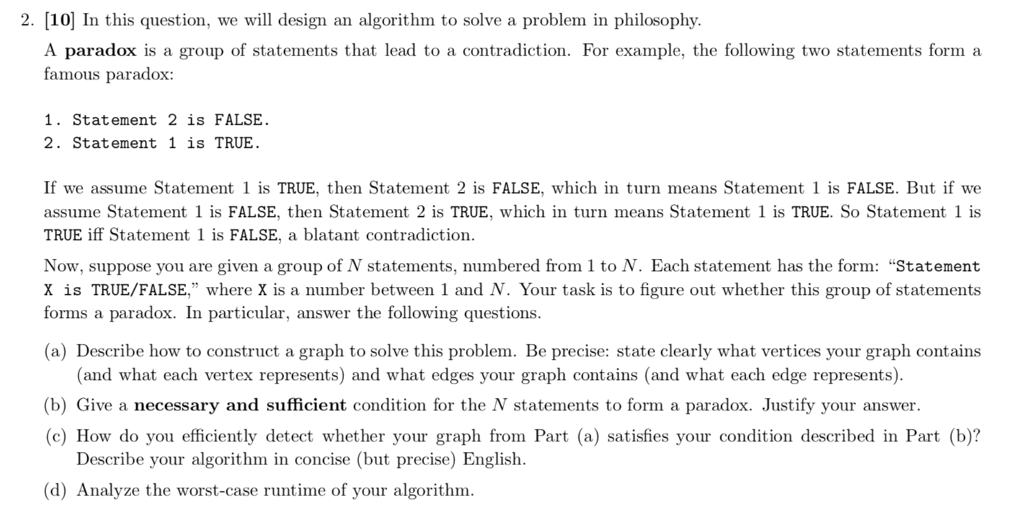
2. [10 In this question, we will design an algorithm to solve a problem in philosophy A paradox is a group of statements that lead to a contradiction. For example, the following two statements form a famous paradox: 1. Statement 2 is FALSE 2. Statement 1 is TRUE If we assume Statement 1 is TRUE, then Statement 2 is FALSE, which in turn means Statement 1 is FALSE. But if we assume Statement 1 is FALSE, then Statement 2 is TRUE, which in turn means Statement is TRUE. So Statement l is TRUE iff Statement 1 is FALSE, a blatant contradiction Now, suppose you are given a group of N statements, numbered from 1 to N. Each statement has the for: "Statement X is TRUE/FALSE," where X is a number between 1 and N. Your task is to figure out whether this group of statements forms a paradox. In particular, answer the following questions (a) Describe how to construct a graph to solve this problem. Be precise: state clearly what vertices your graph contains (and what each vertex represents) and what edges your graph contains (and what each edge represents) b) Give a necessary and sufficient condition for the N statements to form a paradox. Justify your answer. (c) How do you efficiently detect whether your graph from Part (a) satisfies your condition described in Part (b)? Describe your algorithm in concise (but precise) English. (d) Analyze the worst-case runtime of your algorithm
Step by Step Solution
There are 3 Steps involved in it

Get step-by-step solutions from verified subject matter experts
 Study Help