







Question: 2. (10 points) Consider the following computational problems: EQDFA = {(A,B) 1 A and B are DFAs and L(A) = L(B)) SUBDFA = {(A,B) |
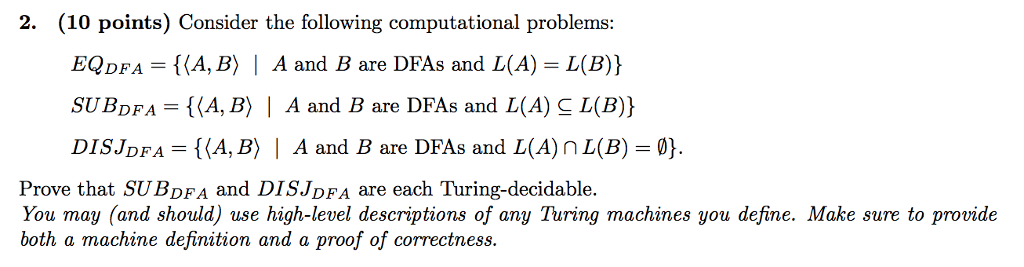
2. (10 points) Consider the following computational problems: EQDFA = {(A,B) 1 A and B are DFAs and L(A) = L(B)) SUBDFA = {(A,B) | A and B are DFAs and L(A) L(B)) DISJDFA-{(A, B) | A and B are DFAs and L(A) n L(B)-0} Prove that SUBDFA and DISJDFA are each Turing-decidable. You may (and should) use high-level descriptions of any Turing machines you define. Make sure to provide both a machine definition and a proof of correctness
Step by Step Solution
There are 3 Steps involved in it
1 Expert Approved Answer
Step: 1 Unlock

Question Has Been Solved by an Expert!
Get step-by-step solutions from verified subject matter experts
Step: 2 Unlock
Step: 3 Unlock
 Study Help