





Question: 2. [11 points} Consider the Potty Parity ease below and answer the three questions at the end of the case. In particular, for case question
2. [11" points} Consider the Potty Parity ease
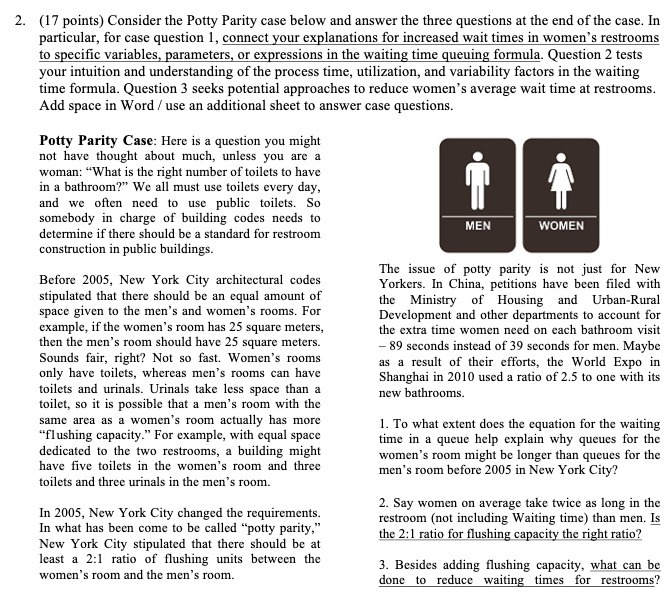
2. [11" points} Consider the Potty Parity ease below and answer the three questions at the end of the case. In particular, for case question 1, connect ur ex ianations for increased wait times in women's restrooms to s eeio variables arameters or ex ssions in the waitin time ueuin formula. Question 2 tests your intuition and understanding of the process timeI utilization, and variability factors in the waiting time formula. Question 3 seeks potential approaches to reduce womenls average wait time at restrooms. Add space in Word I use an additional sheet to answer ease questions. Potty Parity Case: Here is a question you might not have thought about much, unless you are a woman: \"What is the right number of toilets to have in a bathroom?" We all must use toilets every day, and we nen need to use public toilets. So somebody in charge of building codes needs to determine if there should be a standard for restroom construction in public buildings. Before 1905, New York City architectural codes stipulated that there should be an equal amount of space given to the men's and women's rooms. For example, if the women's room has 2.5 square meters, then the men's room should have 25 square meters. Sounds fair, right? Not so fast. 1|t'tl'nmen's rooms only have toilets,I whereas men's rooms can have toilets and urinals. Urinals take less space than a toilet, so it is possible that a men's room with the same area as a women's room actually has more \"flushing capacity." For example, with equal space dedicated to the two restrooms, a building might have five toilets in the women's room and three toilets and three urinals in the men's room. In EMS, New York City changed the requirements. In what has been come to be called "potty parity," New York City stipulated that there should be at least a 2:1 ratio of flushing units between the women's room and the men's room. The issue of potty parity is not just for New Yorkers. In China. petitions have been filed with the Ministry of Housing and Urban-Rural Development and other departments to account for the extra time women need on each bathroom visit 59 seconds instead of 39' seconds for min. Maybe as a result of their efforts, the World Expo in Shanghai in Ei used a ratio of 2.5 to one with its new bathrooms. 1. To what extent does the equation for the waiting time in a queue help explain why queues for the women's room might be longer than queues for the men's room before EMS in New York City? 2. Say women on average take twice as long in the restroom {not including 1'i'ait'ing time} than mll. I_s the 2:1 ratio for ushing capaeigg the right ratio? 3. Besides adding ushing capacity, what can be done to reduce waiting times for restrooms

Step by Step Solution

There are 3 Steps involved in it

1 Expert Approved Answer
Step: 1 Unlock blur-text-image

Question Has Been Solved by an Expert!

Get step-by-step solutions from verified subject matter experts

Step: 2 Unlock
Step: 3 Unlock

Students Have Also Explored These Related Mathematics Questions!