



Question: 2. (15 pts) Consider the following differential equation X(t) = 9-3-() Find the equilibrium points and assess their stability. Use the graphical methods presented in
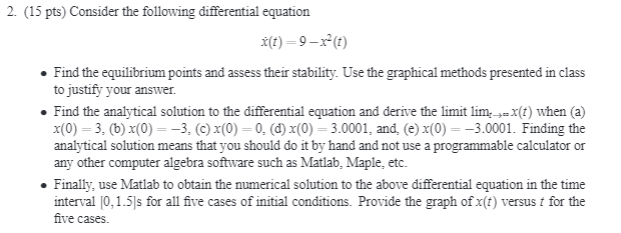
2. (15 pts) Consider the following differential equation X(t) = 9-3-() Find the equilibrium points and assess their stability. Use the graphical methods presented in class to justify your answer . Find the analytical solution to the differential equation and derive the limit lim. --X(t) when(a) x(0) = 3.6) x(0) = -3. C) x(0) = 0, (d) x(0) = 3.0001, and, (e) x(0) = -3.0001. Finding the analytical solution means that you should do it by hand and not use a programmable calculator or any other computer algebra software such as Matlab, Maple, etc. Finally, use Matlab to obtain the numerical solution to the above differential equation in the time interval [0,1.5]s for all five cases of initial conditions. Provide the graph of x(t) versust for the five cases. 2. (15 pts) Consider the following differential equation X(t) = 9-3-() Find the equilibrium points and assess their stability. Use the graphical methods presented in class to justify your answer . Find the analytical solution to the differential equation and derive the limit lim. --X(t) when(a) x(0) = 3.6) x(0) = -3. C) x(0) = 0, (d) x(0) = 3.0001, and, (e) x(0) = -3.0001. Finding the analytical solution means that you should do it by hand and not use a programmable calculator or any other computer algebra software such as Matlab, Maple, etc. Finally, use Matlab to obtain the numerical solution to the above differential equation in the time interval [0,1.5]s for all five cases of initial conditions. Provide the graph of x(t) versust for the five cases
Step by Step Solution
There are 3 Steps involved in it

Get step-by-step solutions from verified subject matter experts