







Question: 2 . 2 4 A free vibrations test is run to determine the stiffness and damping properties of an elastic element. A 2 0 -
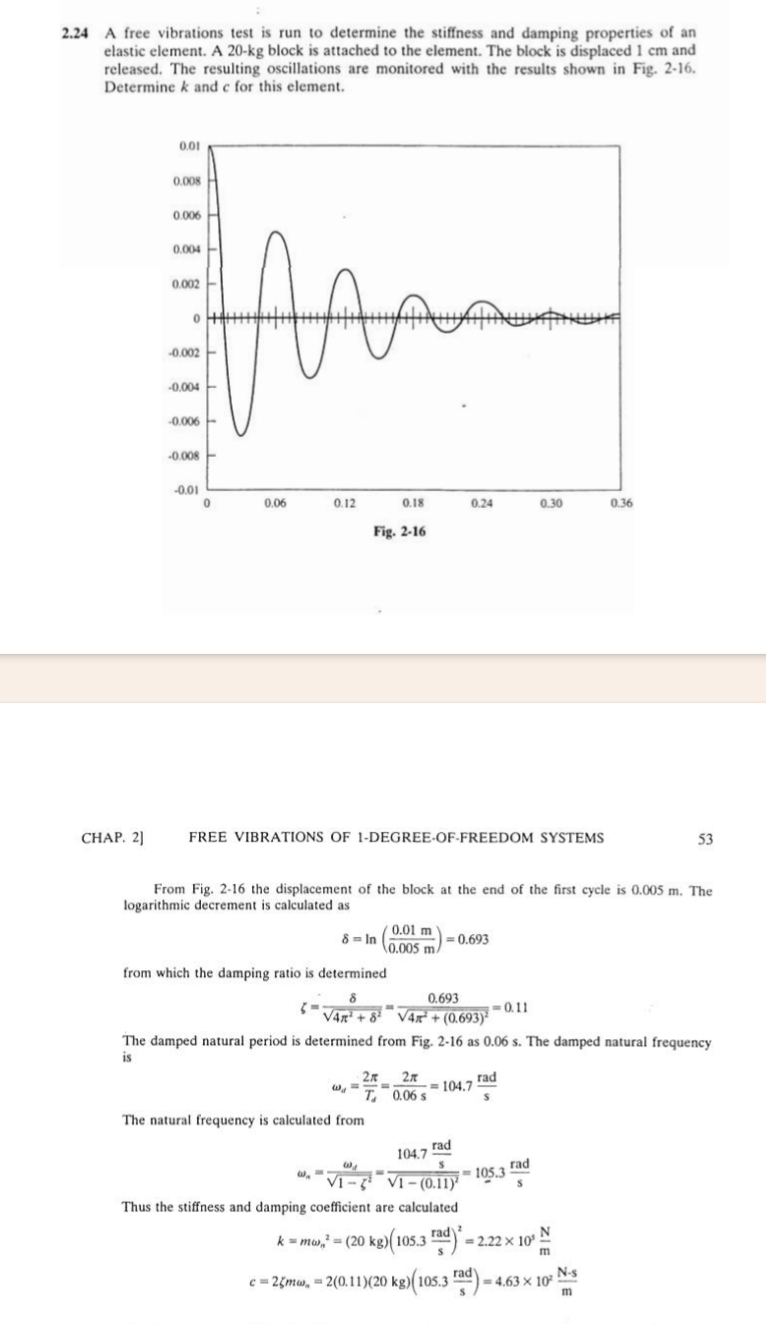
A free vibrations test is run to determine the stiffness and damping properties of an elastic element. A block is attached to the element. The block is displaced cm and released. The resulting oscillations are monitored with the results shown in Fig. Determine and for this element.
CHAP.
FREE VIBRATIONS OF DEGREEOFFREEDOM SYSTEMS
From Fig. the displacement of the block at the end of the first cycle is m The logarithmic decrement is calculated as
from which the damping ratio is determined
The damped natural period is determined from Fig. as s The damped natural frequency is
The natural frequency is calculated from
Thus the stiffness and damping coefficient are calculated
Step by Step Solution
There are 3 Steps involved in it
1 Expert Approved Answer
Step: 1 Unlock

Question Has Been Solved by an Expert!
Get step-by-step solutions from verified subject matter experts
Step: 2 Unlock
Step: 3 Unlock
 Study Help