







Question: 2 2 Let k > 2 be fixed and suppose you are given a matrix M whose columns consist of a single consecutive block of
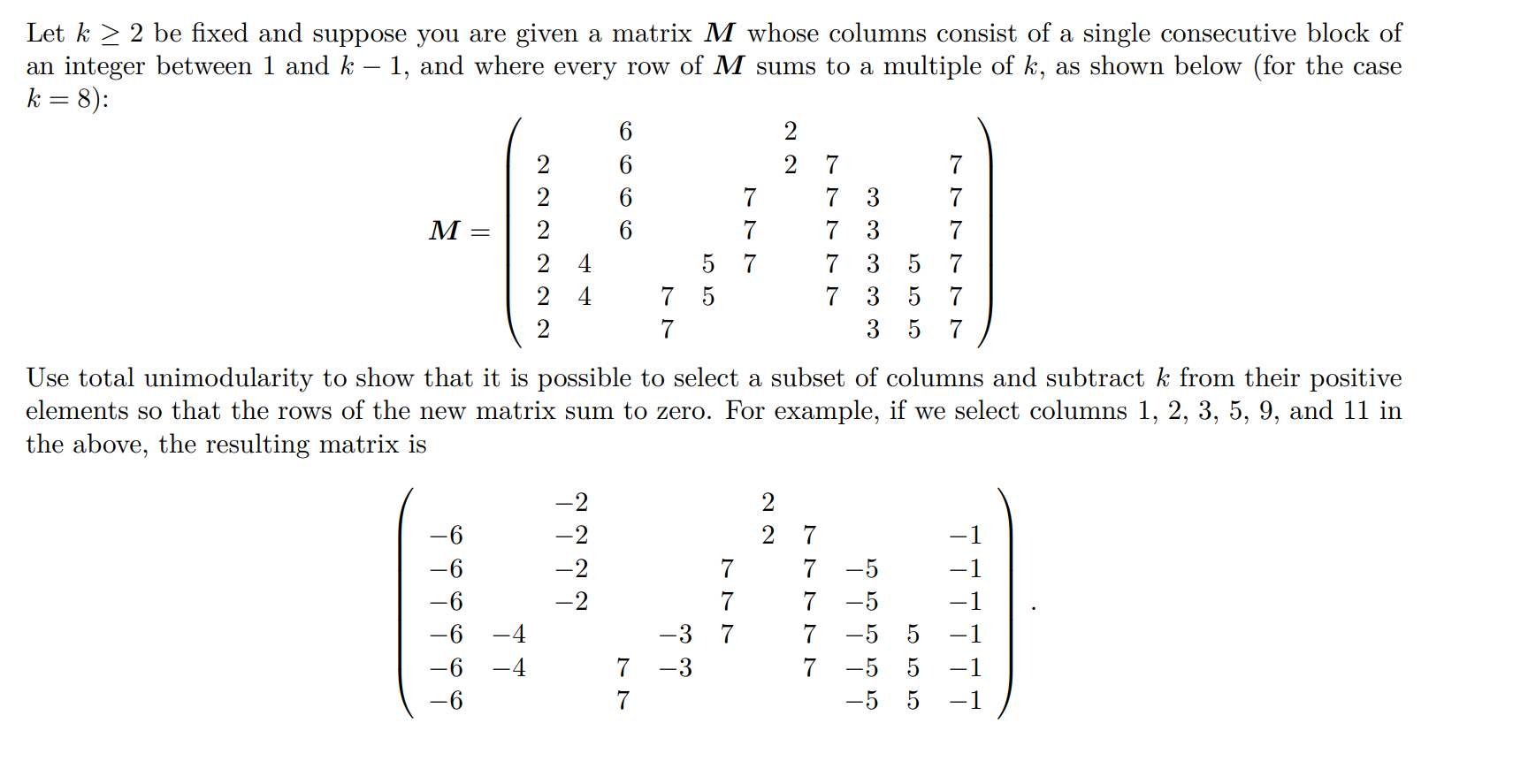
2 2 Let k > 2 be fixed and suppose you are given a matrix M whose columns consist of a single consecutive block of an integer between 1 and k 1, and where every row of M sums to a multiple of k, as shown below (for the case k=8): 6 2 7 7 2 7 3 7 M 6 2 4 7 3 5 4 3 5 7 2 7 5 7 6 7 2 7 7 3 7 5 7 7 2 7 5 7 3 Use total unimodularity to show that it is possible to select a subset of columns and subtract k from their positive elements so that the rows of the new matrix sum to zero. For example, if we select columns 1, 2, 3, 5, 9, and 11 in the above, the resulting matrix is -2 -2 -2 -6 2 27 7 7 7 7 -5 -5 7 7 -3 7 -3 -1 4 -6 -6 7 7 -5 -5 -1 -1 2 2 Let k > 2 be fixed and suppose you are given a matrix M whose columns consist of a single consecutive block of an integer between 1 and k 1, and where every row of M sums to a multiple of k, as shown below (for the case k=8): 6 2 7 7 2 7 3 7 M 6 2 4 7 3 5 4 3 5 7 2 7 5 7 6 7 2 7 7 3 7 5 7 7 2 7 5 7 3 Use total unimodularity to show that it is possible to select a subset of columns and subtract k from their positive elements so that the rows of the new matrix sum to zero. For example, if we select columns 1, 2, 3, 5, 9, and 11 in the above, the resulting matrix is -2 -2 -2 -6 2 27 7 7 7 7 -5 -5 7 7 -3 7 -3 -1 4 -6 -6 7 7 -5 -5 -1 -1
Step by Step Solution
There are 3 Steps involved in it

Get step-by-step solutions from verified subject matter experts
 Study Help