







Question: 2. [26 marks] Let X = (X1, X2, . .., X,) be i.i.d. observations, each from a Poisson distribution: f(ylx) = e() . X/ (y!),
![2. [26 marks] Let X = (X1, X2, . .., X,)](https://s3.amazonaws.com/si.experts.images/answers/2024/07/66880a1c487c0_51666880a1c256f3.jpg)
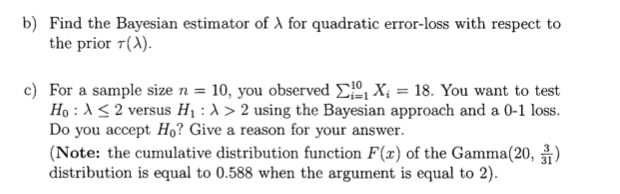
2. [26 marks] Let X = (X1, X2, . .., X,) be i.i.d. observations, each from a Poisson distribution: f(ylx) = e() . X/ (y!), y = 0, 1, 2, . .., A>0. The prior on A is believed to be Gamma(2,3). (Note that, for any values of a > 0, > 0, the density of the Gamma(a, 3) distribution is given by T ( X ) = . xo-exp(-X/B) , > > 0; else and [(a) = foe *x* 'dx is the Gamma function with the property D'(o + 1) = al(a).) a) Find the posterior density h()|X) of A given X = (X1, X2, . .., Xn). Show that, like the prior, the posterior density is also a member of the Gamma family.b) Find the Bayesian estimator of A for quadratic error-loss with respect to the prior T(A). c) For a sample size n = 10, you observed C X, = 18. You want to test Ho : A > 2 using the Bayesian approach and a 0-1 loss. Do you accept Ho? Give a reason for your answer. (Note: the cumulative distribution function F(x) of the Gamma(20, ) distribution is equal to 0.588 when the argument is equal to 2)
Step by Step Solution
There are 3 Steps involved in it

Get step-by-step solutions from verified subject matter experts
 Study Help