







Question: Continue with the same setup as for Question 4. However, for this problem we are assuming asymptotic results. Let X = (X1, X2, . ..,
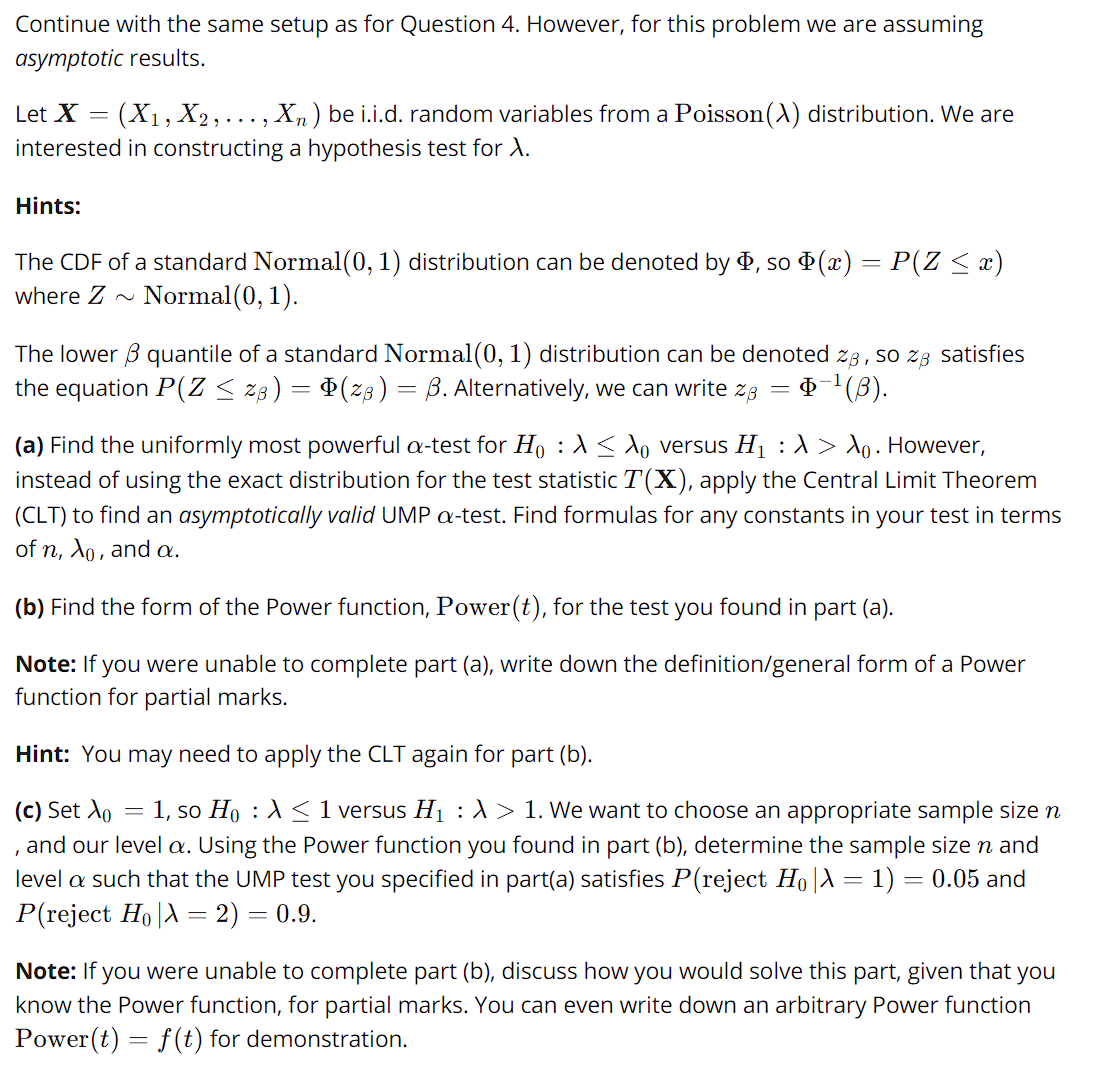
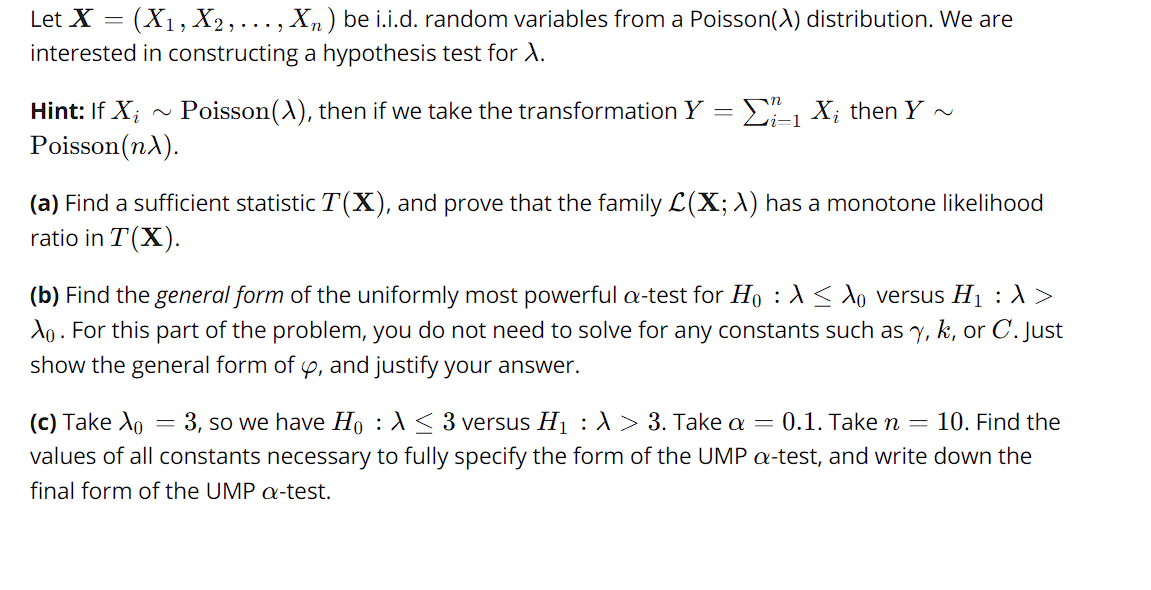
Continue with the same setup as for Question 4. However, for this problem we are assuming asymptotic results. Let X = (X1, X2, . .., Xn ) be i.i.d. random variables from a Poisson ()) distribution. We are interested in constructing a hypothesis test for 1. Hints: The CDF of a standard Normal(0, 1) distribution can be denoted by , so (x) = P(Z > do. However, instead of using the exact distribution for the test statistic T(X), apply the Central Limit Theorem (CLT) to find an asymptotically valid UMP o-test. Find formulas for any constants in your test in terms of n, do, and a. (b) Find the form of the Power function, Power(t), for the test you found in part (a). Note: If you were unable to complete part (a), write down the definition/general form of a Power function for partial marks. Hint: You may need to apply the CLT again for part (b). (c) Set do = 1, so Ho : ) > 1. We want to choose an appropriate sample size n , and our level a. Using the Power function you found in part (b), determine the sample size n and level o such that the UMP test you specified in part(a) satisfies P(reject Ho |) = 1) = 0.05 and P(reject Hold = 2) = 0.9. Note: If you were unable to complete part (b), discuss how you would solve this part, given that you know the Power function, for partial marks. You can even write down an arbitrary Power function Power(t) = f(t) for demonstration.Let X = (X1, X2, . .., Xn ) be i.i.d. random variables from a Poisson()) distribution. We are interested in constructing a hypothesis test for 1. Hint: If Xi ~ Poisson()), then if we take the transformation Y = _ X; then Y~ Poisson (nd). (a) Find a sufficient statistic T(X), and prove that the family C(X; ) ) has a monotone likelihood ratio in T(X). (b) Find the general form of the uniformly most powerful a-test for Ho : > > do. For this part of the problem, you do not need to solve for any constants such as y, k, or C. Just show the general form of 4, and justify your answer. (c) Take Ao = 3, so we have Ho : > > 3. Take a = 0.1. Taken = 10. Find the values of all constants necessary to fully specify the form of the UMP o-test, and write down the final form of the UMP a-test
Step by Step Solution
There are 3 Steps involved in it

Get step-by-step solutions from verified subject matter experts
 Study Help