



Question: 2. (28 points) Decision with an externality The representative consumer has preferences given by U(C, L) = log(C) + y log(==) over consumption C and
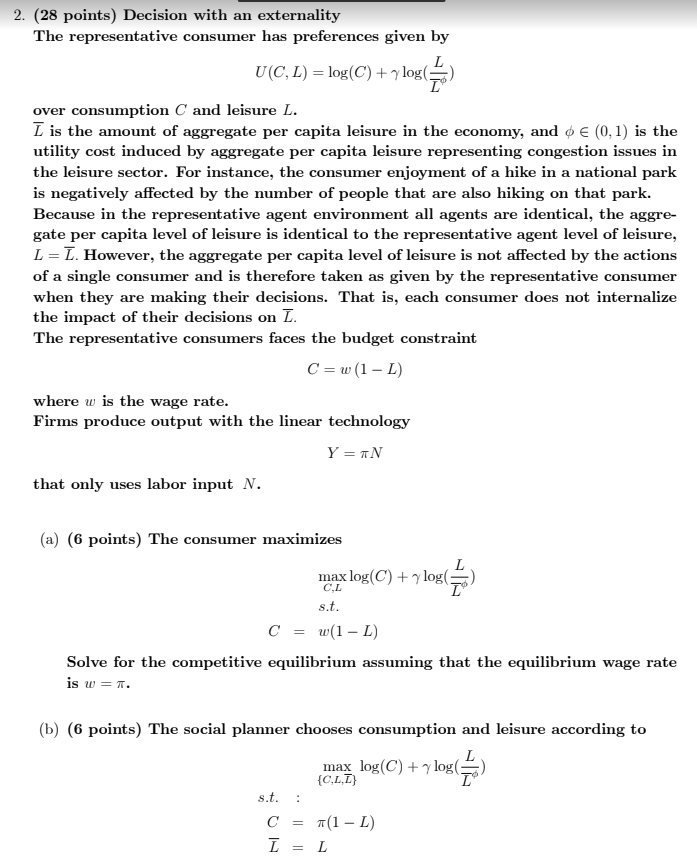
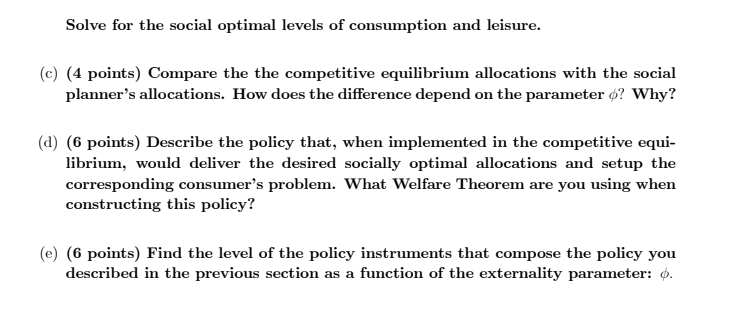
2. (28 points) Decision with an externality The representative consumer has preferences given by U(C, L) = log(C) + y log(==) over consumption C and leisure L. I is the amount of aggregate per capita leisure in the economy, and (0,1) is the utility cost induced by aggregate per capita leisure representing congestion issues in the leisure sector. For instance, the consumer enjoyment of a hike in a national park is negatively affected by the number of people that are also hiking on that park. Because in the representative agent environment all agents are identical, the aggre- gate per capita level of leisure is identical to the representative agent level of leisure, L = L. However, the aggregate per capita level of leisure is not affected by the actions of a single consumer and is therefore taken as given by the representative consume when they are making their decisions. That is, each consumer does not internalize the impact of their decisions on L. The representative consumers faces the budget constraint where wis the wage rate. C = w(1-L) Firms produce output with the linear technology Y = N that only uses labor input N. (a) (6 points) The consumer maximizes max log(C) + log(: C,L s.t. C = w(1-L) Solve for the competitive equilibrium assuming that the equilibrium wage rate is w = T. (b) (6 points) The social planner chooses consumption and leisure according to (1) max log(C) + log(- {C,L,T} s.t. C : = = (1 - L) L Solve for the social optimal levels of consumption and leisure. (c) (4 points) Compare the the competitive equilibrium allocations with the social planner's allocations. How does the difference depend on the parameter 6? Why? (d) (6 points) Describe the policy that, when implemented in the competitive equi- librium, would deliver the desired socially optimal allocations and setup the corresponding consumer's problem. What Welfare Theorem are you using when constructing this policy? (e) (6 points) Find the level of the policy instruments that compose the policy you described in the previous section as a function of the externality parameter: 6
Step by Step Solution
There are 3 Steps involved in it

Get step-by-step solutions from verified subject matter experts