







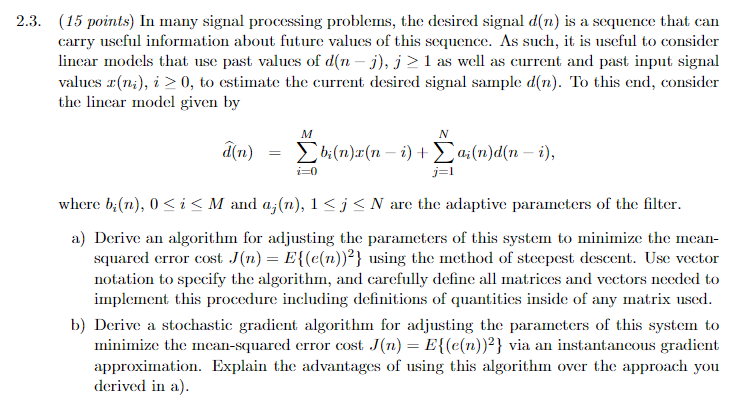
Question: 2 . 3 . ( 1 5 points ) In many signal processing problems, the desired signal d ( n ) is a sequence that
points In many signal processing problems, the desired signal is a sequence that can
carry useful information about future values of this sequence. such, it is useful to consider
linear models that use past values of as well as current and past input signal
values to estimate the current desired signal sample To this end, consider
the linear model given by
widehat
where and are the adaptive parameters of the filter.
a Derive an algorithm for adjusting the parameters of this system to minimize the mean
squared error cost using the method of steepest descent. Use vector
notation to specify the algorithm, and carefully define all matrices and vectors needed to
implement this procedure including definitions of quantities inside of any matrix used.
b Derive a stochastic gradient algorithm for adjusting the parameters of this system to
minimize the meansquared error cost via an instantancous gradient
approximation. Explain the advantages of using this algorithm over the approach you
derived in a
Step by Step Solution
There are 3 Steps involved in it
1 Expert Approved Answer
Step: 1 Unlock

Question Has Been Solved by an Expert!
Get step-by-step solutions from verified subject matter experts
Step: 2 Unlock
Step: 3 Unlock
 Study Help