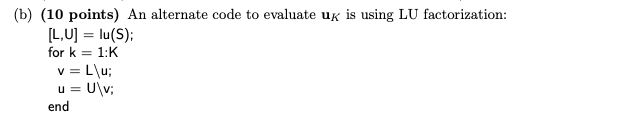
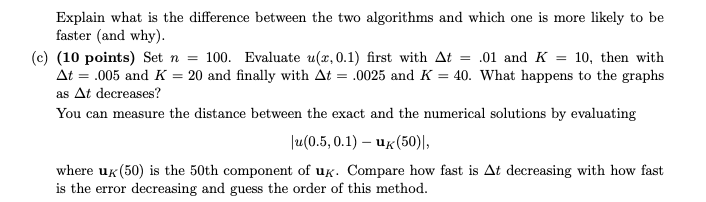
Question: 2. (30 points) The numerical algorithms you learned in this class can be used to solve all kinds of prob- lems. In this problem, I
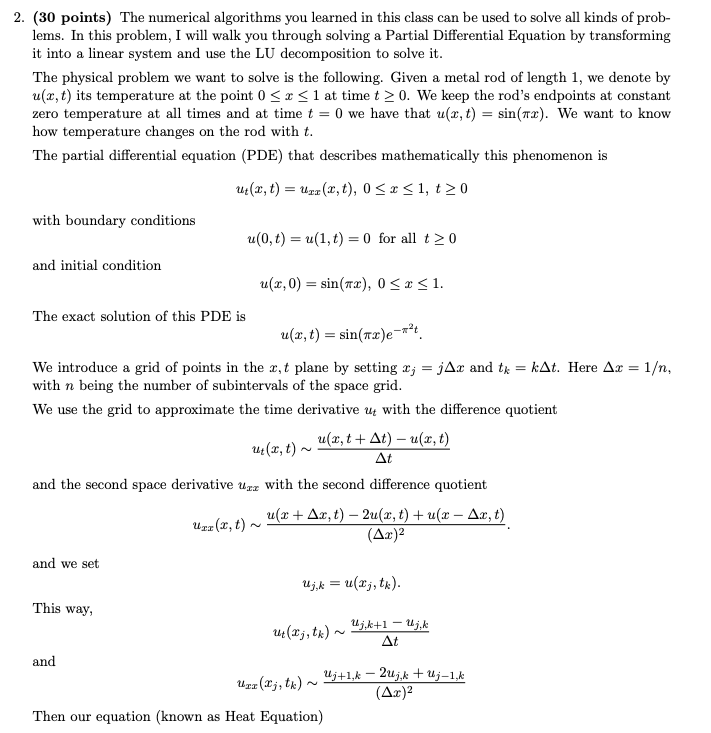
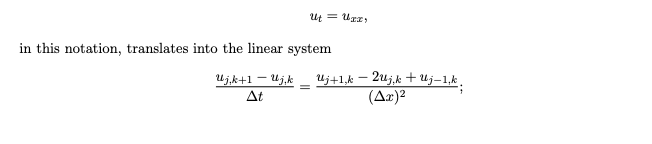
2. (30 points) The numerical algorithms you2. (30 points) The numerical algorithms you2. (30 points) The numerical algorithms you2. (30 points) The numerical algorithms you2. (30 points) The numerical algorithms you

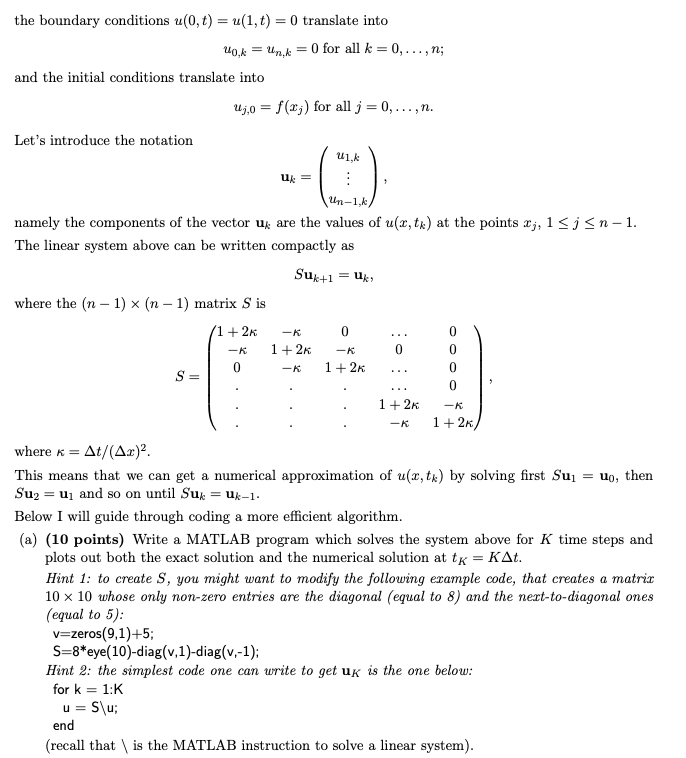
2. (30 points) The numerical algorithms you learned in this class can be used to solve all kinds of prob- lems. In this problem, I will walk you through solving a Partial Differential Equation by transforming it into a linear system and use the LU decomposition to solve it. The physical problem we want to solve is the following. Given a metal rod of length 1, we denote by u(x,t) its temperature at the point 0 0. We keep the rod's endpoints at constant zero temperature at all times and at time t = 0 we have that u(x, t) = sin(Tu). We want to know how temperature changes on the rod with t. The partial differential equation (PDE) that describes mathematically this phenomenon is ut(x, t) = Upx(x,t), O SI 0 with boundary conditions u(0,t) = u(1,t) = 0 for all t > 0 and initial condition u(x,0) = sin(T2), 0 0. We keep the rod's endpoints at constant zero temperature at all times and at time t = 0 we have that u(x, t) = sin(Tu). We want to know how temperature changes on the rod with t. The partial differential equation (PDE) that describes mathematically this phenomenon is ut(x, t) = Upx(x,t), O SI 0 with boundary conditions u(0,t) = u(1,t) = 0 for all t > 0 and initial condition u(x,0) = sin(T2), 0
Step by Step Solution

There are 3 Steps involved in it

1 Expert Approved Answer
Step: 1 Unlock blur-text-image

Question Has Been Solved by an Expert!

Get step-by-step solutions from verified subject matter experts

Step: 2 Unlock
Step: 3 Unlock

Students Have Also Explored These Related General Management Questions!