







Question: 2. (36 points) Consider a dispatchable electricity generation technology and an intermittent renewable generation technology. The 2 technologies have the following characteristics: Dispatchable Renewable Technology
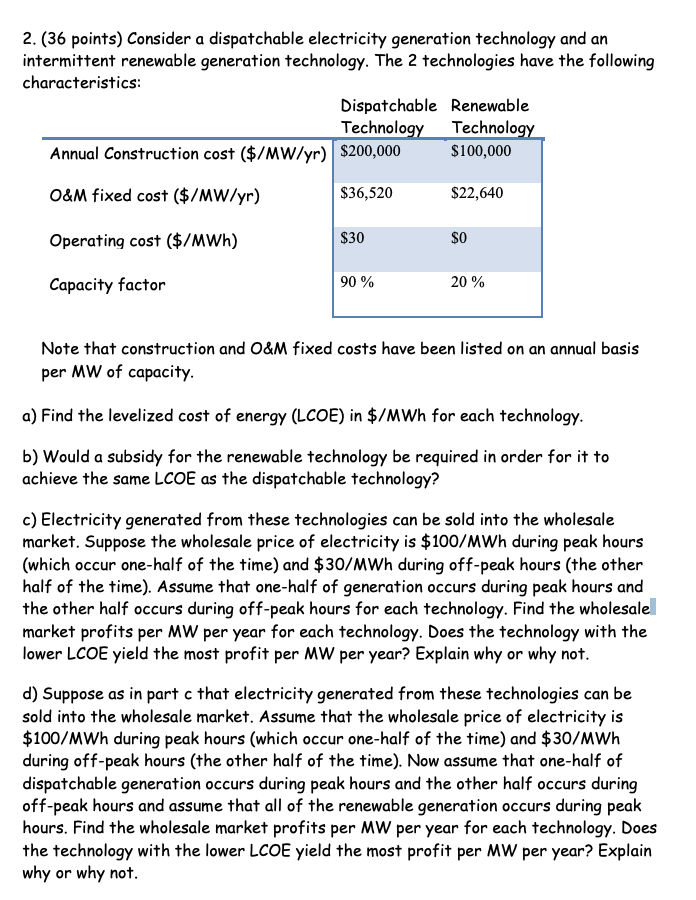
2. (36 points) Consider a dispatchable electricity generation technology and an intermittent renewable generation technology. The 2 technologies have the following characteristics: Dispatchable Renewable Technology Technology Annual Construction cost ($/MW/yr) $200,000 $100,000 O&M fixed cost ($/MW/yr) $36,520 $22,640 Operating cost ($/MWh) $30 $0 Capacity factor 90 % 20 % Note that construction and O&M fixed costs have been listed on an annual basis per MW of capacity. a) Find the levelized cost of energy (LCOE) in $/MWh for each technology. b) Would a subsidy for the renewable technology be required in order for it to achieve the same LCOE as the dispatchable technology? c) Electricity generated from these technologies can be sold into the wholesale market. Suppose the wholesale price of electricity is $100/MWh during peak hours (which occur one-half of the time) and $30/MWh during off-peak hours (the other half of the time). Assume that one-half of generation occurs during peak hours and the other half occurs during off-peak hours for each technology. Find the wholesale market profits per MW per year for each technology. Does the technology with the lower LCOE yield the most profit per MW per year? Explain why or why not. d) Suppose as in part c that electricity generated from these technologies can be sold into the wholesale market. Assume that the wholesale price of electricity is $100/MWh during peak hours (which occur one-half of the time) and $30/MWh during off-peak hours (the other half of the time). Now assume that one-half of dispatchable generation occurs during peak hours and the other half occurs during off-peak hours and assume that all of the renewable generation occurs during peak hours. Find the wholesale market profits per MW per year for each technology. Does the technology with the lower LCOE yield the most profit per MW per year? Explain why or why not 2. (36 points) Consider a dispatchable electricity generation technology and an intermittent renewable generation technology. The 2 technologies have the following characteristics: Dispatchable Renewable Technology Technology Annual Construction cost ($/MW/yr) $200,000 $100,000 O&M fixed cost ($/MW/yr) $36,520 $22,640 Operating cost ($/MWh) $30 $0 Capacity factor 90 % 20 % Note that construction and O&M fixed costs have been listed on an annual basis per MW of capacity. a) Find the levelized cost of energy (LCOE) in $/MWh for each technology. b) Would a subsidy for the renewable technology be required in order for it to achieve the same LCOE as the dispatchable technology? c) Electricity generated from these technologies can be sold into the wholesale market. Suppose the wholesale price of electricity is $100/MWh during peak hours (which occur one-half of the time) and $30/MWh during off-peak hours (the other half of the time). Assume that one-half of generation occurs during peak hours and the other half occurs during off-peak hours for each technology. Find the wholesale market profits per MW per year for each technology. Does the technology with the lower LCOE yield the most profit per MW per year? Explain why or why not. d) Suppose as in part c that electricity generated from these technologies can be sold into the wholesale market. Assume that the wholesale price of electricity is $100/MWh during peak hours (which occur one-half of the time) and $30/MWh during off-peak hours (the other half of the time). Now assume that one-half of dispatchable generation occurs during peak hours and the other half occurs during off-peak hours and assume that all of the renewable generation occurs during peak hours. Find the wholesale market profits per MW per year for each technology. Does the technology with the lower LCOE yield the most profit per MW per year? Explain why or why not
Step by Step Solution
There are 3 Steps involved in it

Get step-by-step solutions from verified subject matter experts
 Study Help