



Question: 2. (40 points) Consider a clerk at a checkout counter that serves customers on average at a rate of 2 per minute when no one
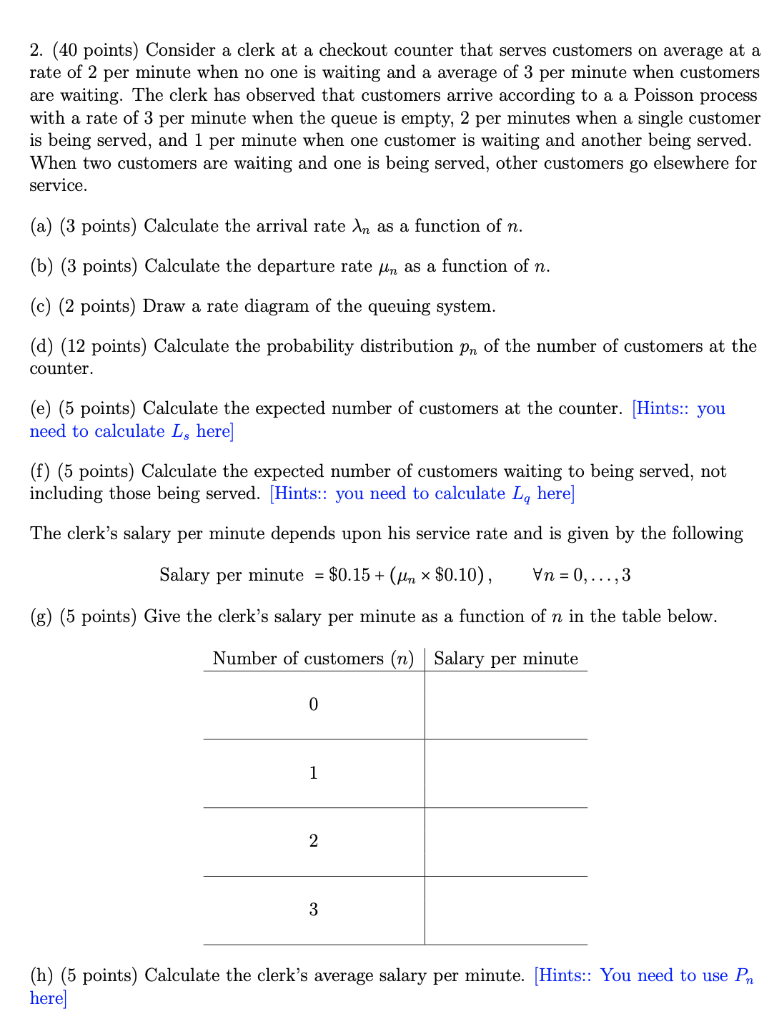
2. (40 points) Consider a clerk at a checkout counter that serves customers on average at a rate of 2 per minute when no one is waiting and a average of 3 per minute when customers are waiting. The clerk has observed that customers arrive according to a a Poisson process with a rate of 3 per minute when the queue is empty, 2 per minutes when a single customer is being served, and 1 per minute when one customer is waiting and another being served. When two customers are waiting and one is being served, other customers go elsewhere for service. (a) (3 points) Calculate the arrival rate n as a function of n. (b) (3 points) Calculate the departure rate n as a function of n. (c) (2 points) Draw a rate diagram of the queuing system. (d) (12 points) Calculate the probability distribution pn of the number of customers at the counter. (e) (5 points) Calculate the expected number of customers at the counter. [Hints:: you need to calculate Ls here] (f) (5 points) Calculate the expected number of customers waiting to being served, not including those being served. [Hints:: you need to calculate Lq here] The clerk's salary per minute depends upon his service rate and is given by the following Salary per minute =$0.15+(n$0.10),n=0,,3 (g) (5 points) Give the clerk's salary per minute as a function of n in the table below. (h) (5 points) Calculate the clerk's average salary per minute. [Hints:: You need to use Pn here] 2. (40 points) Consider a clerk at a checkout counter that serves customers on average at a rate of 2 per minute when no one is waiting and a average of 3 per minute when customers are waiting. The clerk has observed that customers arrive according to a a Poisson process with a rate of 3 per minute when the queue is empty, 2 per minutes when a single customer is being served, and 1 per minute when one customer is waiting and another being served. When two customers are waiting and one is being served, other customers go elsewhere for service. (a) (3 points) Calculate the arrival rate n as a function of n. (b) (3 points) Calculate the departure rate n as a function of n. (c) (2 points) Draw a rate diagram of the queuing system. (d) (12 points) Calculate the probability distribution pn of the number of customers at the counter. (e) (5 points) Calculate the expected number of customers at the counter. [Hints:: you need to calculate Ls here] (f) (5 points) Calculate the expected number of customers waiting to being served, not including those being served. [Hints:: you need to calculate Lq here] The clerk's salary per minute depends upon his service rate and is given by the following Salary per minute =$0.15+(n$0.10),n=0,,3 (g) (5 points) Give the clerk's salary per minute as a function of n in the table below. (h) (5 points) Calculate the clerk's average salary per minute. [Hints:: You need to use Pn here]
Step by Step Solution
There are 3 Steps involved in it

Get step-by-step solutions from verified subject matter experts