







Question: 2. (40 points) Environmental properties. Characterize the environment for each of the following tasks, using the nine properties listed below (described in more detail on
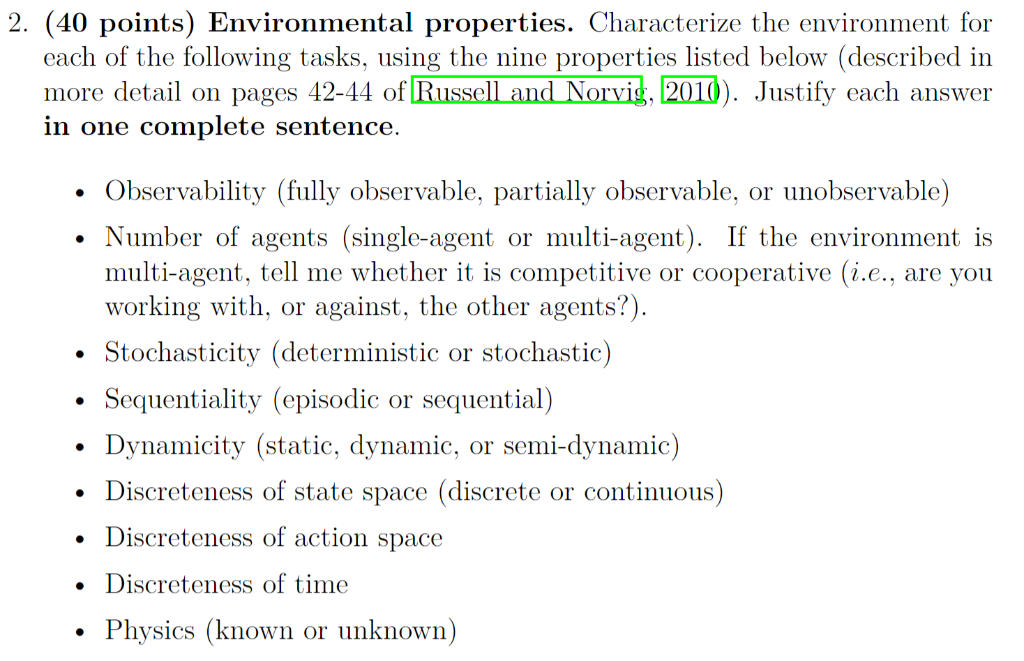

2. (40 points) Environmental properties. Characterize the environment for each of the following tasks, using the nine properties listed below (described in more detail on pages 42-44 of Russell and Norvis, 2010). Justify each answer n one complete sentence. . Observability (fully observable, partially observable, or unobservable) . Number of agents (single-agent or multi-agent). If the environment is multi-agent, tell me whether it is competitive or cooperative (i.e., are you working with, or against, the other agents? . Stochasticity (deterministic or stochastic) . Sequentiality (episodic or sequential) . Dynamicity (static, dynamic, or semi-dynamic) .Discreteness of state space (discrete or continuous) . Discreteness of action space . Discreteness of time . Physics (known or unknown) (d) (10 points, 5013 only) A machine-learning algorithm that analyzes microscope images of tissue and determines whether or not the tissue is diseased. The algorithm does not recommend a course of treatment or try to remediate the disease in any way; the algorithm merely predicts whether or not the tissue is diseased. 2. (40 points) Environmental properties. Characterize the environment for each of the following tasks, using the nine properties listed below (described in more detail on pages 42-44 of Russell and Norvis, 2010). Justify each answer n one complete sentence. . Observability (fully observable, partially observable, or unobservable) . Number of agents (single-agent or multi-agent). If the environment is multi-agent, tell me whether it is competitive or cooperative (i.e., are you working with, or against, the other agents? . Stochasticity (deterministic or stochastic) . Sequentiality (episodic or sequential) . Dynamicity (static, dynamic, or semi-dynamic) .Discreteness of state space (discrete or continuous) . Discreteness of action space . Discreteness of time . Physics (known or unknown) (d) (10 points, 5013 only) A machine-learning algorithm that analyzes microscope images of tissue and determines whether or not the tissue is diseased. The algorithm does not recommend a course of treatment or try to remediate the disease in any way; the algorithm merely predicts whether or not the tissue is diseased
Step by Step Solution
There are 3 Steps involved in it

Get step-by-step solutions from verified subject matter experts
 Study Help