







Question: 2. (40 pts) A central planner solves the household problem without introducing markets by explicitly considering the fact that Yt=Ct+It where It=Kt(1)Kt1, and the production
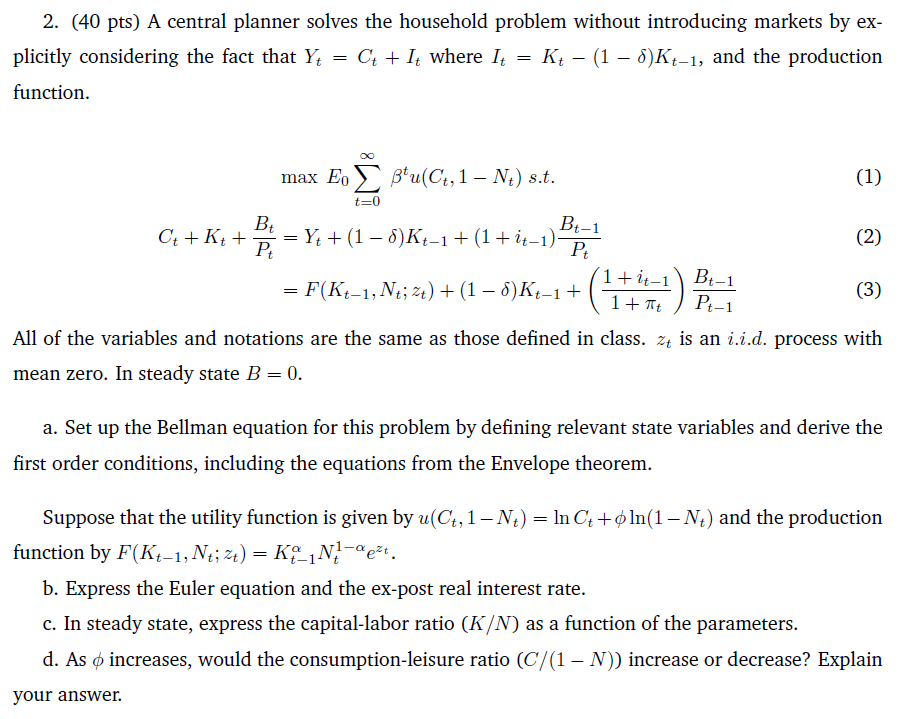
2. (40 pts) A central planner solves the household problem without introducing markets by explicitly considering the fact that Yt=Ct+It where It=Kt(1)Kt1, and the production function. maxE0t=0tu(Ct,1Nt) s.t. Ct+Kt+PtBt=Yt+(1)Kt1+(1+it1)PtBt1 =F(Kt1,Nt;zt)+(1)Kt1+(1+t1+it1)Pt1Bt1 All of the variables and notations are the same as those defined in class. zt is an i.i.d. process with mean zero. In steady state B=0. a. Set up the Bellman equation for this problem by defining relevant state variables and derive the first order conditions, including the equations from the Envelope theorem. Suppose that the utility function is given by u(Ct,1Nt)=lnCt+ln(1Nt) and the production function by F(Kt1,Nt;zt)=Kt1Nt1ezt. b. Express the Euler equation and the ex-post real interest rate. c. In steady state, express the capital-labor ratio (K/N) as a function of the parameters. d. As increases, would the consumption-leisure ratio (C/(1N)) increase or decrease? Explain your answer. 2. (40 pts) A central planner solves the household problem without introducing markets by explicitly considering the fact that Yt=Ct+It where It=Kt(1)Kt1, and the production function. maxE0t=0tu(Ct,1Nt) s.t. Ct+Kt+PtBt=Yt+(1)Kt1+(1+it1)PtBt1 =F(Kt1,Nt;zt)+(1)Kt1+(1+t1+it1)Pt1Bt1 All of the variables and notations are the same as those defined in class. zt is an i.i.d. process with mean zero. In steady state B=0. a. Set up the Bellman equation for this problem by defining relevant state variables and derive the first order conditions, including the equations from the Envelope theorem. Suppose that the utility function is given by u(Ct,1Nt)=lnCt+ln(1Nt) and the production function by F(Kt1,Nt;zt)=Kt1Nt1ezt. b. Express the Euler equation and the ex-post real interest rate. c. In steady state, express the capital-labor ratio (K/N) as a function of the parameters. d. As increases, would the consumption-leisure ratio (C/(1N)) increase or decrease? Explain your
Step by Step Solution
There are 3 Steps involved in it

Get step-by-step solutions from verified subject matter experts
 Study Help