



Question: 2. [40pts. Two non-bonded atoms interact by what is called van der Waals force. When the two atoms are a distance o apart, the van
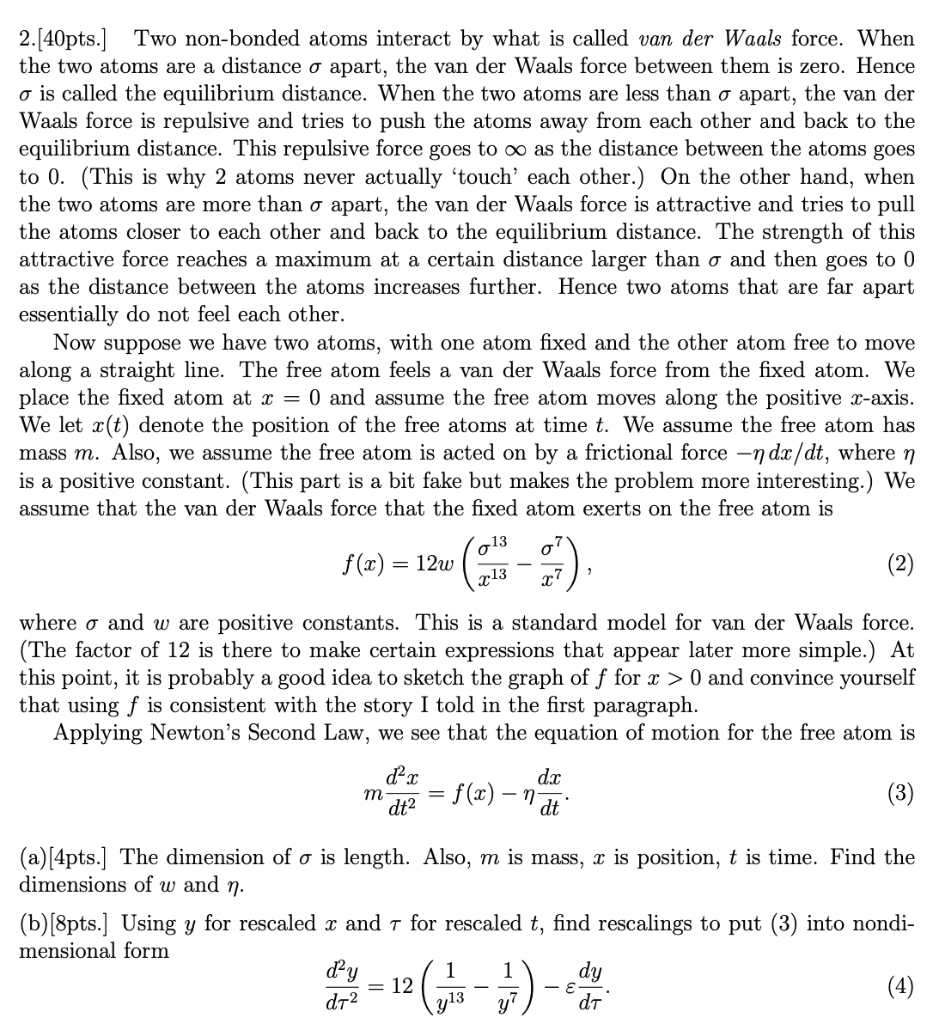
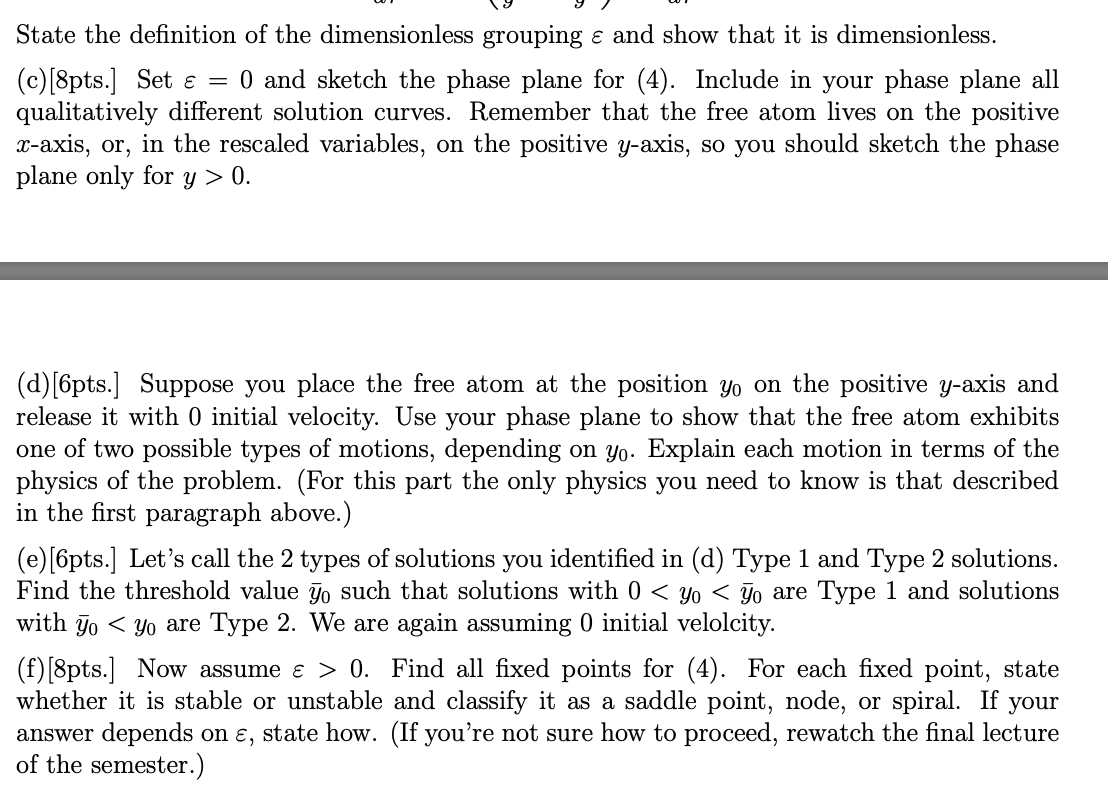
2. [40pts. Two non-bonded atoms interact by what is called van der Waals force. When the two atoms are a distance o apart, the van der Waals force between them is zero. Hence o is called the equilibrium distance. When the two atoms are less than o apart, the van der Waals force is repulsive and tries to push the atoms away from each other and back to the equilibrium distance. This repulsive force goes to oo as the distance between the atoms goes to 0. (This is why 2 atoms never actually 'touch' each other.) On the other hand, when the two atoms are more than o apart, the van der Waals force is attractive and tries to pull the atoms closer to each other and back to the equilibrium distance. The strength of this attractive force reaches a maximum at a certain distance larger than o and then goes to 0 as the distance between the atoms increases further. Hence two atoms that are far apart essentially do not feel each other. Now suppose we have two atoms, with one atom fixed and the other atom free to move along a straight line. The free atom feels a van der Waals force from the fixed atom. We place the fixed atom at x = 0 and assume the free atom moves along the positive x-axis. We let x(t) denote the position of the free atoms at time t. We assume the free atom has mass m. Also, we assume the free atom is acted on by a frictional force -n dx/dt, where n is a positive constant. (This part is a bit fake but makes the problem more interesting.) We assume that the van der Waals force that the fixed atom exerts on the free atom is f(x) = 12w (2) where o and w are positive constants. This is a standard model for van der Waals force. (The factor of 12 is there to make certain expressions that appear later more simple.) At this point, it is probably a good idea to sketch the graph of f for x > 0 and convince yourself that using f is consistent with the story I told in the first paragraph. Applying Newton's Second Law, we see that the equation of motion for the free atom is dec m dt2 dr f(x) m dt (3) (a)[4pts.] The dimension of o is length. Also, m is mass, x is position, t is time. Find the dimensions of w and n. (b)[8pts.] Using y for rescaled x and 7 for rescaled t, find rescalings to put (3) into nondi- mensional form day dy = 12 dT2 (4) dt - E State the definition of the dimensionless grouping and show that it is dimensionless. (C)[8pts.] Set = 0 and sketch the phase plane for (4). Include in your phase plane all qualitatively different solution curves. Remember that the free atom lives on the positive x-axis, or, in the rescaled variables, on the positive y-axis, so you should sketch the phase plane only for y>0. (d)[6pts.] Suppose you place the free atom at the position yo on the positive y-axis and release it with O initial velocity. Use your phase plane to show that the free atom exhibits one of two possible types of motions, depending on yo. Explain each motion in terms of the physics of the problem. (For this part the only physics you need to know is that described in the first paragraph above.) (e)[6pts.] Let's call the 2 types of solutions you identified in (d) Type 1 and Type 2 solutions. Find the threshold value yo such that solutions with 0 0. Find all fixed points for (4). For each fixed point, state whether it is stable or unstable and classify it as a saddle point, node, or spiral. If your answer depends on e, state how. (If you're not sure how to proceed, rewatch the final lecture of the semester.) 2. [40pts. Two non-bonded atoms interact by what is called van der Waals force. When the two atoms are a distance o apart, the van der Waals force between them is zero. Hence o is called the equilibrium distance. When the two atoms are less than o apart, the van der Waals force is repulsive and tries to push the atoms away from each other and back to the equilibrium distance. This repulsive force goes to oo as the distance between the atoms goes to 0. (This is why 2 atoms never actually 'touch' each other.) On the other hand, when the two atoms are more than o apart, the van der Waals force is attractive and tries to pull the atoms closer to each other and back to the equilibrium distance. The strength of this attractive force reaches a maximum at a certain distance larger than o and then goes to 0 as the distance between the atoms increases further. Hence two atoms that are far apart essentially do not feel each other. Now suppose we have two atoms, with one atom fixed and the other atom free to move along a straight line. The free atom feels a van der Waals force from the fixed atom. We place the fixed atom at x = 0 and assume the free atom moves along the positive x-axis. We let x(t) denote the position of the free atoms at time t. We assume the free atom has mass m. Also, we assume the free atom is acted on by a frictional force -n dx/dt, where n is a positive constant. (This part is a bit fake but makes the problem more interesting.) We assume that the van der Waals force that the fixed atom exerts on the free atom is f(x) = 12w (2) where o and w are positive constants. This is a standard model for van der Waals force. (The factor of 12 is there to make certain expressions that appear later more simple.) At this point, it is probably a good idea to sketch the graph of f for x > 0 and convince yourself that using f is consistent with the story I told in the first paragraph. Applying Newton's Second Law, we see that the equation of motion for the free atom is dec m dt2 dr f(x) m dt (3) (a)[4pts.] The dimension of o is length. Also, m is mass, x is position, t is time. Find the dimensions of w and n. (b)[8pts.] Using y for rescaled x and 7 for rescaled t, find rescalings to put (3) into nondi- mensional form day dy = 12 dT2 (4) dt - E State the definition of the dimensionless grouping and show that it is dimensionless. (C)[8pts.] Set = 0 and sketch the phase plane for (4). Include in your phase plane all qualitatively different solution curves. Remember that the free atom lives on the positive x-axis, or, in the rescaled variables, on the positive y-axis, so you should sketch the phase plane only for y>0. (d)[6pts.] Suppose you place the free atom at the position yo on the positive y-axis and release it with O initial velocity. Use your phase plane to show that the free atom exhibits one of two possible types of motions, depending on yo. Explain each motion in terms of the physics of the problem. (For this part the only physics you need to know is that described in the first paragraph above.) (e)[6pts.] Let's call the 2 types of solutions you identified in (d) Type 1 and Type 2 solutions. Find the threshold value yo such that solutions with 0 0. Find all fixed points for (4). For each fixed point, state whether it is stable or unstable and classify it as a saddle point, node, or spiral. If your answer depends on e, state how. (If you're not sure how to proceed, rewatch the final lecture of the semester.)
Step by Step Solution
There are 3 Steps involved in it

Get step-by-step solutions from verified subject matter experts