







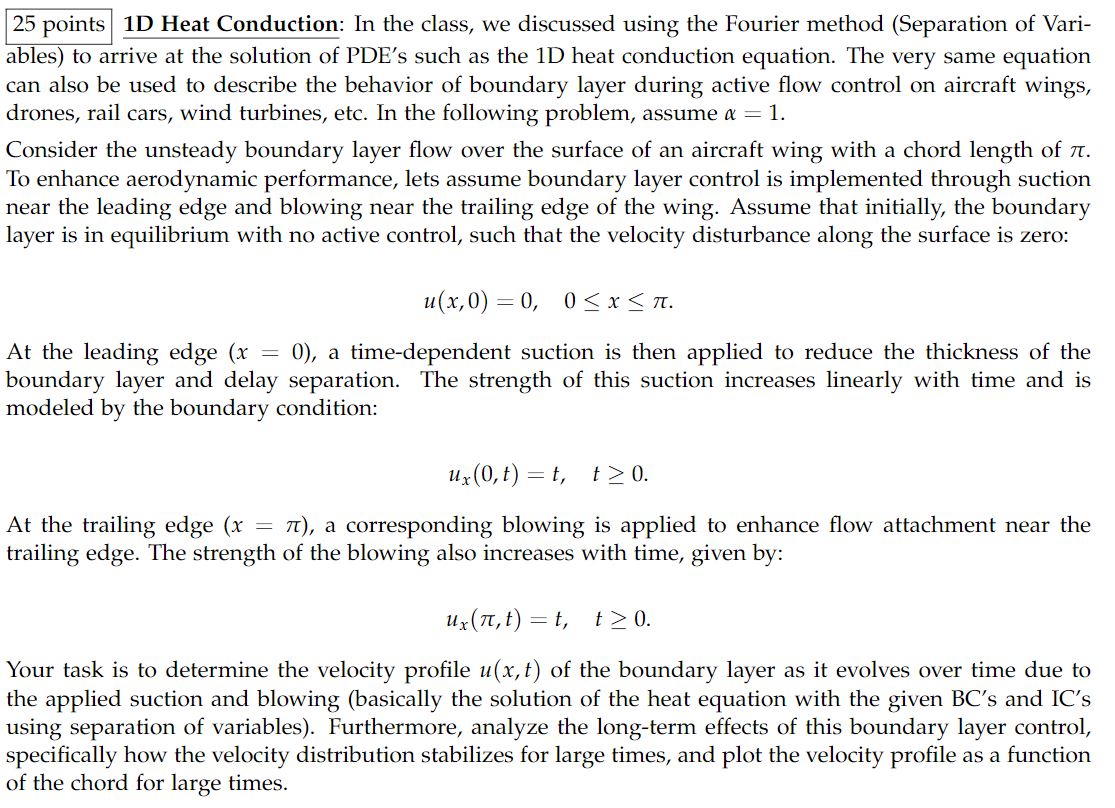
Question: 2 5 points 1 D Heat Conduction: In the class, we discussed using the Fourier method ( Separation of Vari - ables ) to arrive
points D Heat Conduction: In the class, we discussed using the Fourier method Separation of Vari
ables to arrive at the solution of PDE's such as the D heat conduction equation. The very same equation
can also be used to describe the behavior of boundary layer during active flow control on aircraft wings,
drones, rail cars, wind turbines, etc. In the following problem, assume
Consider the unsteady boundary layer flow over the surface of an aircraft wing with a chord length of
To enhance aerodynamic performance, lets assume boundary layer control is implemented through suction
near the leading edge and blowing near the trailing edge of the wing. Assume that initially, the boundary
layer is in equilibrium with no active control, such that the velocity disturbance along the surface is zero:
At the leading edge a timedependent suction is then applied to reduce the thickness of the
boundary layer and delay separation. The strength of this suction increases linearly with time and is
modeled by the boundary condition:
At the trailing edge a corresponding blowing is applied to enhance flow attachment near the
trailing edge. The strength of the blowing also increases with time, given by:
Your task is to determine the velocity profile of the boundary layer as it evolves over time due to
the applied suction and blowing basically the solution of the heat equation with the given BCs and IC's
using separation of variables Furthermore, analyze the longterm effects of this boundary layer control,
specifically how the velocity distribution stabilizes for large times, and plot the velocity profile as a function
of the chord for large times.
Step by Step Solution
There are 3 Steps involved in it
1 Expert Approved Answer
Step: 1 Unlock

Question Has Been Solved by an Expert!
Get step-by-step solutions from verified subject matter experts
Step: 2 Unlock
Step: 3 Unlock
 Study Help