







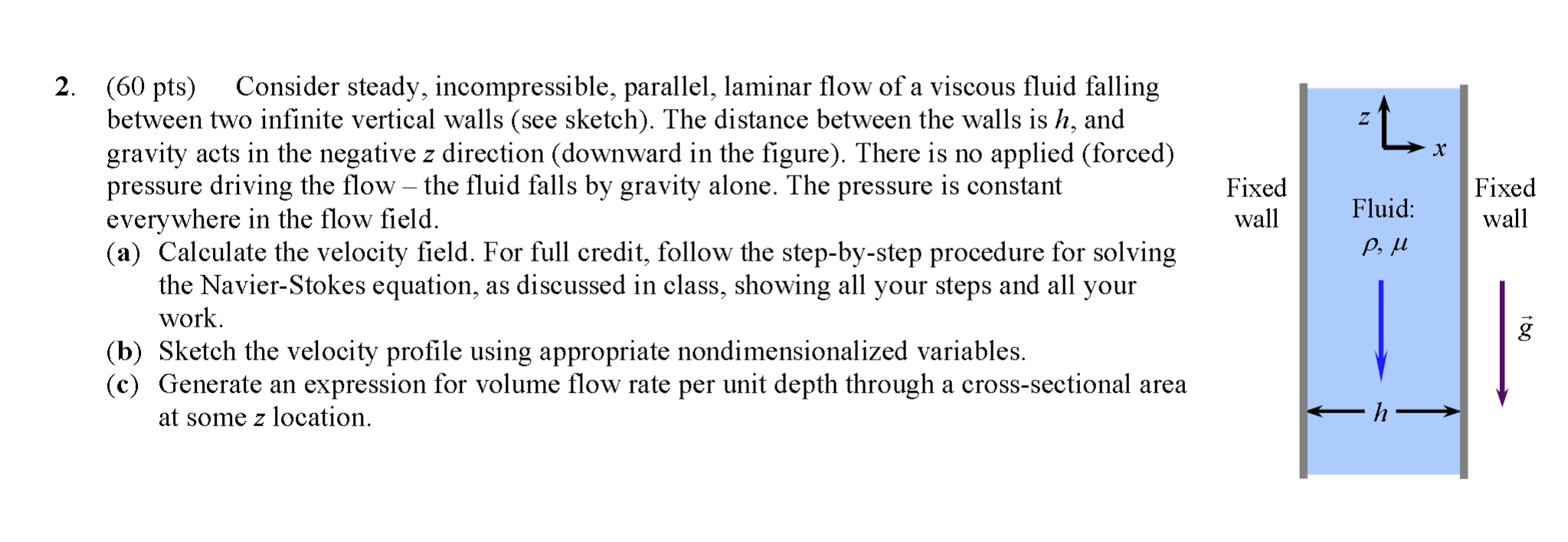
Question: 2 . ( 6 0 pts ) Consider steady, incompressible, parallel, laminar flow of a viscous fluid falling between two infinite vertical walls ( see
pts Consider steady, incompressible, parallel, laminar flow of a viscous fluid falling between two infinite vertical walls see sketch The distance between the walls is h and gravity acts in the negative z direction downward in the figure There is no applied forced pressure driving the flow the fluid falls by gravity alone. The pressure is constant everywhere in the flow field.
a Calculate the velocity field. For full credit, follow the stepbystep procedure for solving the NavierStokes equation, as discussed in class, showing all your steps and all your work.
b Sketch the velocity profile using appropriate nondimensionalized variables.
c Generate an expression for volume flow rate per unit depth through a crosssectional area at some z location.
Step by Step Solution
There are 3 Steps involved in it
1 Expert Approved Answer
Step: 1 Unlock

Question Has Been Solved by an Expert!
Get step-by-step solutions from verified subject matter experts
Step: 2 Unlock
Step: 3 Unlock
 Study Help