







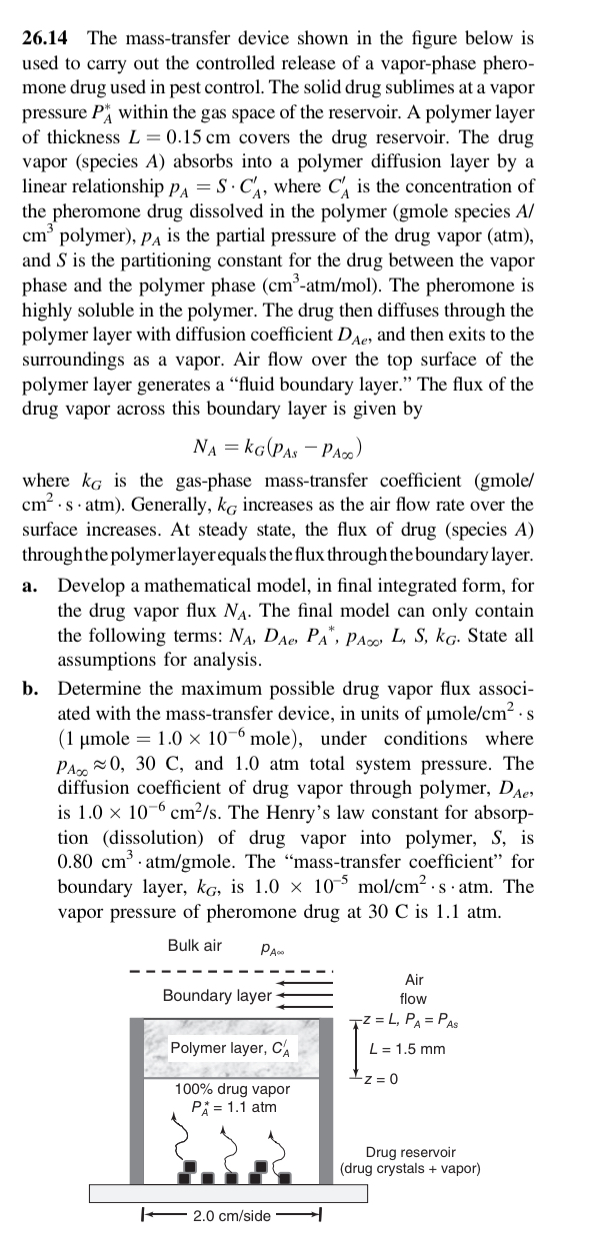
Question: 2 6 . 1 4 The mass - transfer device shown in the figure below is used to carry out the controlled release of a
The masstransfer device shown in the figure below is
used to carry out the controlled release of a vaporphase phero
mone drug used in pest control. The solid drug sublimes at a vapor
pressure within the gas space of the reservoir. A polymer layer
of thickness covers the drug reservoir. The drug
vapor species absorbs into a polymer diffusion layer by a
linear relationship where is the concentration of
the pheromone drug dissolved in the polymer gmole species
polymer is the partial pressure of the drug vapor atm
and is the partitioning constant for the drug between the vapor
phase and the polymer phase The pheromone is
highly soluble in the polymer. The drug then diffuses through the
polymer layer with diffusion coefficient and then exits to the
surroundings as a vapor. Air flow over the top surface of the
polymer layer generates a "fluid boundary layer." The flux of the
drug vapor across this boundary layer is given by
where is the gasphase masstransfer coefficient gmole
Generally, increases as the air flow rate over the
surface increases. At steady state, the flux of drug species
through the polymer layer equals the flux through the boundary layer.
a Develop a mathematical model, in final integrated form, for
the drug vapor flux The final model can only contain
the following terms: State all
assumptions for analysis.
b Determine the maximum possible drug vapor flux associ
ated with the masstransfer device, in units of
mole mole
Step by Step Solution
There are 3 Steps involved in it
1 Expert Approved Answer
Step: 1 Unlock

Question Has Been Solved by an Expert!
Get step-by-step solutions from verified subject matter experts
Step: 2 Unlock
Step: 3 Unlock
 Study Help