







Question: 2 A (20 points) / (1, 1 ) y(X) A function y(x) runs from the origin (x = 0,y = 0) to a point (x
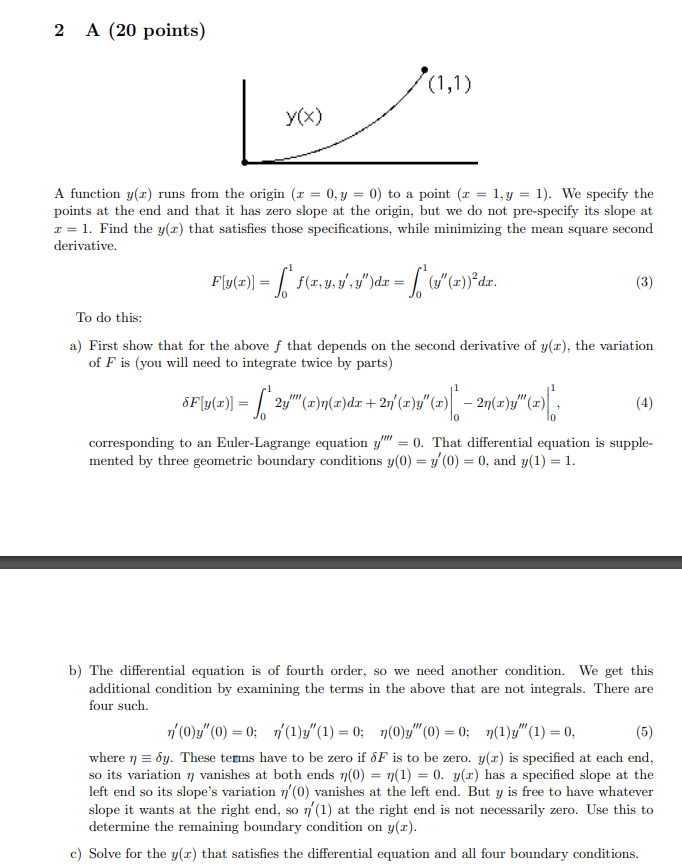
2 A (20 points) / (1, 1 ) y(X) A function y(x) runs from the origin (x = 0,y = 0) to a point (x = 1,y = 1). We specify the points at the end and that it has zero slope at the origin, but we do not pre-specify its slope at r = 1. Find the y(x) that satisfies those specifications, while minimizing the mean square second derivative. Fly(z)] = f(zy. y ,y)da = [ ("(2)) dz. (3) To do this: a) First show that for the above f that depends on the second derivative of y(r), the variation of F is (you will need to integrate twice by parts) "Fly(x)] = 2y"(x)(x)da + 27) (x)y"(2) - 20(2)"(2) (4) corresponding to an Euler-Lagrange equation ?" = 0. That differential equation is supple- mented by three geometric boundary conditions y(0) = y (0) = 0, and y(1) = 1. b) The differential equation is of fourth order, so we need another condition. We get this additional condition by examining the terms in the above that are not integrals. There are four such. 7/'(0)y"(0) = 0; 7(1)y"(1) =0; n(0)y"(0) =0; n(1)y"(1) =0. (5) where n = dy. These terms have to be zero if of is to be zero. y(r) is specified at each end, so its variation 7 vanishes at both ends 7(0) = 7(1) = 0. y(x) has a specified slope at the left end so its slope's variation 7'(0) vanishes at the left end. But y is free to have whatever slope it wants at the right end, so 7 (1) at the right end is not necessarily zero. Use this to determine the remaining boundary condition on y(r). c) Solve for the y(r) that satisfies the differential equation and all four boundary conditions
Step by Step Solution
There are 3 Steps involved in it

Get step-by-step solutions from verified subject matter experts
 Study Help