







Question: 2 . ( a ) A jet hits a stationary car body at a speed ( mathrm { V } _ {
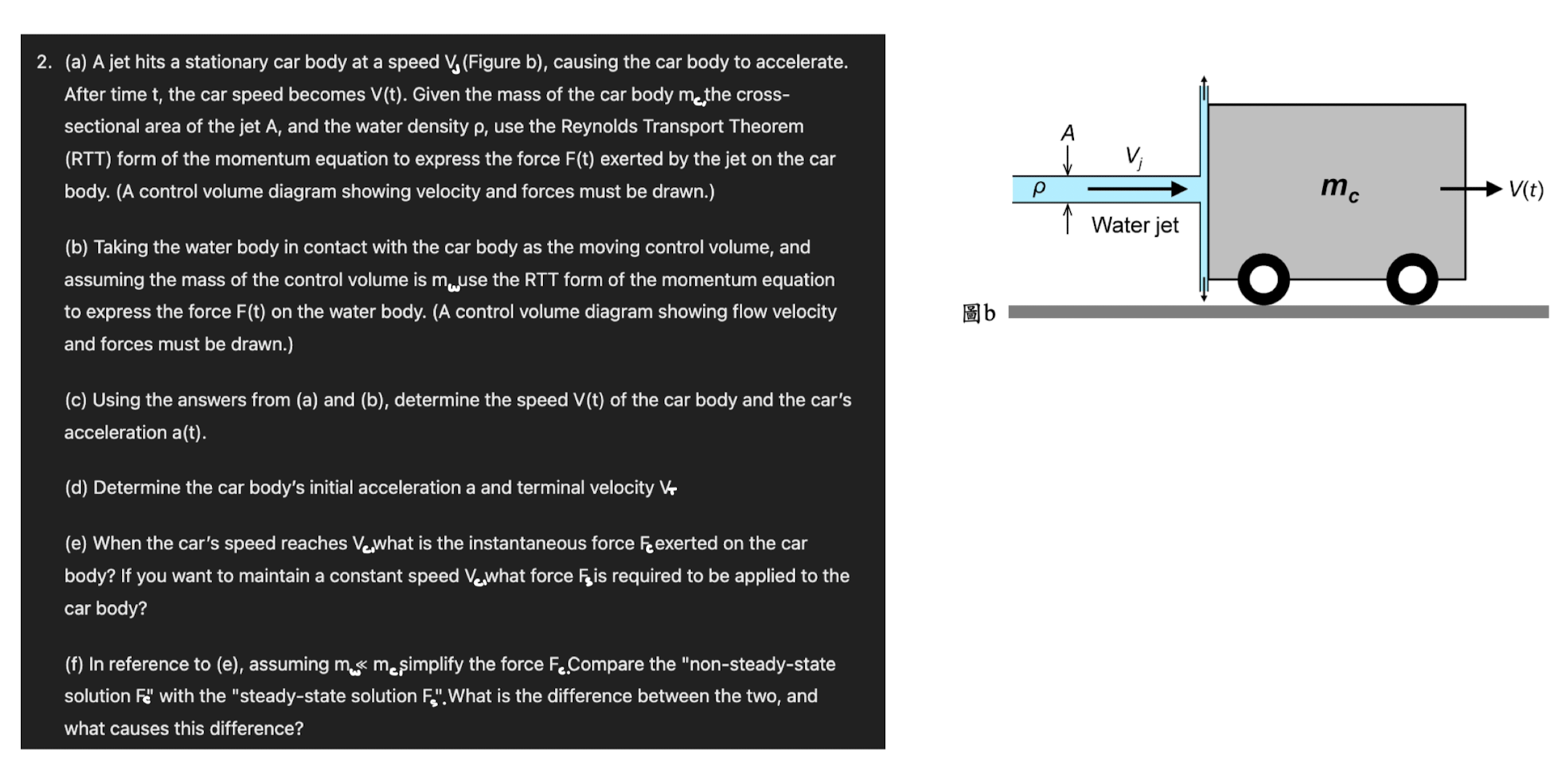
a A jet hits a stationary car body at a speed mathrmVmathrmJFigure b causing the car body to accelerate. After time t the car speed becomes mathrmVmathrmt Given the mass of the car body mathrmmmathrme the crosssectional area of the jet A and the water density rho use the Reynolds Transport Theorem RTT form of the momentum equation to express the force Ft exerted by the jet on the car body. A control volume diagram showing velocity and forces must be drawn.
b Taking the water body in contact with the car body as the moving control volume, and assuming the mass of the control volume is mathrmmboldsymbolomega use the RTT form of the momentum equation to express the force Ft on the water body. A control volume diagram showing flow velocity and forces must be drawn.
c Using the answers from a and b determine the speed mathrmVmathrmt of the car body and the car's acceleration mathrmamathrmt
d Determine the car body's initial acceleration a and terminal velocity mathrmVboldsymbolsim
e When the car's speed reaches Vmathbfc what is the instantaneous force mathrmFmathrme exerted on the car body? If you want to maintain a constant speed Vc what force Fs is required to be applied to the car body?
f In reference to e assuming mathrmmmathbfwmathrmmmathbfctext simplify the force mathrmFmathrme Compare the "nonsteadystate solution Fe with the "steadystate solution mathrmFmathrms What is the difference between the two, and what causes this difference?
Step by Step Solution
There are 3 Steps involved in it
1 Expert Approved Answer
Step: 1 Unlock

Question Has Been Solved by an Expert!
Get step-by-step solutions from verified subject matter experts
Step: 2 Unlock
Step: 3 Unlock
 Study Help