





Question: (2) (a) Let v = (-1, -2,3). Find a vector of magnitude 4 in the opposite direction as v. (b) Determine k, if possible, such
(2) (a) Let v = (-1, -2,3). Find a vector of
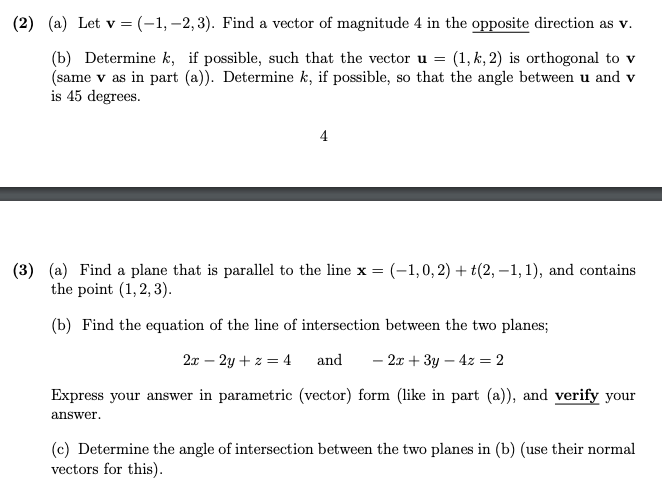
(2) (a) Let v = (-1, -2,3). Find a vector of magnitude 4 in the opposite direction as v. (b) Determine k, if possible, such that the vector u = (1, k, 2) is orthogonal to v (same v as in part (a)). Determine k, if possible, so that the angle between u and v is 45 degrees. 4 (3) (a) Find a plane that is parallel to the line x = (-1, 0,2) + t(2, -1, 1), and contains the point (1, 2, 3). (b) Find the equation of the line of intersection between the two planes; 2x - 2y + z =4 and - 2x + 3y - 4z = 2 Express your answer in parametric (vector) form (like in part (a)), and verify your answer. (c) Determine the angle of intersection between the two planes in (b) (use their normal vectors for this)

Step by Step Solution

There are 3 Steps involved in it

1 Expert Approved Answer
Step: 1 Unlock blur-text-image

Question Has Been Solved by an Expert!

Get step-by-step solutions from verified subject matter experts

Step: 2 Unlock
Step: 3 Unlock

Students Have Also Explored These Related Mathematics Questions!