







Question: 2. (a) Let X be a continuous random variable taking values in (a, b) where a ( RU {-co} and be RU foo}. (This simply
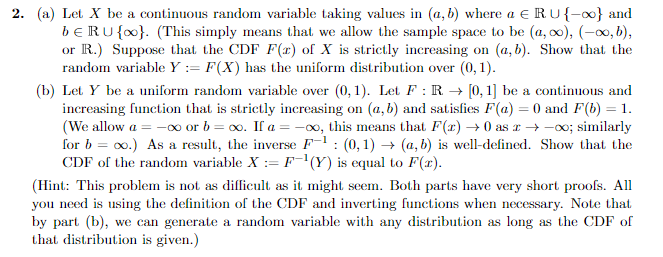
2. (a) Let X be a continuous random variable taking values in (a, b) where a ( RU {-co} and be RU foo}. (This simply means that we allow the sample space to be (a, co), (-0o, b), or .) Suppose that the CDF F(a) of X is strictly increasing on (a, b). Show that the random variable Y := F(X ) has the uniform distribution over (0, 1). (b) Let Y be a uniform random variable over (0, 1). Let F : R -> [0, 1] be a continuous and increasing function that is strictly increasing on (a, b) and satisfies F(a) =0 and F(b) = 1. (We allow a = -co or b = co. If a = -co, this means that F(a) -> 0 as > > -co; similarly for b = co.) As a result, the inverse F- : (0, 1) -> (a, b) is well-defined. Show that the CDF of the random variable X := F-(Y) is equal to F(a). (Hint: This problem is not as difficult as it might seem. Both parts have very short proofs. All you need is using the definition of the CDF and inverting functions when necessary. Note that by part (b), we can generate a random variable with any distribution as long as the CDF of that distribution is given.)
Step by Step Solution
There are 3 Steps involved in it

Get step-by-step solutions from verified subject matter experts
 Study Help