







Question: 2 . A manager is trying to decide whether to purchase a certain part or to have it produced internally. Internal production could use either
A manager is trying to decide whether to purchase a certain part or to have it produced
internally. Internal production could use either of two processes. One would entail a
variable cost of $ per unit and an annual fixed cost of $; the other would entail
a variable cost of $ per unit and an annual fixed cost of $ Three vendors are
willing to provide the part. Vendor A has a price of $ per unit for any volume up to
units. Vendor B has a price of $ per unit for demand of units or less, and
$ per unit for larger quantities. Vendor C offers a price of $ per unit for the first
units, and $ per unit for additional units. a If the manager anticipates an annual volume of units, which alternative
would be best from a cost standpoint? For units, which alternative would
be best?
b Determine the range for which each alternative is best. Are there any alternatives
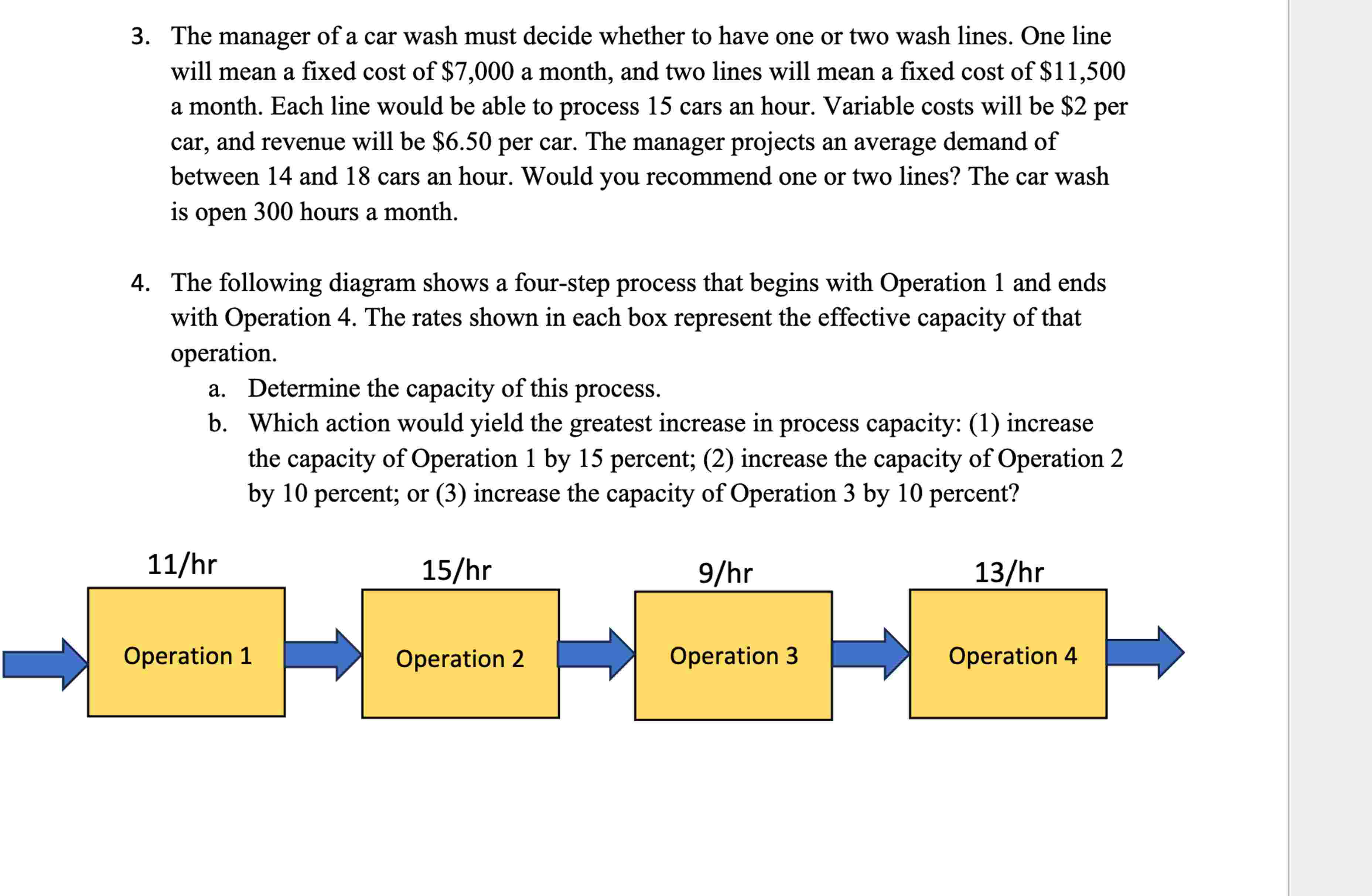
that are never best? Which? The following diagram shows a fourstep process that begins with Operation and ends
with Operation The rates shown in each box represent the effective capacity of that
operation.
a Determine the capacity of this process.
b Which action would yield the greatest increase in process capacity: increase
the capacity of Operation by percent; increase the capacity of Operation
by percent; or increase the capacity of Operation by percent?
The manager of a car wash must decide whether to have one or two wash lines. One line
will mean a fixed cost of $ a month, and two lines will mean a fixed cost of $
a month. Each line would be able to process cars an hour. Variable costs will be $ per
car, and revenue will be $ per car. The manager projects an average demand of
between and cars an hour. Would you recommend one or two lines? The car wash
is open hours a month.
The following diagram shows a fourstep process that begins with Operation and ends
with Operation The rates shown in each box represent the effective capacity of that
operation.
a Determine the capacity of this process.
b Which action would yield the greatest increase in process capacity: increase
the capacity of Operation by percent; increase the capacity of Operation
by percent; or increase the capacity of Operation by percent?
Step by Step Solution
There are 3 Steps involved in it
1 Expert Approved Answer
Step: 1 Unlock

Question Has Been Solved by an Expert!
Get step-by-step solutions from verified subject matter experts
Step: 2 Unlock
Step: 3 Unlock
 Study Help