



Question: 2. A market has a demand function Q=125P. This market has an established firm (A) that can produce at unit cost 5, and a potential
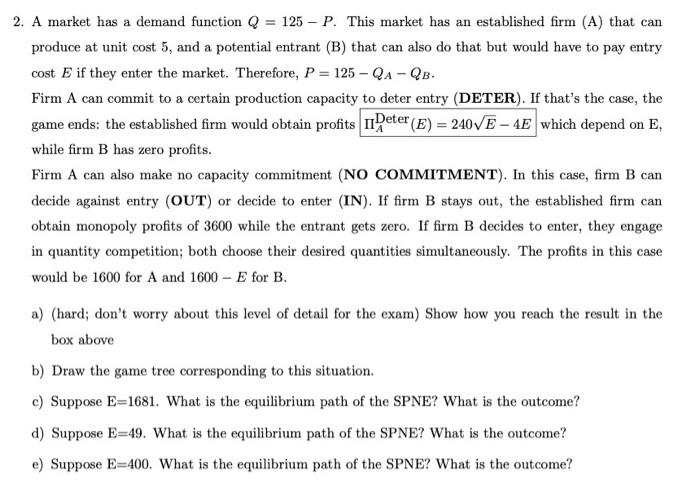
2. A market has a demand function Q=125P. This market has an established firm (A) that can produce at unit cost 5, and a potential entrant (B) that can also do that but would have to pay entry costE if they enter the market. Therefore, P=125QAQB. Firm A can commit to a certain production capacity to deter entry (DETER). If that's the case, the game ends: the established firm would obtain profits ADeter(E)=240E4E which depend on E, while firm B has zero profits. Firm A can also make no capacity commitment (NO COMMITMENT). In this case, firm B can decide against entry (OUT) or decide to enter (IN). If firm B stays out, the established firm can obtain monopoly profits of 3600 while the entrant gets zero. If firm B decides to enter, they engage in quantity competition; both choose their desired quantities simultaneously. The profits in this case would be 1600 for A and 1600E for B. a) (hard; don't worry about this level of detail for the exam) Show how you reach the result in the box above b) Draw the game tree corresponding to this situation. c) Suppose E=1681. What is the equilibrium path of the SPNE? What is the outcome? d) Suppose E=49. What is the equilibrium path of the SPNE? What is the outcome? e) Suppose E=400. What is the equilibrium path of the SPNE? What is the outcome? 2. A market has a demand function Q=125P. This market has an established firm (A) that can produce at unit cost 5, and a potential entrant (B) that can also do that but would have to pay entry costE if they enter the market. Therefore, P=125QAQB. Firm A can commit to a certain production capacity to deter entry (DETER). If that's the case, the game ends: the established firm would obtain profits ADeter(E)=240E4E which depend on E, while firm B has zero profits. Firm A can also make no capacity commitment (NO COMMITMENT). In this case, firm B can decide against entry (OUT) or decide to enter (IN). If firm B stays out, the established firm can obtain monopoly profits of 3600 while the entrant gets zero. If firm B decides to enter, they engage in quantity competition; both choose their desired quantities simultaneously. The profits in this case would be 1600 for A and 1600E for B. a) (hard; don't worry about this level of detail for the exam) Show how you reach the result in the box above b) Draw the game tree corresponding to this situation. c) Suppose E=1681. What is the equilibrium path of the SPNE? What is the outcome? d) Suppose E=49. What is the equilibrium path of the SPNE? What is the outcome? e) Suppose E=400. What is the equilibrium path of the SPNE? What is the outcome
Step by Step Solution
There are 3 Steps involved in it

Get step-by-step solutions from verified subject matter experts