







Question: 2. . a. On a separate tab, consider the following two bonds. Plants has bonds with 8% coupons. The bonds make semiannual payments and have
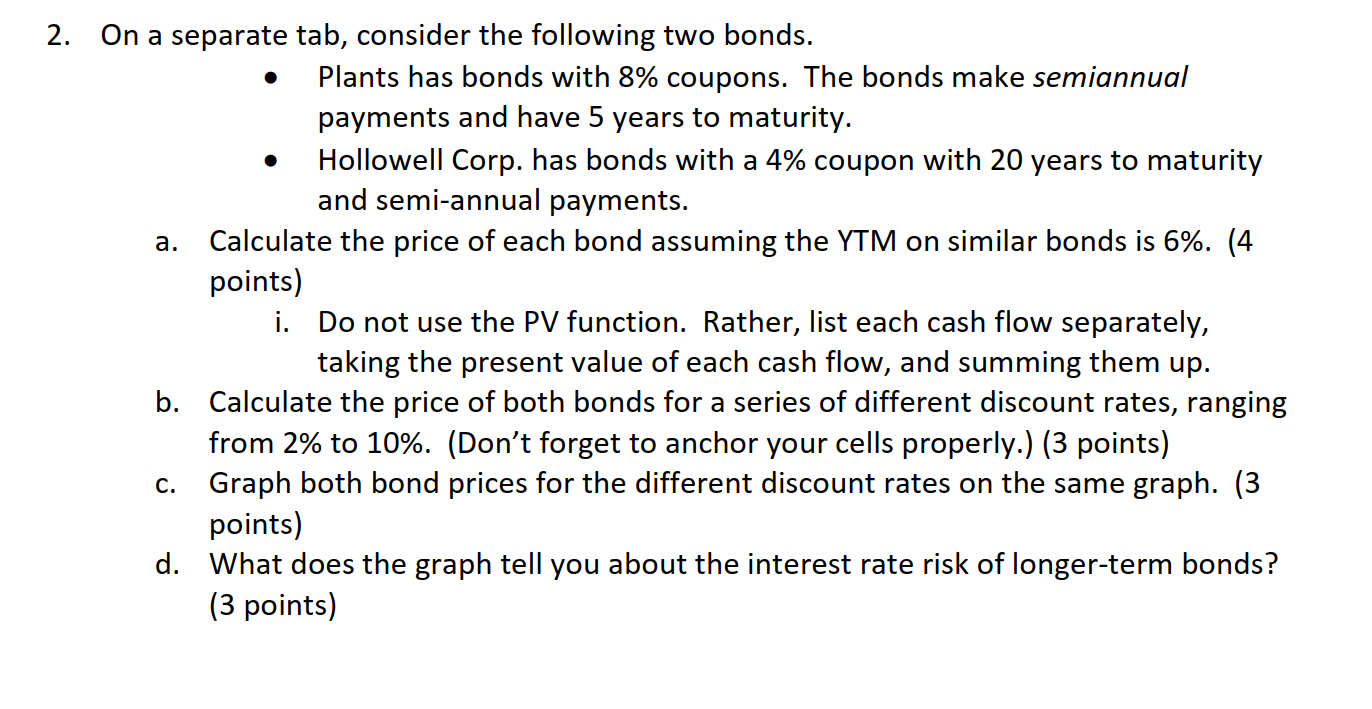
2. . a. On a separate tab, consider the following two bonds. Plants has bonds with 8% coupons. The bonds make semiannual payments and have 5 years to maturity. Hollowell Corp. has bonds with a 4% coupon with 20 years to maturity and semi-annual payments. Calculate the price of each bond assuming the YTM on similar bonds is 6%. (4 points) i. Do not use the PV function. Rather, list each cash flow separately, taking the present value of each cash flow, and summing them up. b. Calculate the price of both bonds for a series of different discount rates, ranging from 2% to 10%. (Don't forget to anchor your cells properly.) (3 points) C. Graph both bond prices for the different discount rates on the same graph. (3 points) d. What does the graph tell you about the interest rate risk of longer-term bonds? (3 points) 2. . a. On a separate tab, consider the following two bonds. Plants has bonds with 8% coupons. The bonds make semiannual payments and have 5 years to maturity. Hollowell Corp. has bonds with a 4% coupon with 20 years to maturity and semi-annual payments. Calculate the price of each bond assuming the YTM on similar bonds is 6%. (4 points) i. Do not use the PV function. Rather, list each cash flow separately, taking the present value of each cash flow, and summing them up. b. Calculate the price of both bonds for a series of different discount rates, ranging from 2% to 10%. (Don't forget to anchor your cells properly.) (3 points) C. Graph both bond prices for the different discount rates on the same graph. (3 points) d. What does the graph tell you about the interest rate risk of longer-term bonds? (3 points)
Step by Step Solution
There are 3 Steps involved in it

Get step-by-step solutions from verified subject matter experts
 Study Help