







Question: 2. A pond drains through a pipe as shown in the figure below. Under several simplifying assumptions, the following differential equation describes how the water
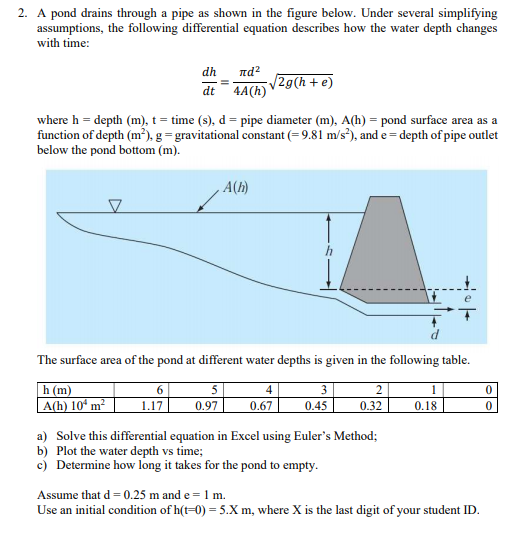
2. A pond drains through a pipe as shown in the figure below. Under several simplifying assumptions, the following differential equation describes how the water depth changes with time: dh d2 dtAch V2g(h+e) where h-depth (m), t = time (s), d = pipe diameter (m), Ah) - pond surface area as a function of depth (m), g = gravitational constant (=9.81 m/s), and e-depth of pipe outlet below the pond bottom (m). Ah) The surface area of the pond at different water depths is given in the following table. h (m) A(h) 10m 6 1.17 5 0.97 4 0.67 3 0.45 2 0.32 1 0.18 0 0 a) Solve this differential equation in Excel using Euler's Method; b) Plot the water depth vs time; c) Determine how long it takes for the pond to empty. Assume that d = 0.25 m and e=1 m. Use an initial condition of h(t0) = 5.X m, where X is the last digit of your student ID. 2. A pond drains through a pipe as shown in the figure below. Under several simplifying assumptions, the following differential equation describes how the water depth changes with time: dh d2 dtAch V2g(h+e) where h-depth (m), t = time (s), d = pipe diameter (m), Ah) - pond surface area as a function of depth (m), g = gravitational constant (=9.81 m/s), and e-depth of pipe outlet below the pond bottom (m). Ah) The surface area of the pond at different water depths is given in the following table. h (m) A(h) 10m 6 1.17 5 0.97 4 0.67 3 0.45 2 0.32 1 0.18 0 0 a) Solve this differential equation in Excel using Euler's Method; b) Plot the water depth vs time; c) Determine how long it takes for the pond to empty. Assume that d = 0.25 m and e=1 m. Use an initial condition of h(t0) = 5.X m, where X is the last digit of your student ID
Step by Step Solution
There are 3 Steps involved in it

Get step-by-step solutions from verified subject matter experts
 Study Help