





Question: 2. A pulse input x(t) is applied to the RC circuit shown below. The expected capacitor voltage output, y(t), is also shown. J(o)- Note :
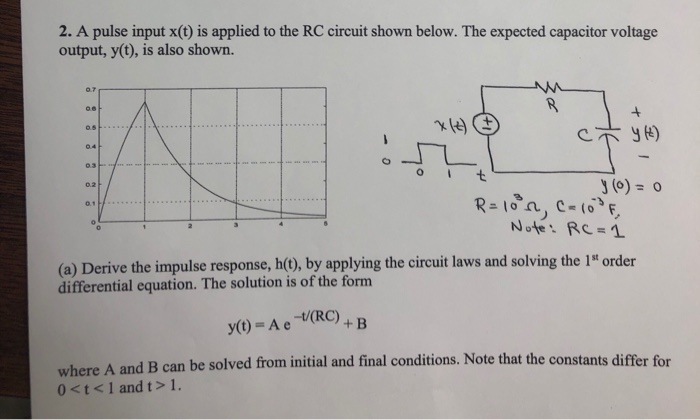
 2. A pulse input x(t) is applied to the RC circuit
shown below. The expected capacitor voltage output, y(t), is also shown. J(o)-

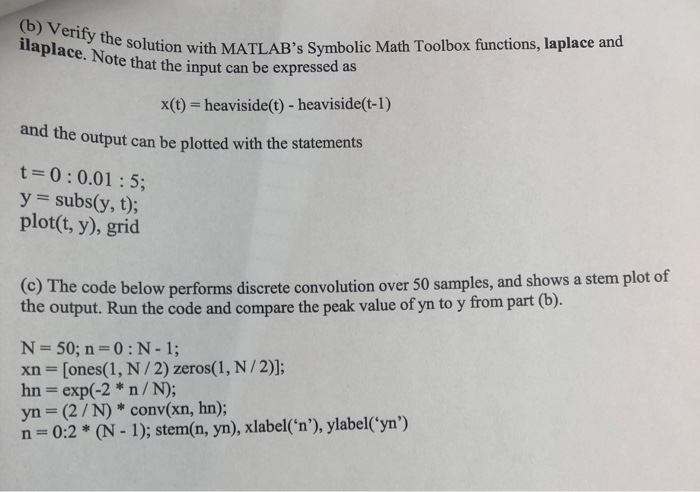
2. A pulse input x(t) is applied to the RC circuit shown below. The expected capacitor voltage output, y(t), is also shown. J(o)- Note : RC = 1 )Derive the impulse response, h(), by applying the circuit laws and solving the 1t order differential equation. The solution is of the form y(t) =Ae-t/(RC) + B where A and B can be solved from initial and final conditions. Note that the constants differ for 01. (b) Verify the ilaplace. Note Solution with MATLAB's Symbolic Math Toolbox functions, laplace and with tNote that the input can be expressed as x(t) heaviside(t) - heaviside(t-1) and the output can be plotted with the statements t 0:0.01:5; y = subs(y, t); plot(t, y), grid (C) The code below performs discrete convolution over 50 samples, and shows a stem plot of the output. Run the code and compare the peak value of yn to y from part (b). N 50; n-0:N-1; xn- [ones(1, N/2) zeros(1, N/2)]; hn exp(-2* n/N); yn = (2/ N) * conv(xn, hn); n 0:2 (N - 1); stem(n, yn), xlabel('n'), ylabel("'yn')

Step by Step Solution

There are 3 Steps involved in it

1 Expert Approved Answer
Step: 1 Unlock blur-text-image
Question Has Been Solved by an Expert!

Get step-by-step solutions from verified subject matter experts

Step: 2 Unlock
Step: 3 Unlock

Students Have Also Explored These Related Databases Questions!