







Question: 2. A worker can work at most 40 hours a week. Time spent not working is spent in leisure. Where, 40 =h+l and, h 20
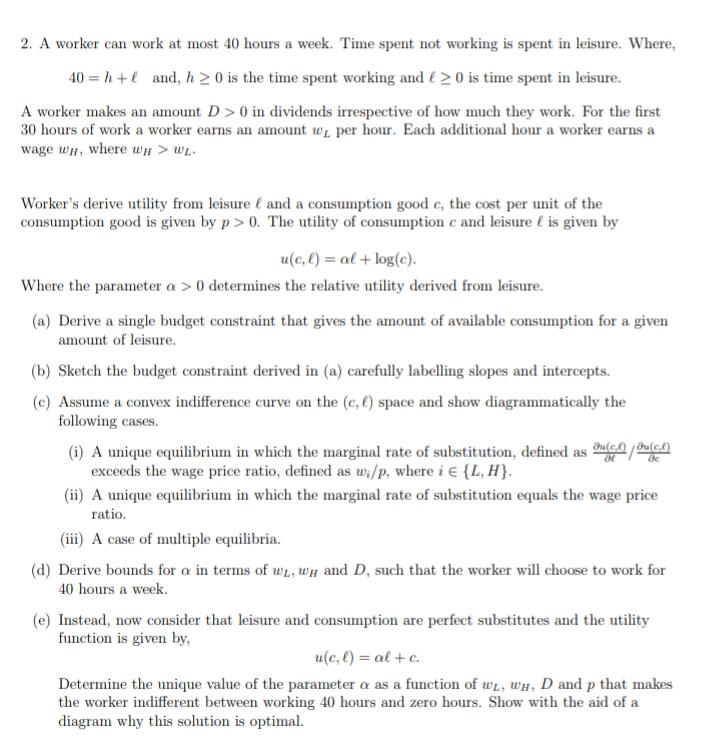
2. A worker can work at most 40 hours a week. Time spent not working is spent in leisure. Where, 40 =h+l and, h 20 is the time spent working and ( 0 is time spent in leisure. A worker makes an amount D > 0 in dividends irrespective of how much they work. For the first 30 hours of work a worker earns an amount w, per hour. Each additional hour a worker earns a wage w, where we > WL. Worker's derive utility from leisure l and a consumption good c, the cost per unit of the consumption good is given by p > 0. The utility of consumption c and leisure l is given by uc,l) = al + log(e). Where the parameter a > 0 determines the relative utility derived from leisure. (a) Derive a single budget constraint that gives the amount of available consumption for a given amount of leisure. (b) Sketch the budget constraint derived in (a) carefully labelling slopes and intercepts. (c) Assume a convex indifference curve on the (c, ) space and show diagrammatically the following cases. (i) A unique equilibrium in which the marginal rate of substitution, defined as dulce) ou c..) exceeds the wage price ratio, defined as wi/p, where i {L, H}. (ii) A unique equilibrium in which the marginal rate of substitution equals the wage price ratio. (iii) A case of multiple equilibria. (a) Derive bounds for a in terms of w., wh and D, such that the worker will choose to work for 40 hours a week. (e) Instead, now consider that leisure and consumption are perfect substitutes and the utility function is given by u(cl) = al +c. Determine the unique value of the parameter a as a function of wl, wh, D and p that makes the worker indifferent between working 40 hours and zero hours. Show with the aid of a diagram why this solution is optimal. 2. A worker can work at most 40 hours a week. Time spent not working is spent in leisure. Where, 40 =h+l and, h 20 is the time spent working and ( 0 is time spent in leisure. A worker makes an amount D > 0 in dividends irrespective of how much they work. For the first 30 hours of work a worker earns an amount w, per hour. Each additional hour a worker earns a wage w, where we > WL. Worker's derive utility from leisure l and a consumption good c, the cost per unit of the consumption good is given by p > 0. The utility of consumption c and leisure l is given by uc,l) = al + log(e). Where the parameter a > 0 determines the relative utility derived from leisure. (a) Derive a single budget constraint that gives the amount of available consumption for a given amount of leisure. (b) Sketch the budget constraint derived in (a) carefully labelling slopes and intercepts. (c) Assume a convex indifference curve on the (c, ) space and show diagrammatically the following cases. (i) A unique equilibrium in which the marginal rate of substitution, defined as dulce) ou c..) exceeds the wage price ratio, defined as wi/p, where i {L, H}. (ii) A unique equilibrium in which the marginal rate of substitution equals the wage price ratio. (iii) A case of multiple equilibria. (a) Derive bounds for a in terms of w., wh and D, such that the worker will choose to work for 40 hours a week. (e) Instead, now consider that leisure and consumption are perfect substitutes and the utility function is given by u(cl) = al +c. Determine the unique value of the parameter a as a function of wl, wh, D and p that makes the worker indifferent between working 40 hours and zero hours. Show with the aid of a diagram why this solution is optimal
Step by Step Solution
There are 3 Steps involved in it

Get step-by-step solutions from verified subject matter experts
 Study Help