







Question: 2. As the Wikipedis articleon the widest path problem describes, finding all widest paths from a single starting vertex may be solved by sorting all
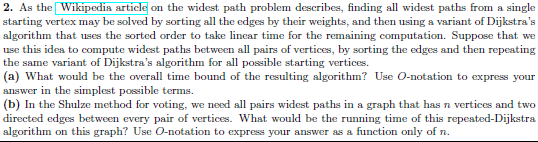
2. As the Wikipedis articleon the widest path problem describes, finding all widest paths from a single starting vertex may be solved by sorting all the edges by their weights, and then using a variant of Dijkstra's algorithm that uses the sorted order to take linear time for the remaining computation. Suppose that we use this ides to compute widest paths between all pairs of vertices, by sorting the edges and then repeating the same variant of Dijkstra's algorithm for all possible starting vertices. (a) What would be the overall time bound of the resulting algorithm? Use O-notation to express your simplest possible ternas.d all pairs widest paths in a (b) In the Shulze method for voting, we need all pairs widest paths in a graph that has n vertices and two directed edges between every pair of vertices. What would be the running time of this repeated-Dijkstra algorithm on this graph? Use O-notation to express your answer as a function only of rn 2. As the Wikipedis articleon the widest path problem describes, finding all widest paths from a single starting vertex may be solved by sorting all the edges by their weights, and then using a variant of Dijkstra's algorithm that uses the sorted order to take linear time for the remaining computation. Suppose that we use this ides to compute widest paths between all pairs of vertices, by sorting the edges and then repeating the same variant of Dijkstra's algorithm for all possible starting vertices. (a) What would be the overall time bound of the resulting algorithm? Use O-notation to express your simplest possible ternas.d all pairs widest paths in a (b) In the Shulze method for voting, we need all pairs widest paths in a graph that has n vertices and two directed edges between every pair of vertices. What would be the running time of this repeated-Dijkstra algorithm on this graph? Use O-notation to express your answer as a function only of rn
Step by Step Solution
There are 3 Steps involved in it

Get step-by-step solutions from verified subject matter experts
 Study Help