







Question: 2 . Compositions. Consider the Kripke structure defined in problem 1 , and let us call it K 1 = ( S , S 0
Compositions. Consider the Kripke structure defined in problem and let us call it Next, consider that we had a second copy of that Kripke structure and lets call it where T contains states dots, and contains a similar labeling function with predicates dots,
Answer the following questions:
a How many transitions exist in
b Given a synchronous composition of and how many states are there? Note: You do not need to analyze whether the states in the composition are reachable.
c Given an asynchronous composition of and how many states are there? Note: You do not need to analyze whether the states in the composition are reachable.
d Given a synchronous composition of and how many predicates are there? Note: Use as few predicates as possible.
e Given an asynchronous composition of and how many predicates are there?
f Given a synchronous composition of and give an upper bound estimate on the number of transitions?
g Given an asynchronous composition of and give an upper bound estimate on the number of transitions?
BDD Terminal Cases and Operation BDDOR
a Specify a set of terminal cases for BDDANDfg
b Justify that the operation BDDOR can be derived from BDDAND by replacing the terminal cases. Specify a set of terminal cases for BDDORfg
BDDs
a Write a BDD for Use the ordering
Represent all three one shared structure.
Construct a for Use the algorithm presented class.
Construct a for Use a 'modified' algorithm problem
Write a for Use the ordering
Represent all three one shared structure.
Construct a for Use the algorithm presented class.
Construct a for Use a 'modified' algorithm problem
Write a for Use the ordering
Write a for Use the ordering
Represent all three one shared structure.
Construct a for Use the algorithm presented class.
Construct a for Use a 'modified' algorithm problem
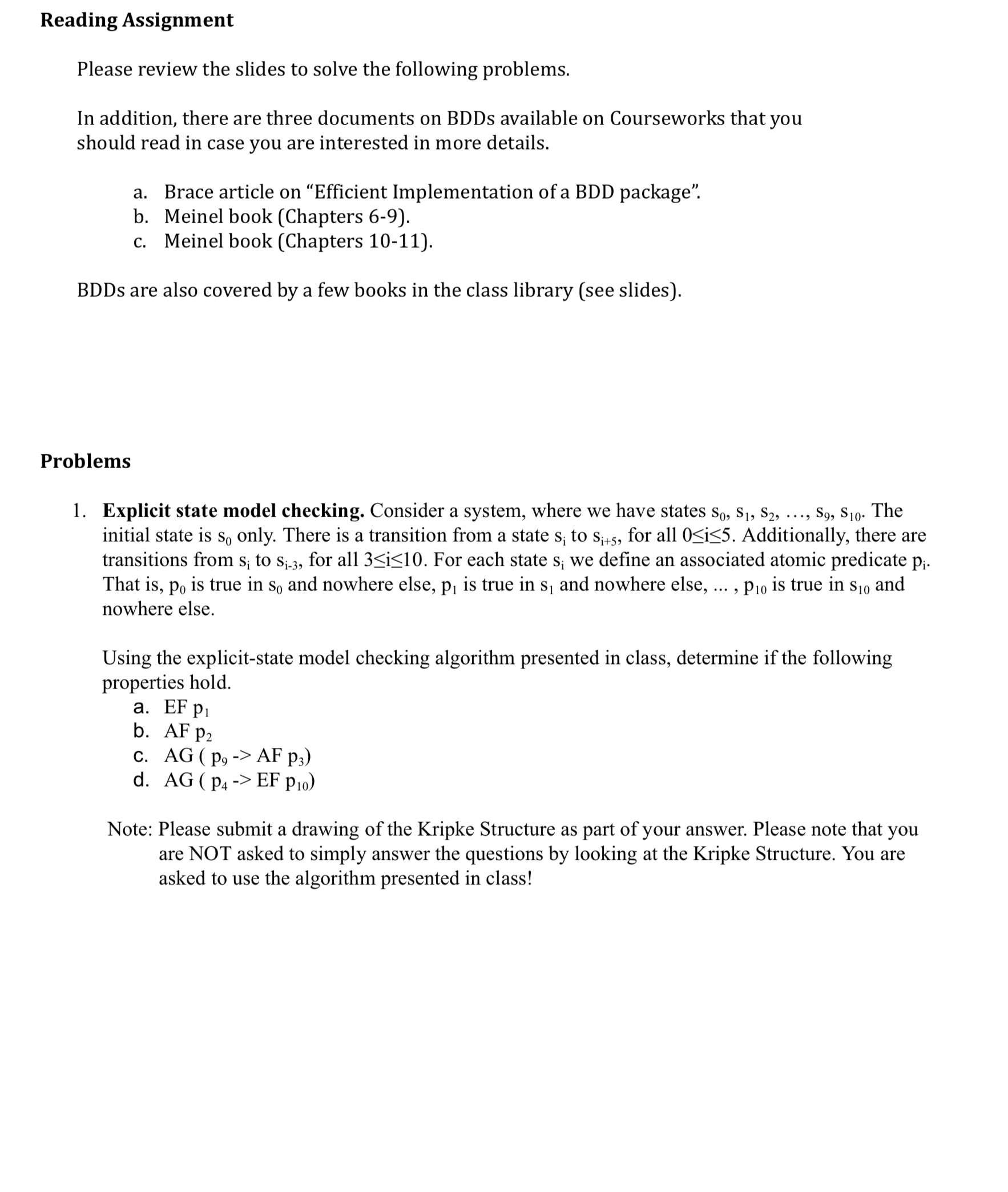
Reading Assignment
Please review the slides to solve the following problems.
In addition, there are three documents on BDDs available on Courseworks that you should read in case you are interested in more details.
a Brace article on "Efficient Implementation of a BDD package".
b Meinel book Chapters
c Meinel book Chapters
BDDs are also covered by a few books in the class library see slides
Problems
Explicit state model checking. Consider a system, where we have states dots, The initial state is only. There is a transition from a state to for all Additionally, there are transitions from to for all For each state we define an associated atomic predicate That is is true in and nowhere else, is true in and nowhere else, dots, is true in and nowhere else.
Using the explicitstate model checking algorithm presented in class, determine if the following properties hold.
a
b
c
d
Note: Please submit a drawing of the Kripke Structure as part of your answer. Please note that you are NOT asked to simply answer the questions by looking at the Kripke Structur
Step by Step Solution
There are 3 Steps involved in it
1 Expert Approved Answer
Step: 1 Unlock

Question Has Been Solved by an Expert!
Get step-by-step solutions from verified subject matter experts
Step: 2 Unlock
Step: 3 Unlock
 Study Help