







Question: 2- Consider a binary 3-bit communication system that transmits either zeros or ones with with probability p1 and p2 respectively. Transmitting probabilities have a ratio
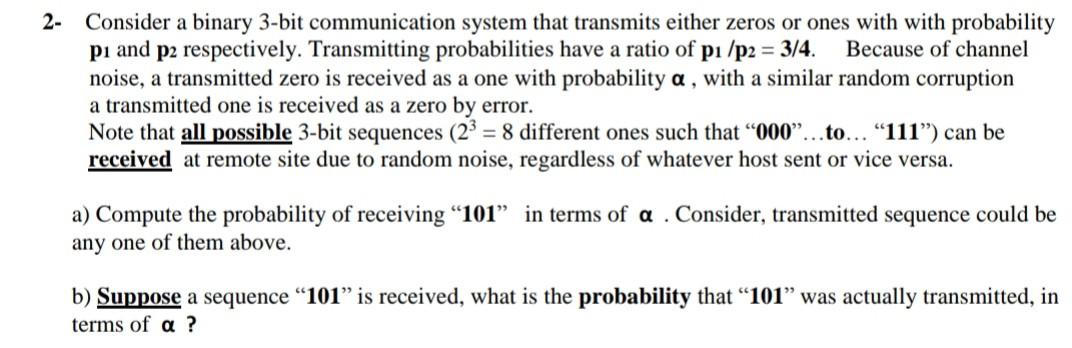
2- Consider a binary 3-bit communication system that transmits either zeros or ones with with probability p1 and p2 respectively. Transmitting probabilities have a ratio of p1 /p2 = 3/4. Because of channel noise, a transmitted zero is received as a one with probability , with a similar random corruption a transmitted one is received as a zero by error. Note that all possible 3-bit sequences (2^3 = 8 different ones such that 000to 111) can be received at remote site due to random noise, regardless of whatever host sent or vice versa. a) Compute the probability of receiving 101 in terms of . Consider, transmitted sequence could be any one of them above. b) Suppose a sequence 101 is received, what is the probability that 101 was actually transmitted, in terms of ?
2- Consider a binary 3-bit communication system that transmits either zeros or ones with with probability pi and p2 respectively. Transmitting probabilities have a ratio of p1 /p2 = 3/4. Because of channel noise, a transmitted zero is received as a one with probability a , with a similar random corruption a transmitted one is received as a zero by error. Note that all possible 3-bit sequences (23 = 8 different ones such that 000...to... 111") can be received at remote site due to random noise, regardless of whatever host sent or vice versa. a) Compute the probability of receiving 101 in terms of a . Consider, transmitted sequence could be any one of them above. b) Suppose a sequence "101" is received, what is the probability that 101 was actually transmitted, in terms of aStep by Step Solution
There are 3 Steps involved in it

Get step-by-step solutions from verified subject matter experts
 Study Help