







Question: 2. Consider a classification problem with two Gaussian classes Px Y(x i) = 9(x. A;, E), ie {1,2). equal class probabilities Py (i) = 1/2,
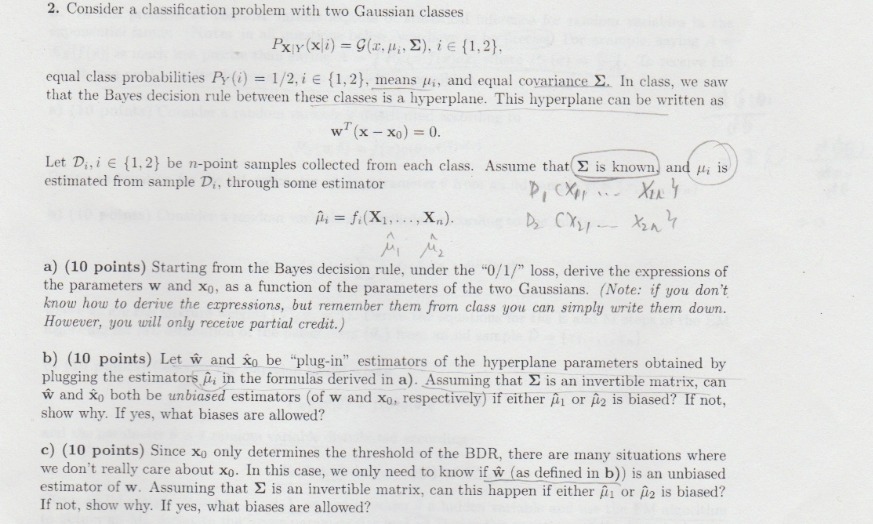
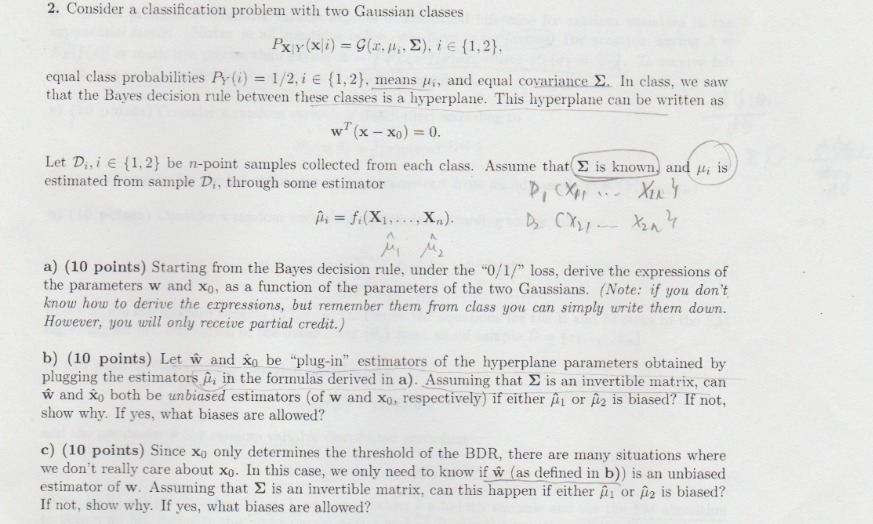
2. Consider a classification problem with two Gaussian classes Px Y(x i) = 9(x. A;, E), ie {1,2). equal class probabilities Py (i) = 1/2, i e {1, 2}, means pi, and equal covariance E. In class, we saw that the Bayes decision rule between these classes is a hyperplane. This hyperplane can be written as w (x - xo) = 0. Let Di, i E {1, 2} be n-point samples collected from each class. Assume that E is known, and #; is estimated from sample ,, through some estimator M = f.(X1, . . ., Xn). Do CX21 - Xzn 4 a) (10 points) Starting from the Bayes decision rule, under the "0/1/" loss, derive the expressions of the parameters w and Xo, as a function of the parameters of the two Gaussians. (Note: if you don't know how to derive the expressions, but remember them from class you can simply write them down. However, you will only receive partial credit.) b) (10 points) Let w and xo be "plug-in" estimators of the hyperplane parameters obtained by plugging the estimators (, in the formulas derived in a). Assuming that E is an invertible matrix, can w and xo both be unbiased estimators (of w and Xo, respectively) if either / or /2 is biased? If not, show why. If yes, what biases are allowed? c) (10 points) Since xo only determines the threshold of the BDR, there are many situations where we don't really care about xo. In this case, we only need to know if w (as defined in b)) is an unbiased estimator of w. Assuming that E is an invertible matrix, can this happen if either , or /2 is biased? If not, show why. If yes, what biases are allowed
Step by Step Solution
There are 3 Steps involved in it

Get step-by-step solutions from verified subject matter experts
 Study Help