







Question: 2. Consider a continuous-time Markov chain {X(t),t > 0} with the following matrix of transition rates Q= R > >0 T > O > RO
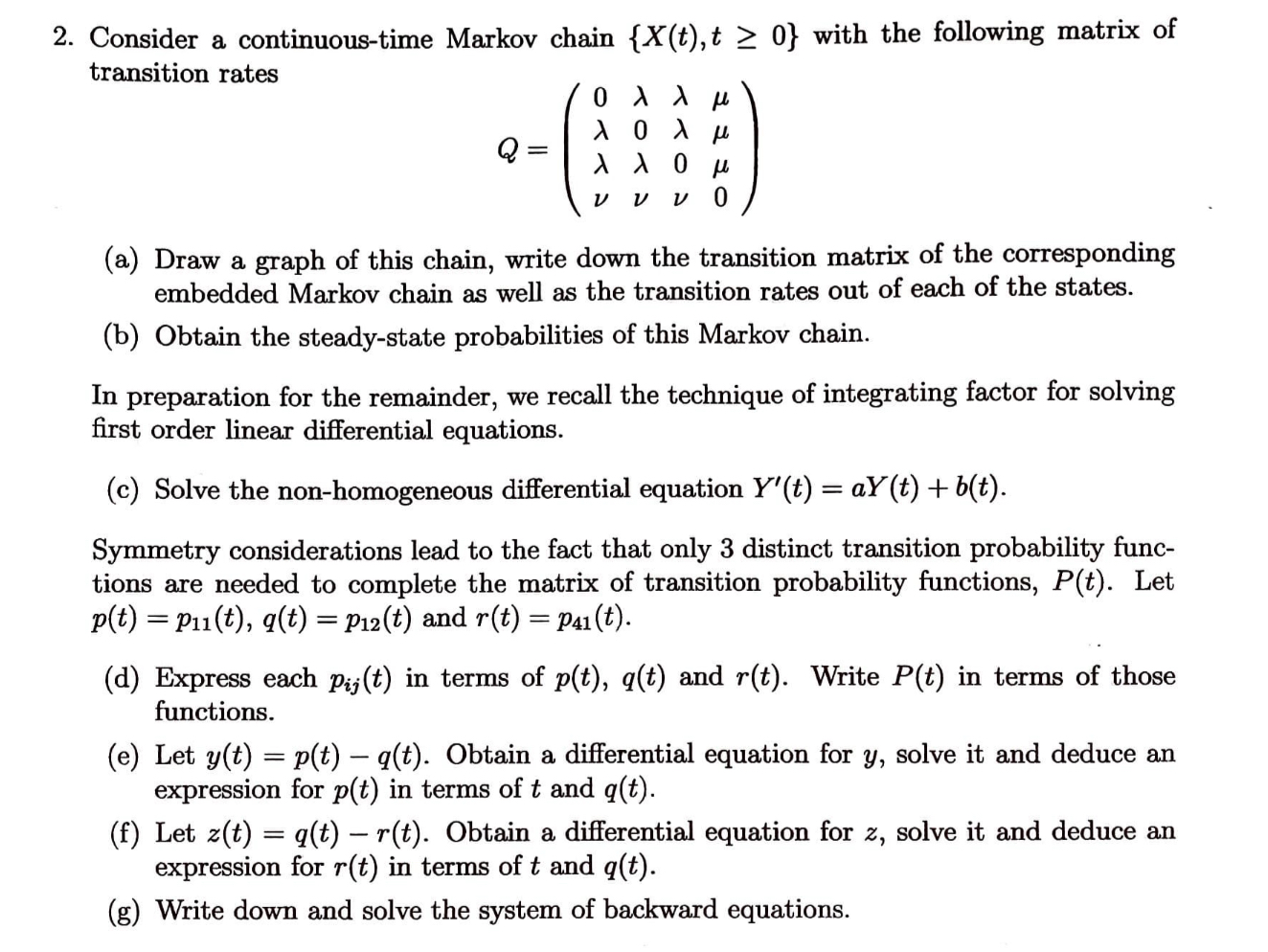
2. Consider a continuous-time Markov chain {X(t),t > 0} with the following matrix of transition rates Q= R > >0 T > O > RO > > OETE T FE (a) Draw a graph of this chain, write down the transition matrix of the corresponding embedded Markov chain as well as the transition rates out of each of the states. (b) Obtain the steady-state probabilities of this Markov chain. In preparation for the remainder, we recall the technique of integrating factor for solving first order linear differential equations. (c) Solve the non-homogeneous differential equation Y'(t) = aY () + b(t). g Symmetry considerations lead to the fact that only 3 distinct transition probability func- tions are needed to complete the matrix of transition probability functions, P(t). Let p(t) = pu(t), q(t) = p1a2(t) and 7(t) = pau(t). (d) Express each p;(t) in terms of p(t), (t) and r(t). Write P(t) in terms of those functions. (e) Let y(t) = p(t) g(t). Obtain a differential equation for y, solve it and deduce an expression for p(t) in terms of and g(t). (f) Let z(t) = q(t) r(t). Obtain a differential equation for z, solve it and deduce an expression for 7(t) in terms of and g(%). (g) Write down and solve the system of backward equations
Step by Step Solution
There are 3 Steps involved in it

Get step-by-step solutions from verified subject matter experts
 Study Help