







Question: 2. Consider an arbitrary DFA M = (Q, {0,1), ?, 40, F) and call the language of this DFA L. Fill in the blanks in
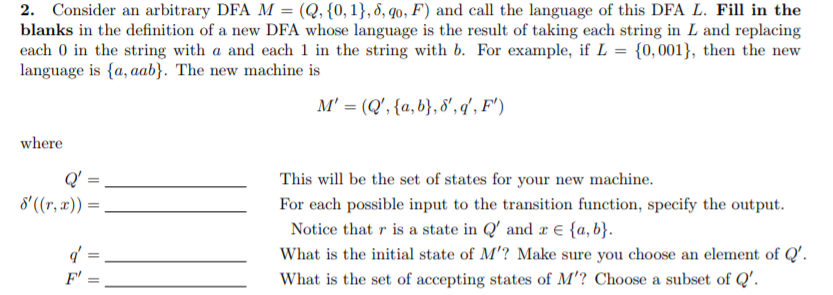
2. Consider an arbitrary DFA M = (Q, {0,1), ?, 40, F) and call the language of this DFA L. Fill in the blanks in the definition of a new DFA whose language is the result of taking each string in L and replacing each 0 in the string with a and each 1 in the string with b. For example, if L-0,001), then the new language is fa,aab). The new machine is where This will be the set of states for your new machine For each possible input to the transition function, specify the output Notice that r is a state in Q, and x E {a, b). What is the initial state of M'? Make sure you choose an element of Q Q, = )-F F- What is the set of accepting states of M'? Choose a subset of Q 2. Consider an arbitrary DFA M = (Q, {0,1), ?, 40, F) and call the language of this DFA L. Fill in the blanks in the definition of a new DFA whose language is the result of taking each string in L and replacing each 0 in the string with a and each 1 in the string with b. For example, if L-0,001), then the new language is fa,aab). The new machine is where This will be the set of states for your new machine For each possible input to the transition function, specify the output Notice that r is a state in Q, and x E {a, b). What is the initial state of M'? Make sure you choose an element of Q Q, = )-F F- What is the set of accepting states of M'? Choose a subset of
Step by Step Solution
There are 3 Steps involved in it

Get step-by-step solutions from verified subject matter experts
 Study Help