





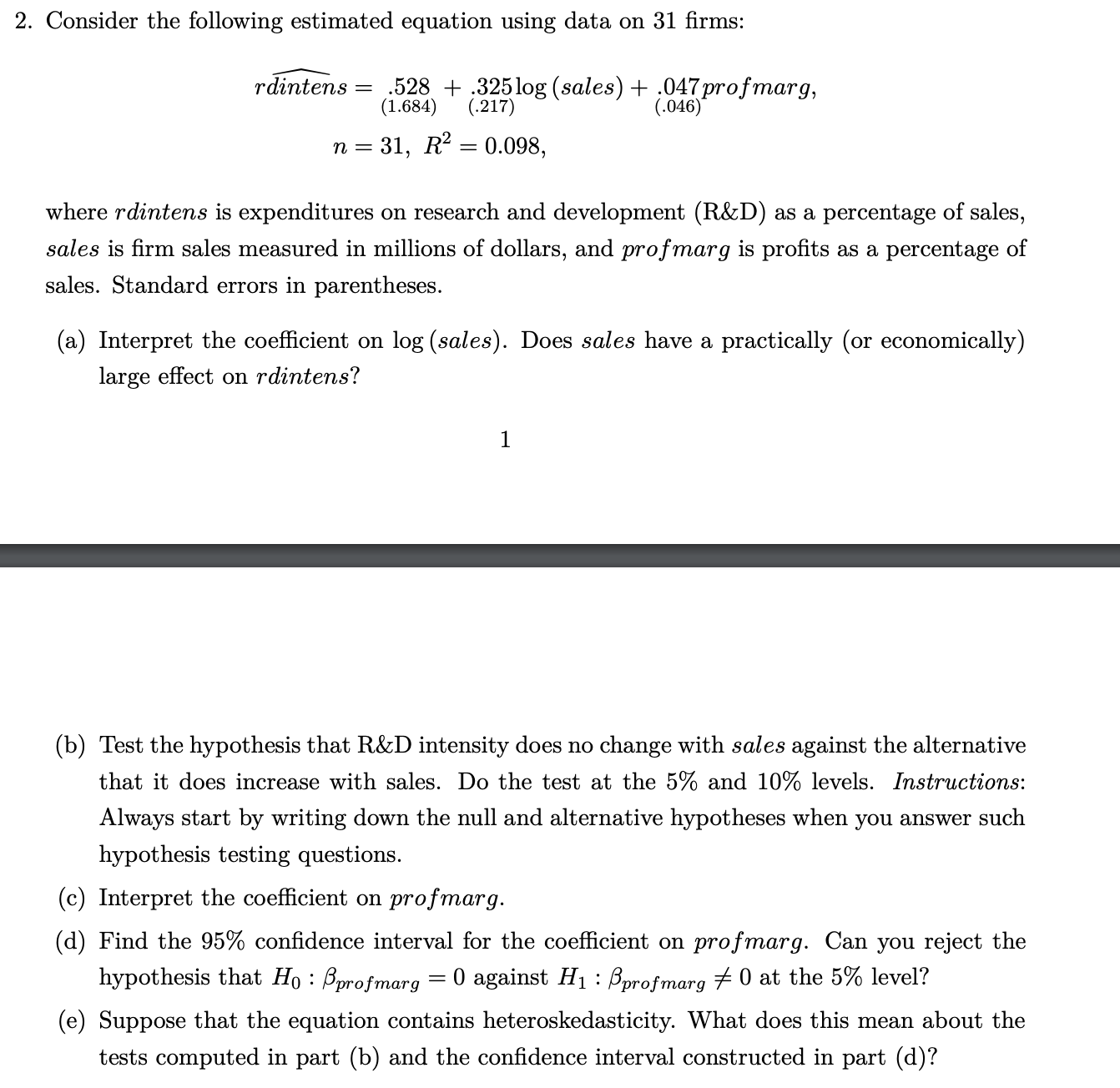
Question: 2. Consider the following estimated equation using data on 31 firms: rdintens = .528 + .325 log (sales) +.047 profmarg, (1.684) (.217) (.046) 0.098, n
2. Consider the following estimated equation

2. Consider the following estimated equation using data on 31 firms: rdintens = .528 + .325 log (sales) +.047 profmarg, (1.684) (.217) (.046) 0.098, n = = 31, R2 where rdintens is expenditures on research and development (R&D) as a percentage of sales, sales is firm sales measured in millions of dollars, and profmarg is profits as a percentage of sales. Standard errors in parentheses. (a) Interpret the coefficient on log (sales). Does sales have a practically (or economically) large effect on rdintens? 1 (b) Test the hypothesis that R&D intensity does no change with sales against the alternative that it does increase with sales. Do the test at the 5% and 10% levels. Instructions: Always start by writing down the null and alternative hypotheses when you answer such hypothesis testing questions. (c) Interpret the coefficient on profmarg. (d) Find the 95% confidence interval for the coefficient on profmarg. Can you reject the hypothesis that Ho : Bprofmarg O against Hi : Bprofmarg = 0 at the 5% level? (e) Suppose that the equation contains heteroskedasticity. What does this mean about the tests computed in part (b) and the confidence interval constructed in part (d)? 2. Consider the following estimated equation using data on 31 firms: rdintens = .528 + .325 log (sales) +.047 profmarg, (1.684) (.217) (.046) 0.098, n = = 31, R2 where rdintens is expenditures on research and development (R&D) as a percentage of sales, sales is firm sales measured in millions of dollars, and profmarg is profits as a percentage of sales. Standard errors in parentheses. (a) Interpret the coefficient on log (sales). Does sales have a practically (or economically) large effect on rdintens? 1 (b) Test the hypothesis that R&D intensity does no change with sales against the alternative that it does increase with sales. Do the test at the 5% and 10% levels. Instructions: Always start by writing down the null and alternative hypotheses when you answer such hypothesis testing questions. (c) Interpret the coefficient on profmarg. (d) Find the 95% confidence interval for the coefficient on profmarg. Can you reject the hypothesis that Ho : Bprofmarg O against Hi : Bprofmarg = 0 at the 5% level? (e) Suppose that the equation contains heteroskedasticity. What does this mean about the tests computed in part (b) and the confidence interval constructed in part (d)

Step by Step Solution

There are 3 Steps involved in it

1 Expert Approved Answer
Step: 1 Unlock blur-text-image

Question Has Been Solved by an Expert!

Get step-by-step solutions from verified subject matter experts

Step: 2 Unlock
Step: 3 Unlock

Students Have Also Explored These Related General Management Questions!