



Question: 2. Consider the following experiments with Ph3CCl. a) In aqueous acetone, the reaction of the alkyl chloride follows a first order (in alkyl chloride) rate
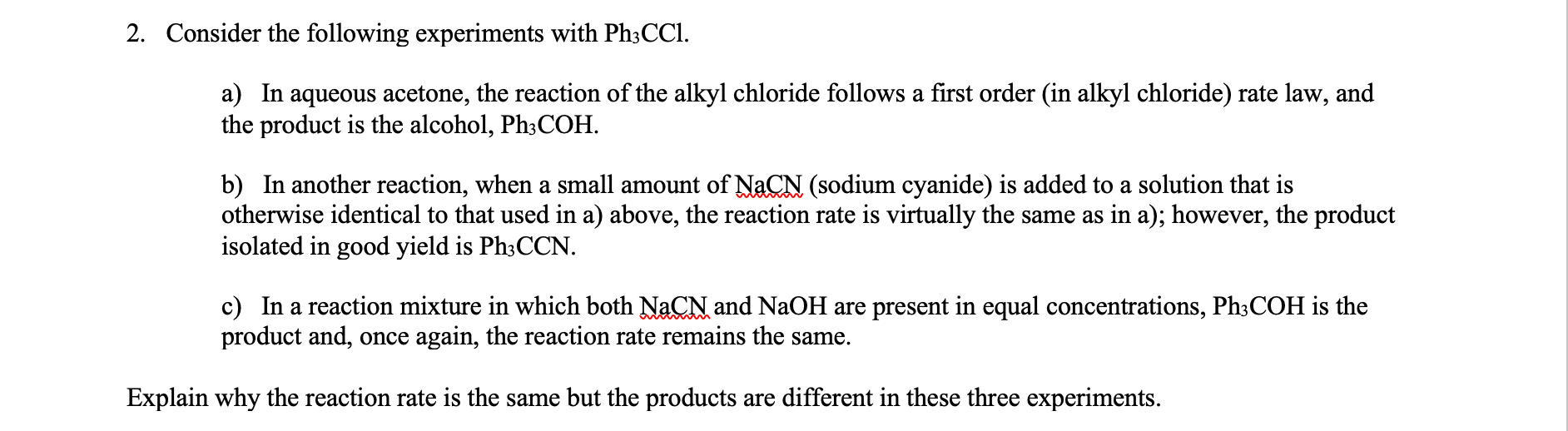
2. Consider the following experiments with Ph3CCl. a) In aqueous acetone, the reaction of the alkyl chloride follows a first order (in alkyl chloride) rate law, and the product is the alcohol, Ph3COH. b) In another reaction, when a small amount of NaCN (sodium cyanide) is added to a solution that is otherwise identical to that used in a) above, the reaction rate is virtually the same as in a); however, the product isolated in good yield is Ph3CCN. c) In a reaction mixture in which both NaCN and NaOH are present in equal concentrations, Ph3COH is the product and, once again, the reaction rate remains the same. Explain why the reaction rate is the same but the products are different in these three experiments
Step by Step Solution
There are 3 Steps involved in it

Get step-by-step solutions from verified subject matter experts