



Question: #2. Consider the following special All-Pay Common-Value auction. There are N bidders. Each bidder receives a private signal, 6, which is a random and independent
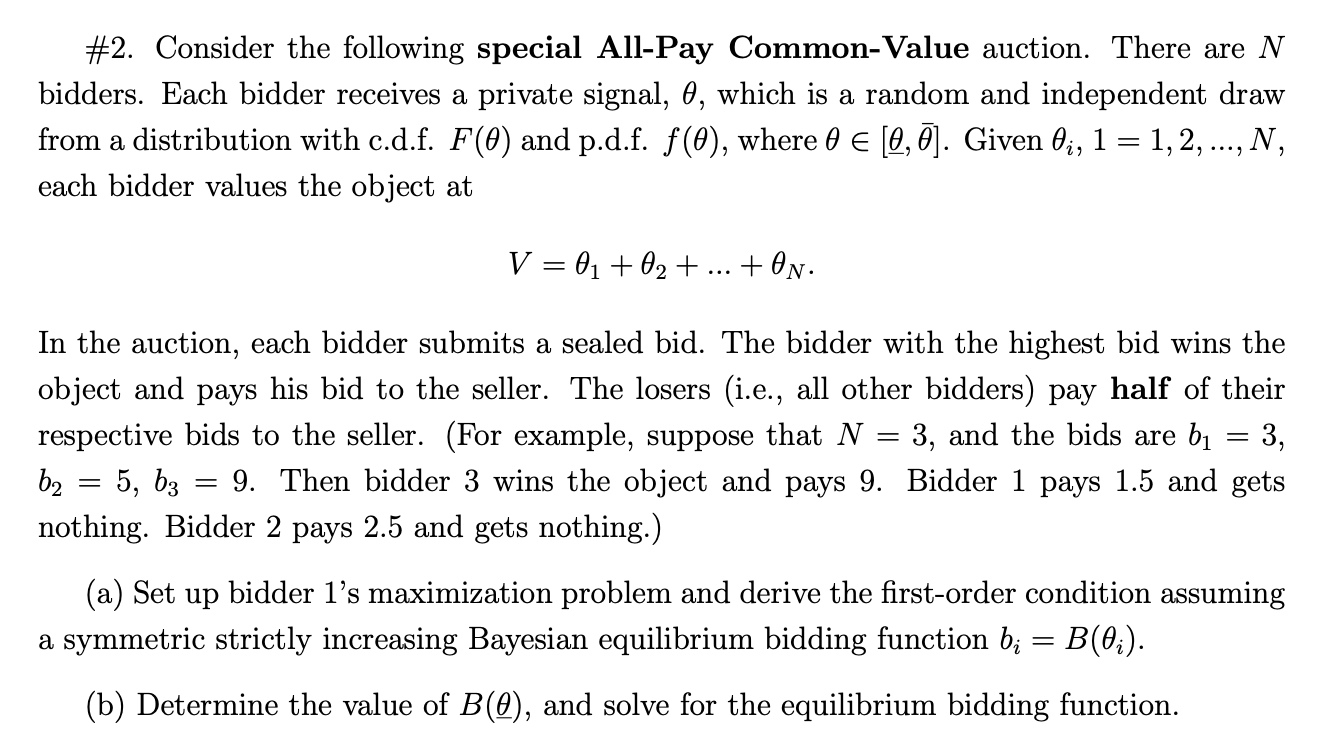
#2. Consider the following special All-Pay Common-Value auction. There are N bidders. Each bidder receives a private signal, 6, which is a random and independent draw from a distribution with c.d.f. 13(0) and p.d.f. f(6), where 6 E [Q, 6]. Given (9,, 1 = 1, 2, ..., N, each bidder values the object at In the auction, each bidder submits a sealed bid. The bidder with the highest bid wins the object and pays his bid to the seller. The losers (i.e., all other bidders) pay half of their reSpective bids to the seller. (For example, suppose that N = 3, and the bids are bl = 3, b2 = 5, b3 = 9. Then bidder 3 wins the object and pays 9. Bidder 1 pays 1.5 and gets nothing. Bidder 2 pays 2.5 and gets nothing.) (a) Set up bidder 1's maximization problem and derive the rstorder condition assuming a symmetric strictly increasing Bayesian equilibrium bidding function I),- = B ((9,) (b) Determine the value of B(E_J), and solve for the equilibrium bidding function
Step by Step Solution
There are 3 Steps involved in it

Get step-by-step solutions from verified subject matter experts