







Question: 2. Consider the following table: 6 points create table Employees ( Employee_ID int, Employee_name varchar(40), Job_title varchar(30), Company_Name varchar(30) ); a. Construct list-partition on job_title
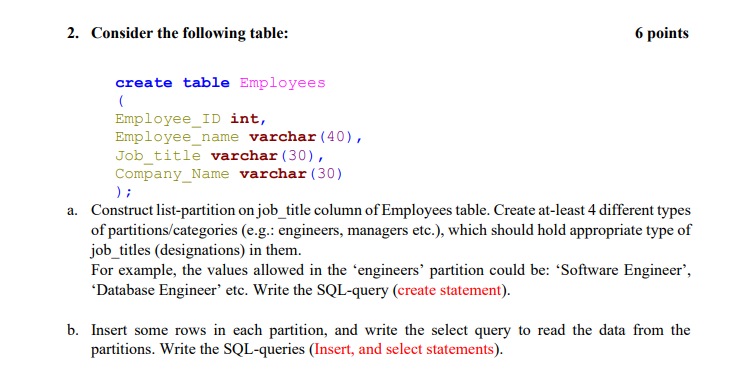
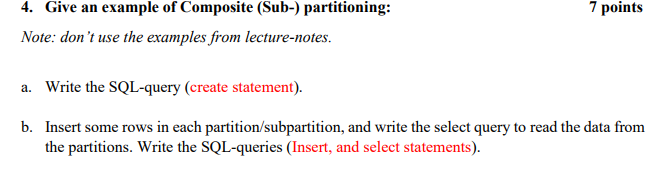
2. Consider the following table: 6 points create table Employees ( Employee_ID int, Employee_name varchar(40), Job_title varchar(30), Company_Name varchar(30) ); a. Construct list-partition on job_title column of Employees table. Create at-least 4 different types of partitions/categories (e.g.: engineers, managers etc.), which should hold appropriate type of job_titles (designations) in them. For example, the values allowed in the 'engineers' partition could be: 'Software Engineer', 'Database Engineer' etc. Write the SQL-query (create statement). b. Insert some rows in each partition, and write the select query to read the data from the partitions. Write the SQL-queries (Insert, and select statements). 4. Give an example of Composite (Sub-) partitioning: 7 points Note: don't use the examples from lecture-notes. a. Write the SQL-query (create statement). b. Insert some rows in each partition/subpartition, and write the select query to read the data from the partitions. Write the SQL-queries (Insert, and select statements)
Step by Step Solution
There are 3 Steps involved in it

Get step-by-step solutions from verified subject matter experts
 Study Help